
A county 4-H fair-entry desk wants the named framework—not a statute—that offers guidelines for managing AI risks with a focus on fairness, transparency, and security, and that supports preventing biased test results. Which instrument is it?
Select an answer to reveal the explanation.
Short Explanation
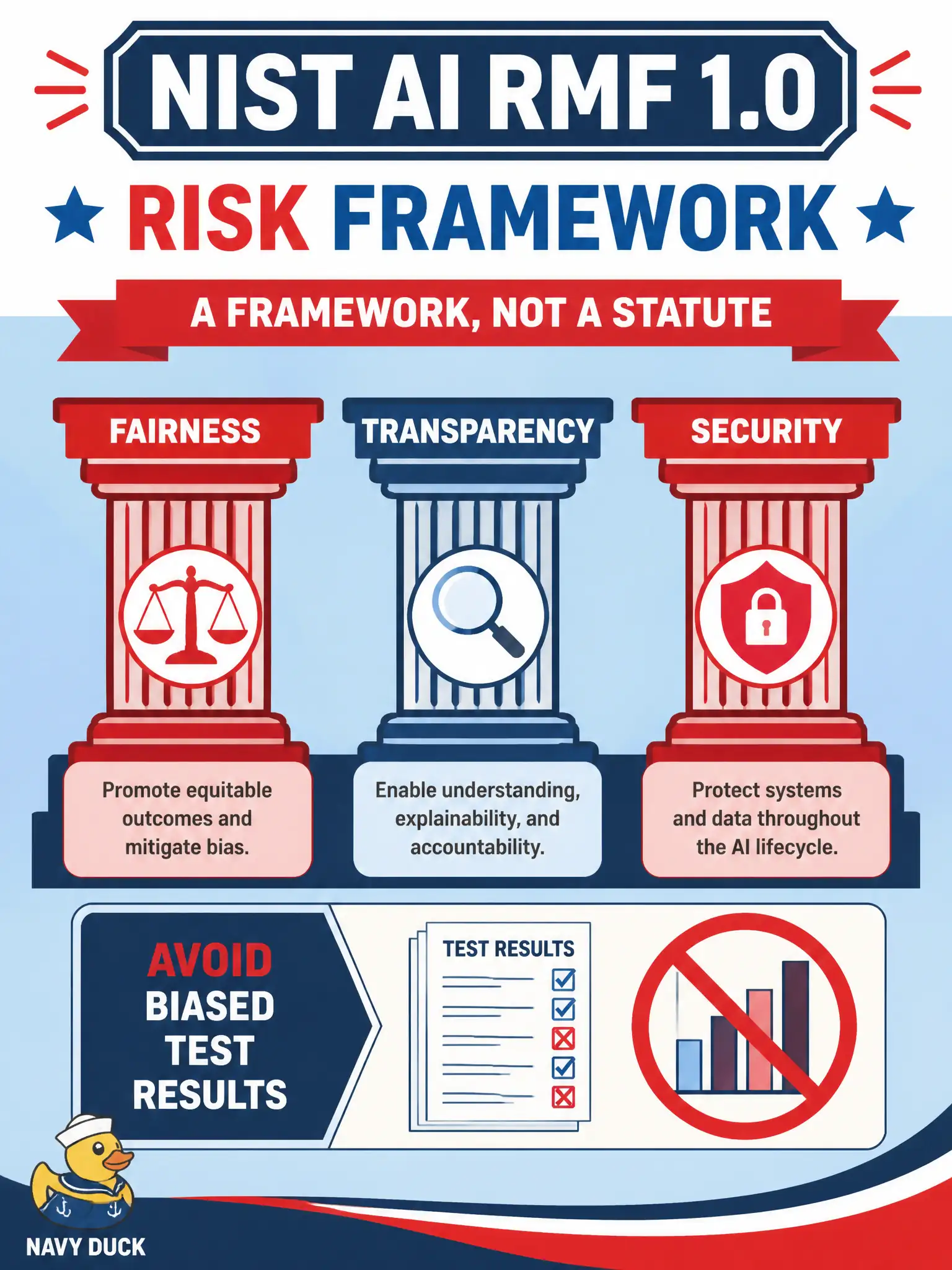
Fairness, transparency, and security guidelines in a US risk framework—not a statute—means NIST AI RMF 1.0. It helps teams manage AI risks that can bias test results. Do not relabel the EU AI Act or an ISO document as that framework.
Full Explanation
County 4-H fair-entry desks wanting the named framework—not a statute—that offers guidelines for managing AI risks with focus on fairness, transparency, and security, supporting prevention of biased test results, should select NIST AI RMF 1.0. Framework guidelines, not law, are the tell.
EU AI Act as a voluntary ISO management standard fails by mis-typing the Act. ISO/IEC 23053:2022 as the US binding AI statute fails both identity and type. GDPR as the framework for ML lifecycle safety only fails the NIST role described.
Exam caveat: fairness/transparency/security guidelines in a non-statute framework → NIST AI RMF 1.0.
Operational check: use NIST RMF language in fair-entry AI risk workshops; explicitly mark it as guidance/framework; cross-walk to EU duties only when legally in scope; prevent biased GenAI test results via documented risk controls. Fair-entry AI risk workshops can adopt NIST AI RMF 1.0 language for fairness, transparency, and security guidelines while clearly marking it as a framework, not a statute. Cross-walk to legal duties only when jurisdiction requires, without renaming the Act or ISO documents as that framework. Fair-entry facilitators should open workshops by stating aloud that NIST AI RMF 1.0 is guidance, then walk fairness and transparency controls that reduce biased GenAI test results.