
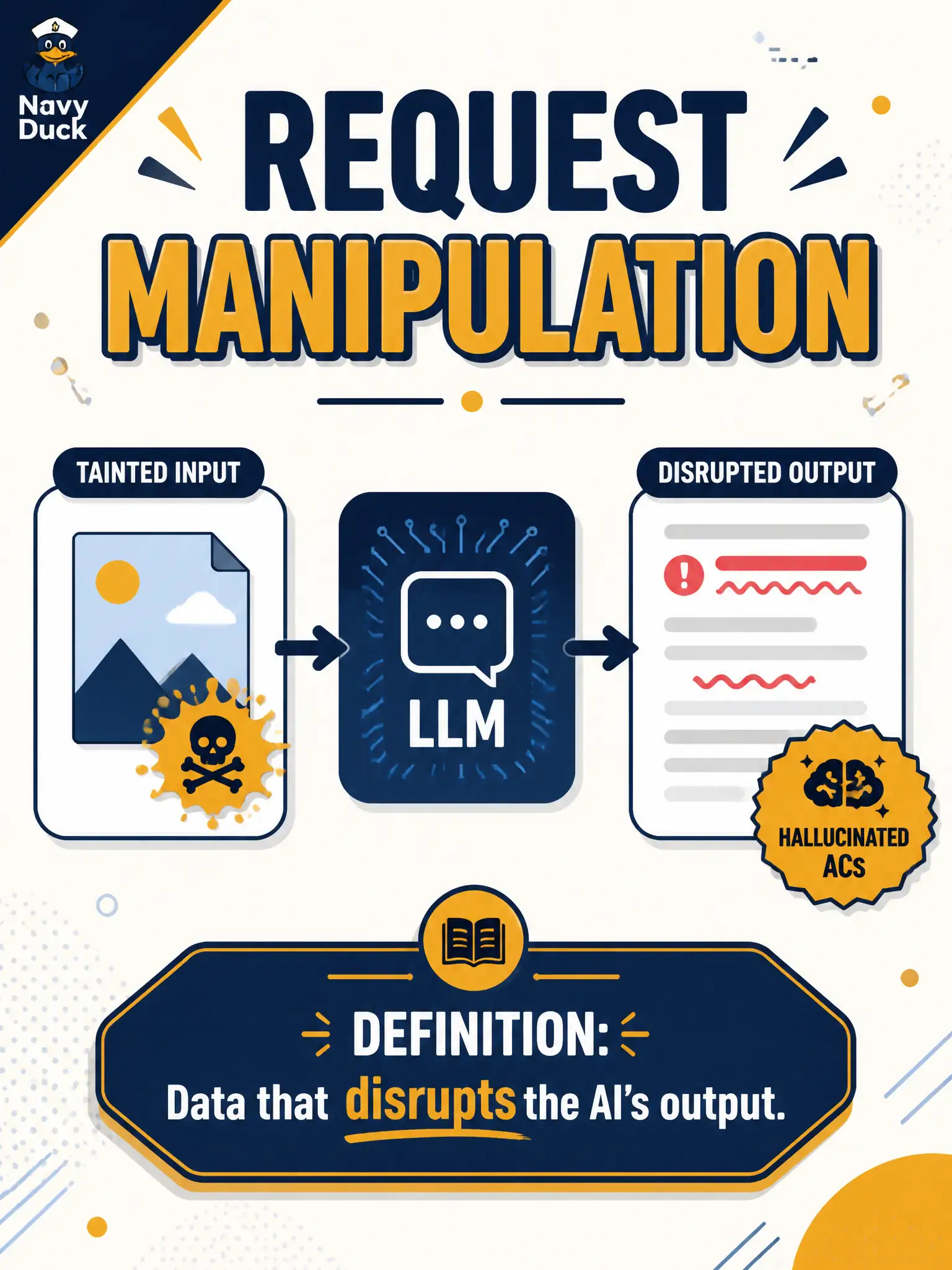
A municipal leaf-collection brief defines a GenAI security vector as introducing data that disrupts the AI’s output — for example, an image that lures the model into another context and provokes hallucinated acceptance criteria. Which vector is that?
Select an answer to reveal the explanation.
Short Explanation
Request manipulation is the “poison the ask” vector — tainted input that knocks the reply off course. A misleading image that drags the model into inventing acceptance criteria fits that definition. It is about disrupted output, not the training-data extraction story.
Full Explanation
Municipal leaf-collection briefs that define a vector as introducing data that disrupts the AI’s output—for example an image that lures the model into another context and provokes hallucinated acceptance criteria—are describing request manipulation. The core idea is tainted or disruptive input that knocks generation off the legitimate basis.
Context manipulation aimed only at extracting confidential training corpora fails by concept: that is the extraction/leakage-oriented vector, not disrupted-output-via-input. Data poisoning limited to fake star ratings fails because ratings corruption is a different vector focused on training or evaluation signals. Random-seed fixation fails because seeds replay sampling; they do not define this security vector.
Exam caveat: request manipulation is about disrupting outputs through introduced data; do not collapse it into data poisoning or into context-manipulation leakage narratives.
Operational check: treat untrusted images and pastes in leaf-collection GenAI jobs as potentially disruptive; require basis cross-checks for every generated acceptance criterion; quarantine packs that introduce rules absent from the posted collection ordinance. Leaf-collection GenAI jobs should quarantine image attachments from unknown senders and require an ordinance citation next to every generated acceptance criterion before the pack can leave draft status.