
A municipal after-school sign-out generator becomes repetitive once the team lowers temperature for more stable wording. What trade-off does a low temperature setting introduce?
Select an answer to reveal the explanation.
Short Explanation
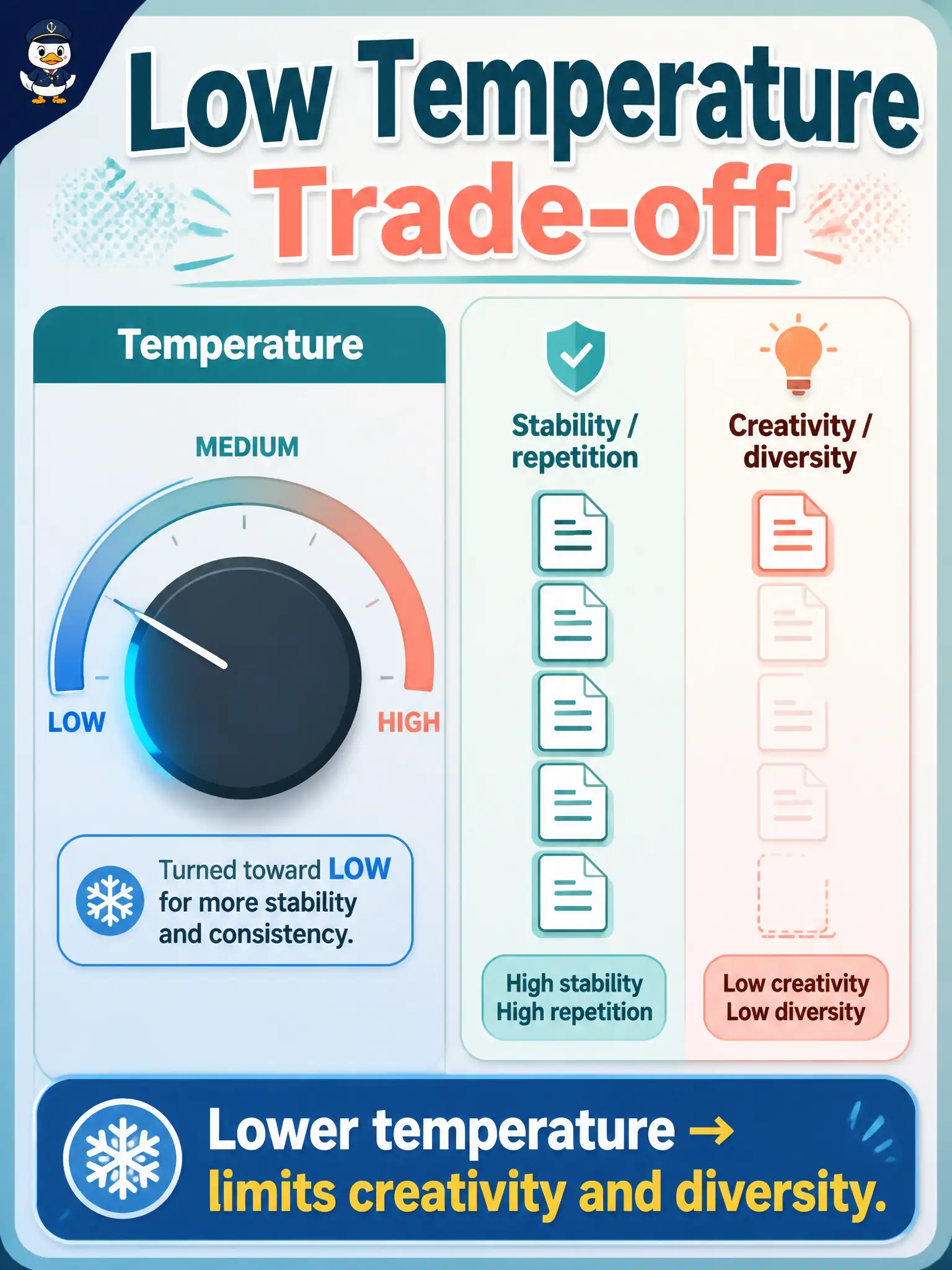
Picture temperature like a spice dial — turn it way down and every plate tastes the same. Low temperature favors stable, predictable wording. The cost is less creativity and less diversity in what the model invents.
Full Explanation
After-school sign-out generators illustrate the temperature trade-off clearly. A low temperature setting limits creativity and diversity, so outputs tend to become more repetitive or overly deterministic. Stability for wording is bought by narrowing the sampling range; the civic cost is fewer varied edge-case phrasings from the same prompt.
Claiming low temperature widens the sampling range fails by concept—that describes raising temperature. Claiming it removes the need to verify generated testware fails because parameter choice never replaces checking against the sign-out policy. Claiming it guarantees complete reproducibility across vendors and model versions fails because temperature is only one factor; vendors, versions, and seeds still differ.
Exam caveat: “more repetitive” is a tendency, not a promise of bit-identical outputs forever. Low temperature reduces diversity; it does not create a rule engine.
Operational check: decide per civic task whether diversity or stability matters more; document the chosen temperature and accepted repetition risk; if edge-case brainstorming is needed, run a separate higher-temperature pass that is labeled exploratory and still verified. For sign-out workflows, treat low-temperature repetition as an accepted cost when guardianship wording must stay predictable, and schedule a separate exploratory generation session if the team truly needs diverse edge narratives.