
A municipal bulk-trash scheduler sends the same prompt twice and receives two different pickup-route cases. What causes this non-deterministic behavior?
Select an answer to reveal the explanation.
Short Explanation
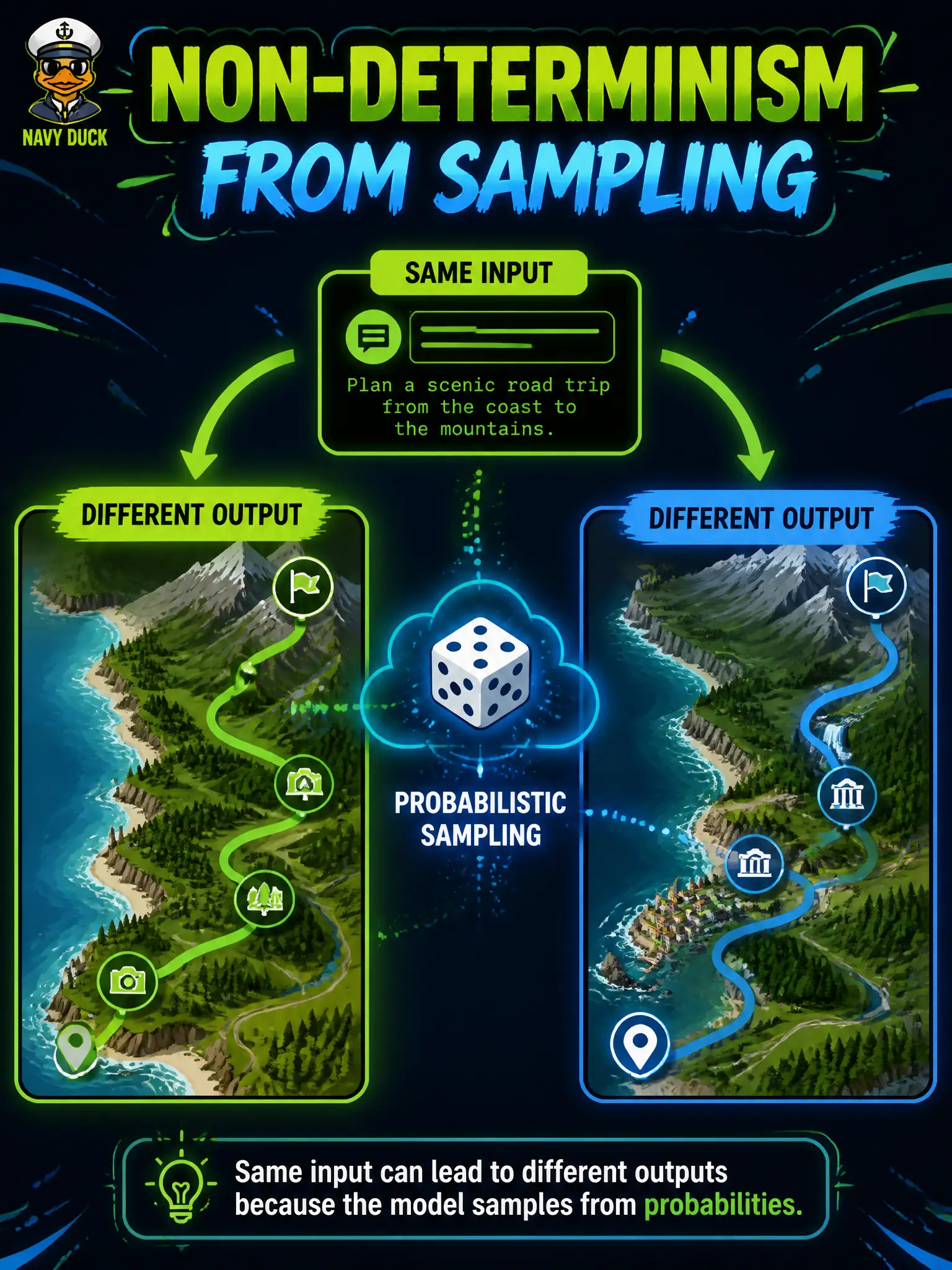
Same prompt, different routes—that is not a broken clipboard; it is probabilistic sampling during inference producing non-deterministic outputs.
Full Explanation
Municipal bulk-trash schedulers that send the same prompt twice and receive different pickup-route cases are seeing non-deterministic GenAI behavior. The cause is probabilistic sampling during inference: the model draws tokens from a distribution, so identical inputs can yield different outputs unless sampling is constrained. Testers should expect variation across runs rather than treat every difference as a broken municipal table.
Deterministic hashing of the municipal route table fails by concept: hashing would stabilize lookup, not explain divergent generative cases from one prompt. Mandatory neuron-coverage variation fails because neuron coverage is a CT-AI-style model-testing idea, not the inference mechanism producing ordinary output drift. Guaranteed identical decoding when temperature is high fails because higher temperature increases randomness rather than guaranteeing identical outputs.
Exam caveat: non-determinism is expected behavior of sampling-based generation, not proof that the city’s route data itself changed between runs.
Operational check: for fair prompt comparisons on civic packs, fix seed where supported, lower temperature when consistency matters, record run ids and outputs, and never assume two unaided runs must match before investigating.