
A municipal lost-and-found chatbot is prompted only with “write tests” and no desk rules. The pack invents shelves and reverses claim order. What does this situation illustrate about defect likelihood?
Select an answer to reveal the explanation.
Short Explanation
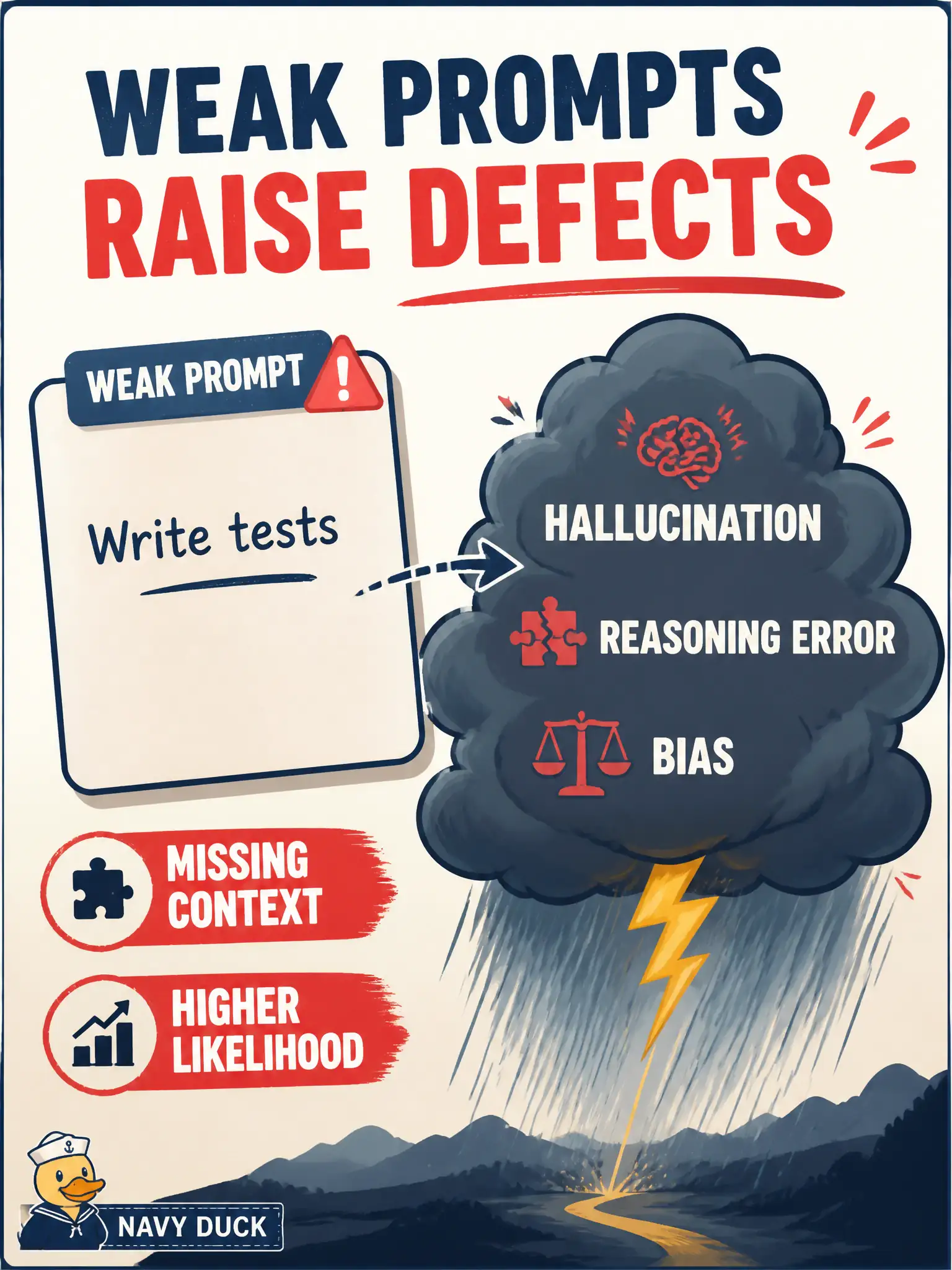
“Write tests” with no desk rules is an empty brief. Weak prompts and missing context make hallucinations, reasoning errors, and bias more likely—not less.
Full Explanation
Municipal lost-and-found desks have claim order and shelf rules that must appear in the brief. Prompting only “write tests” with no desk rules yields invented shelves and reversed claim order. That situation illustrates that hallucinations, reasoning errors, and biases are more likely when prompts are poorly designed or relevant context is missing—the official linkage between weak prompting and elevated defect likelihood.
Claiming hallucinations become impossible when prompts are short fails by concept: brevity without basis often increases invention. Saying reasoning errors only occur after fine-tuning fails because reasoning failures appear on poorly scoped multi-step tasks without any fine-tuning. Claiming bias disappears at default temperature fails because temperature does not remove distributional bias in generated packs.
Exam caveat: poor prompts raise likelihood; they do not guarantee every defect class on every run. Detection and mitigation still matter even after prompts improve.
Operational check: ban bare “write tests” prompts for civic bots; attach desk SOPs, claim-order rules, and location maps; peer-review prompts against a checklist before generation; re-run known failure scenarios after any prompt redesign.