
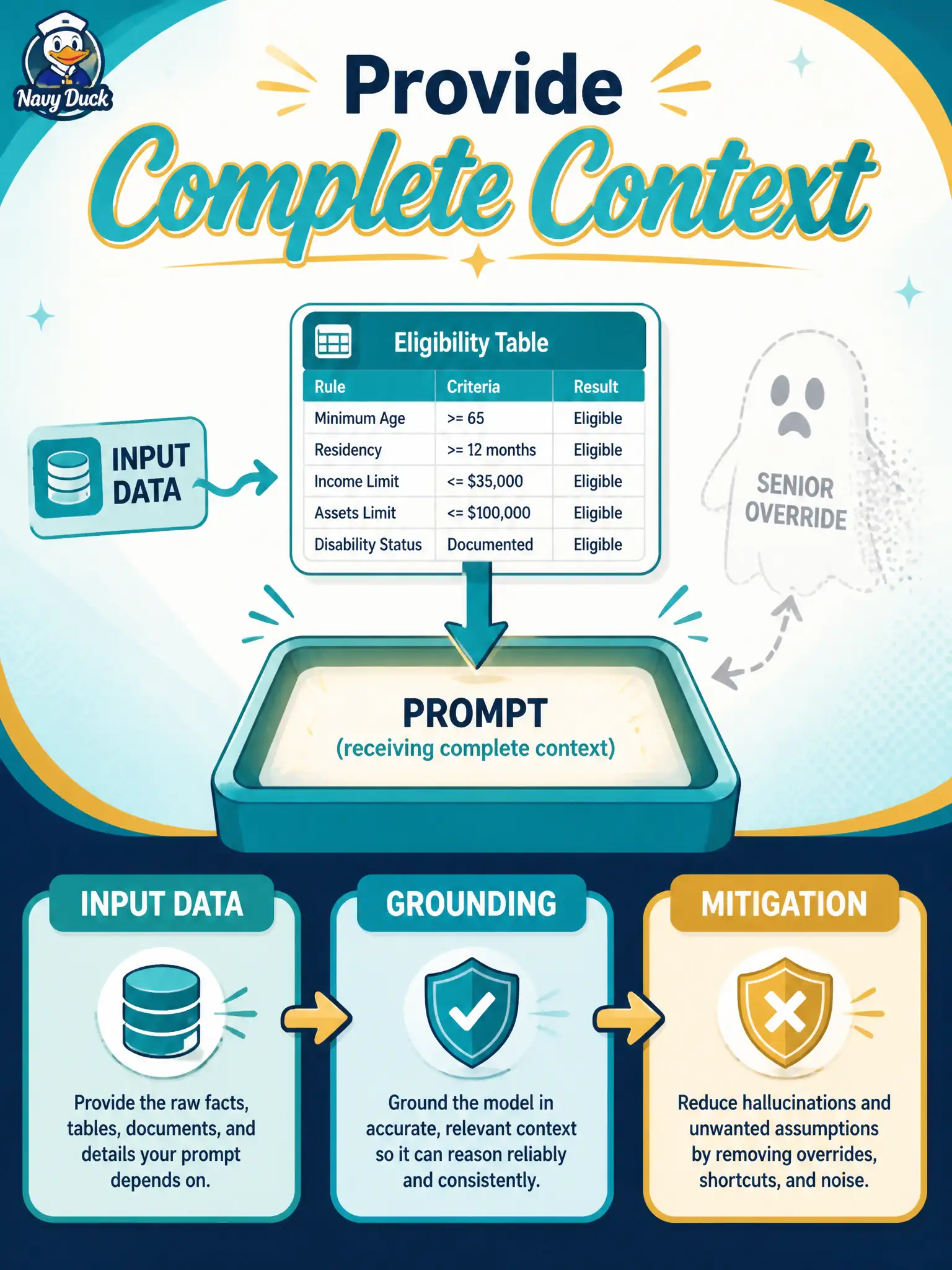
A community-garden plot lottery LLM keeps inventing a “senior override” because the prompt omitted the posted eligibility table. Adding that table as input data stops the invention. Which mitigation is this?
Select an answer to reveal the explanation.
Short Explanation
When the model fills gaps, it invents. Handing it the full eligibility table is providing complete context—the first fix for that gap-filling habit.
Full Explanation
Community-garden plot lotteries live or die on posted eligibility rules. When the prompt omitted the eligibility table, the model invented a “senior override”; supplying that table as input data stopped the invention. The named Chapter 3 mitigation is providing complete context in the prompt so generation is grounded in the real basis instead of gap-filling with plausible fiction.
Lowering temperature fails by concept here: temperature changes sampling breadth, but it does not insert missing eligibility facts; a cooler model can still invent rules it never saw. Comparing results across unrelated models only fails because cross-model comparison is a different mitigation and is not what stopped the invention in the stem—adding the table did. Fine-tuning a new checkpoint as the first Chapter 3 step fails because the syllabus places fine-tuning among complementary Chapter 4 techniques, not as the in-chapter first response to missing context.
Exam caveat: “complete context” means relevant, accurate basis material for the task—not dumping every municipal PDF into the prompt. Completeness is about closing the specific gap that caused invention, not maximizing token volume.
Operational check: for each civic GenAI generation job, list the basis artefacts (tables, ordinances, SOPs) the model must see, attach or retrieve them before generation, re-test known invention scenarios after context changes, and keep a checklist so omitted tables cannot silently return.