
A community climbing-wall waiver team wants to build its own LLM-powered case helper so wall-height rules never leave the building. What does the in-house GenAI test-tool path emphasize?
Select an answer to reveal the explanation.
Short Explanation
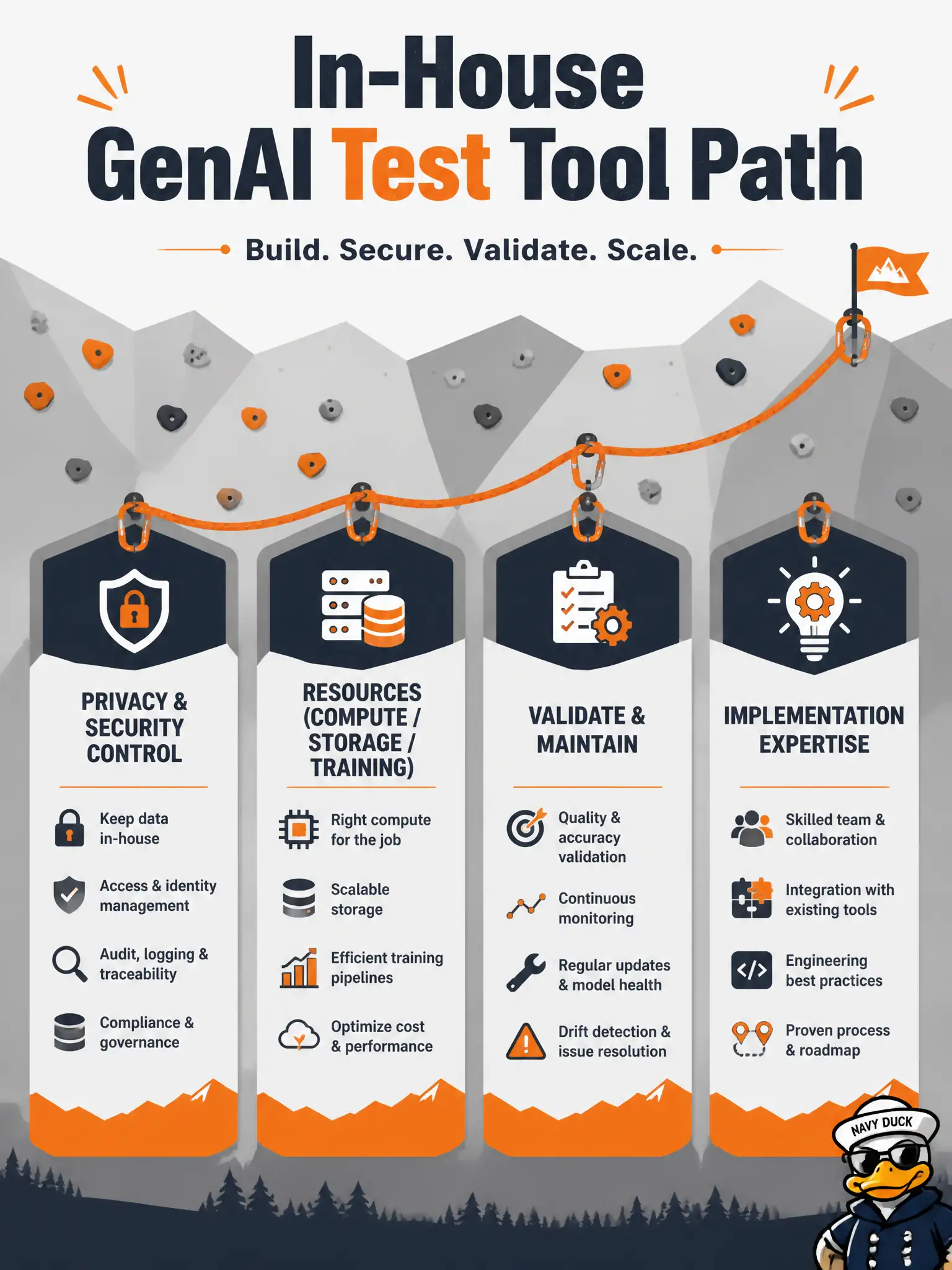
Building in-house is like keeping the rulebook inside the gym — more control, more homework. You plan compute, storage, and training, and you validate and maintain what you build. Expertise to implement the infrastructure is part of the path.
Full Explanation
The in-house GenAI test-tool path emphasizes comprehensive privacy and security control, planning for compute, storage, and staff training, plus structured processes to validate and maintain GenAI-specific developments and the expertise to implement the infrastructure. A community climbing-wall waiver team building its own LLM-powered case helper so wall-height rules never leave the building is choosing that control-heavy path. Outsourcing all prompts to an anonymous public chat with no controls is the opposite of in-house control and reintroduces leakage risk. Skipping validation because in-house models cannot drift is false; in-house GenAI still needs validation and maintenance. Naming a single cloud vendor SKU as the only allowed implementation turns a path choice into branding and may still externalize control. Exam caveat: depth stays at tester and organization awareness, not cluster sizing or rack diagrams. Operational check: if wall-height rules must stay on-premises, confirm plans for compute, storage, staff capability, validation, and maintenance before treating the in-house helper as production-ready. Keep civic testware subject to the same review discipline you would apply to human-authored packs.