
A community orchard-gleaning model, after a tuning pass, only writes cases that copy last October’s three stories and fails on this week’s new “wet-ladder” rule. Which challenge is that?
Select an answer to reveal the explanation.
Short Explanation
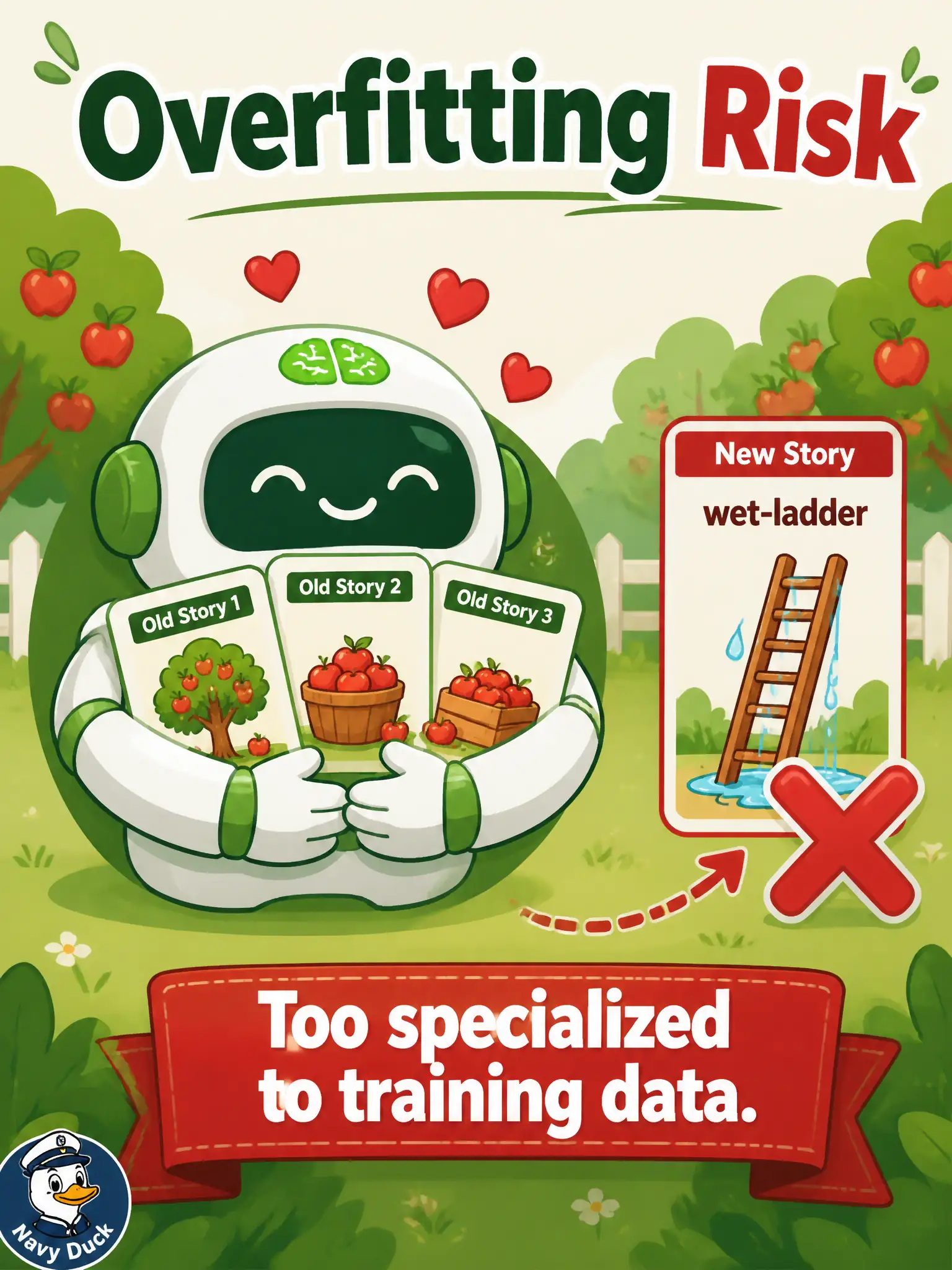
Memorizing last October’s three stories is like studying only three flashcards and blanking on a new question. Overfitting means too much specialization to the training set and weaker results on unseen tasks. That is a fine-tuning challenge, not a few-shot prompt trick.
Full Explanation
Overfitting occurs when the model becomes too specialized to the training data and performs worse on new, unseen test tasks. A community orchard-gleaning model that, after a tuning pass, only writes cases copying last October’s three stories and fails on this week’s new “wet-ladder” rule illustrates that over-specialization: memorization of the teaching set without generalization to fresh civic safety rules. Held-out probes expose the gap that fluency on familiar stories can hide. Few-shot prompting is a Chapter 2 prompting technique and does not define overfitting, nor does it always prevent specialization from fine-tuning. Calling the outcome successful generalization is the opposite of what the stem shows; failure on the new wet-ladder rule proves weak generalization. Treating vector indexing as a synonym for overfitting in relational case tables confuses RAG or storage mechanics with a training-fit failure mode. Exam caveat: overfitting is a fine-tuning challenge distinct from prompting tricks and from RAG indexing vocabulary. Operational check: after tuning, probe with held-out civic rules such as a new wet-ladder constraint; if the model only regurgitates last October’s stories, broaden or regularize the set and re-validate before relying on the packs.