
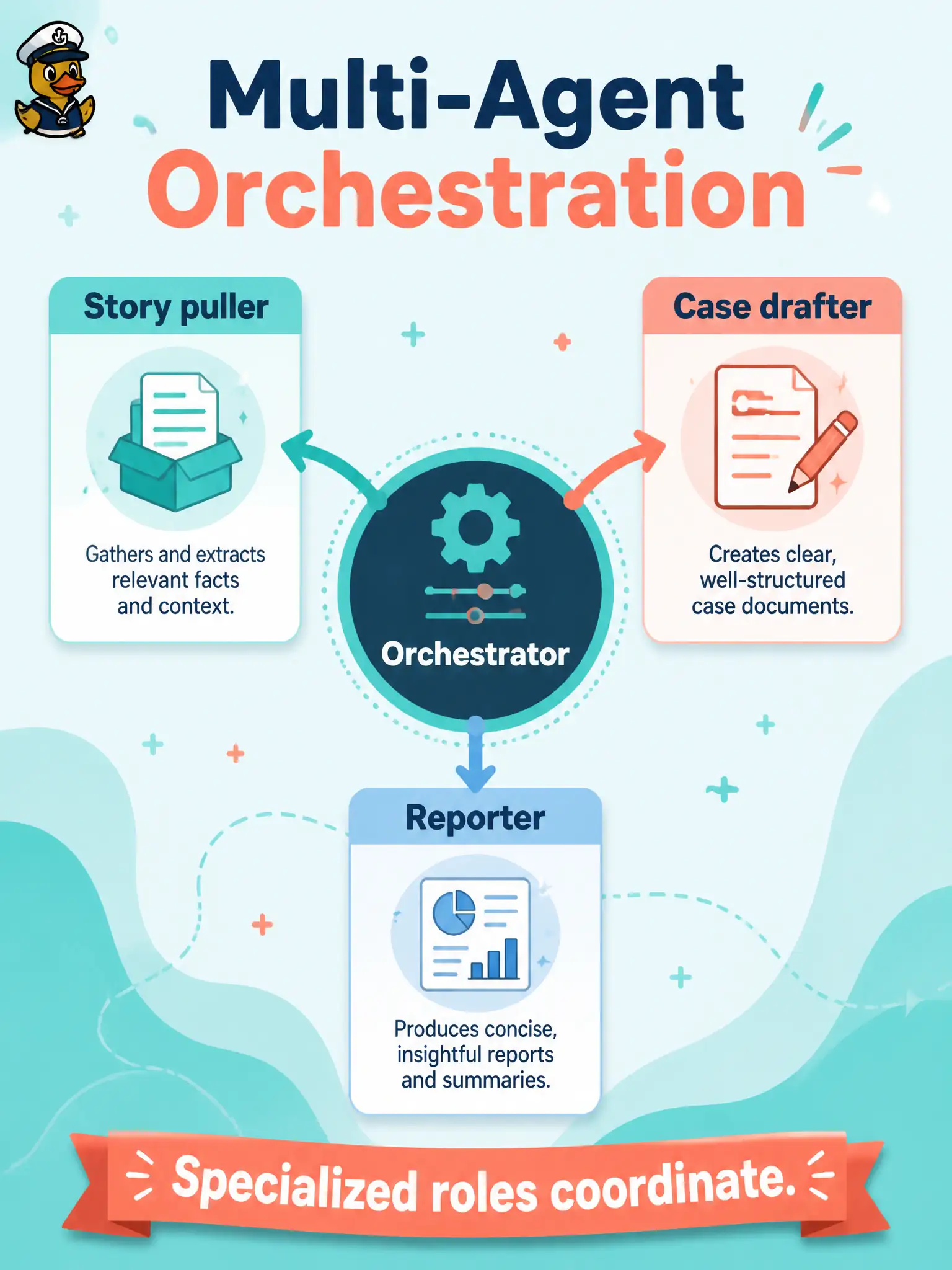
A municipal splash-pad suite uses one agent to pull stories, one to draft cases, and one to write the daily report, with a coordinator passing work between them. What architecture pattern is this?
Select an answer to reveal the explanation.
Short Explanation
Specialized workers plus a conductor — that is multi-agent orchestration. One pulls stories, one drafts cases, one reports, and a coordinator passes the baton. No vendor product name is required to describe the pattern.
Full Explanation
A multi-agent architecture with orchestration assigns specialized agents to parts of a complex test problem and uses a coordinator to pass work among them. In the municipal splash-pad suite, one agent pulls stories, one drafts cases, one writes the daily report, and an orchestrator routes the baton—exactly the communicate-and-coordinate pattern the syllabus describes for complex civic testing workflows. Splitting roles improves focus while orchestration keeps the end-to-end pack coherent from story intake through daily reporting. A single chatbot with no tool use and no role split cannot explain specialized agents, tool-backed actions, or coordination across stages. A relational-only store that replaces all agents may hold structured cases but performs neither story pull, drafting, nor reporting and is not an agent architecture. Naming a vendor product SKU on the exam is not required; the syllabus wants the architectural pattern, not a commercial brand. Exam caveat: describe multi-agent orchestration conceptually at tester awareness depth; proprietary product names and SKUs are out of scope for written items. Operational check: if distinct agents own story intake, case drafting, and reporting while a coordinator hands off work for the splash-pad suite, document the design as multi-agent with orchestration rather than as one undifferentiated chatbot or a database-only substitute.