
A community-darkroom booking lead wants every page of the chemical-safety binder stuffed into the prompt “so nothing is missed.” What is the better description of how RAG works?
Select an answer to reveal the explanation.
Short Explanation
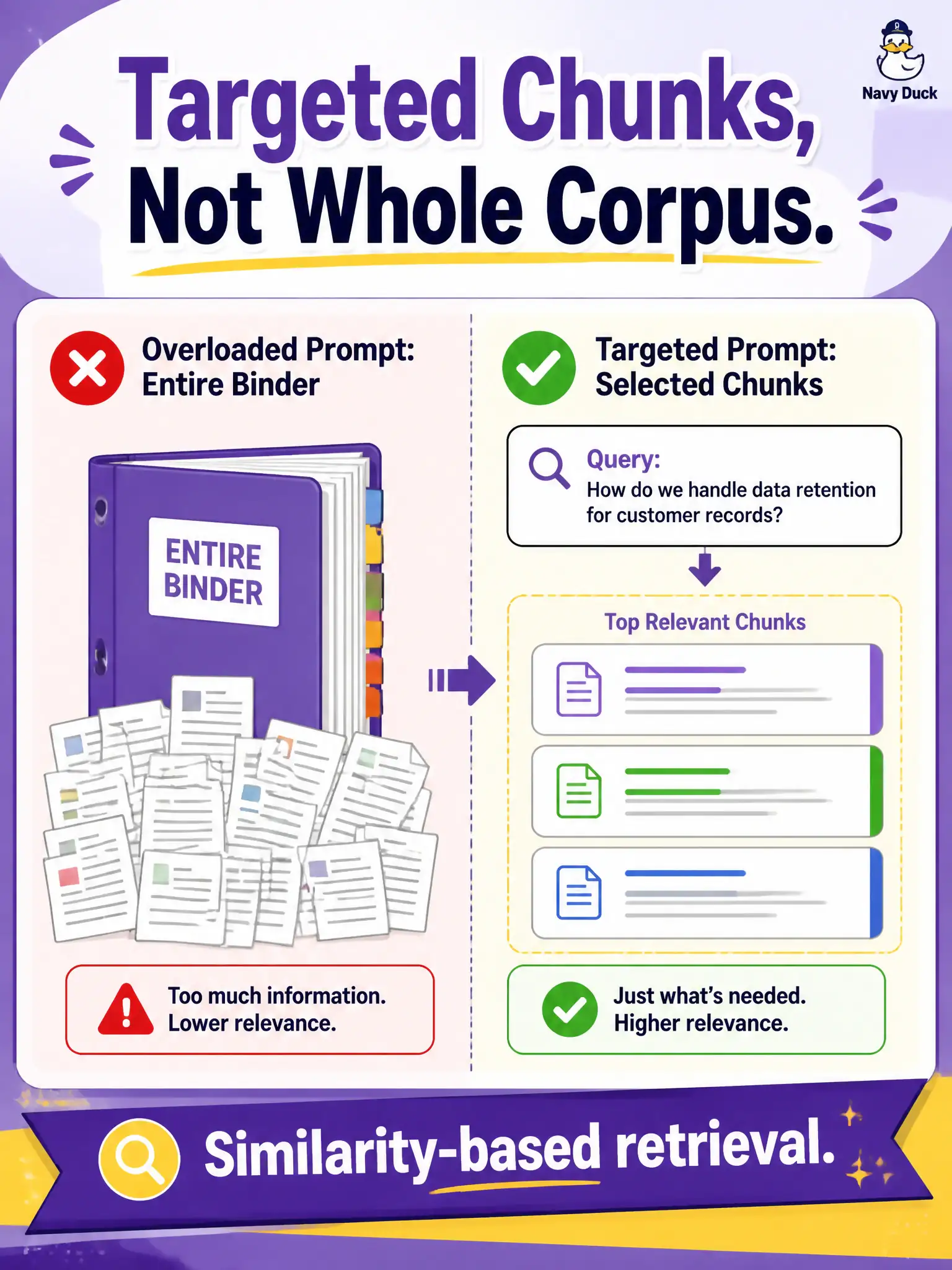
You do not dump the whole library on the desk for one question — you pull the matching chapters. RAG retrieves similar chunks for the ask. Whole-corpus paste is not how the pattern is built.
Full Explanation
Retrieval-augmented generation is built around similarity search: the darkroom booking lead’s chemical-safety ask is encoded, matching binder chunks are retrieved, and the LLM generates with that focused context rather than with every page of the handbook on every call. Targeted retrieval improves relevance, keeps prompts inside the model’s context window, and reduces noise that would otherwise dilute safety guidance for community-darkroom workflows. Claiming that RAG always uploads the full corporate archive without selection confuses whole-corpus paste with retrieval and erases the similarity step that defines the pattern. Replacing retrieval with random sampling of unrelated marketing pages severs grounding in the chemical-safety binder and would invent or omit critical controls. Saying RAG deletes the handbook so the model must invent safety rules from scratch inverts the purpose of grounding; RAG exists to keep authoritative municipal or community sources available, not to force hallucination. Exam caveat: written CT-GenAI items expect you to summarize retrieve-then-generate behavior at K2 depth—they do not treat stuffing an entire dataset into every prompt as RAG. Operational check: for a binder-backed safety ask, confirm that only similarity-matched chunks enter the generation step and that the full archive is not pasted wholesale on each call.