
A tree-trimming tester walks a chatbot through “list ambiguities, then draft cases” in one sitting, while a colleague’s tool always emits a case table from a ticket id. What contrast does this highlight?
Select an answer to reveal the explanation.
Short Explanation
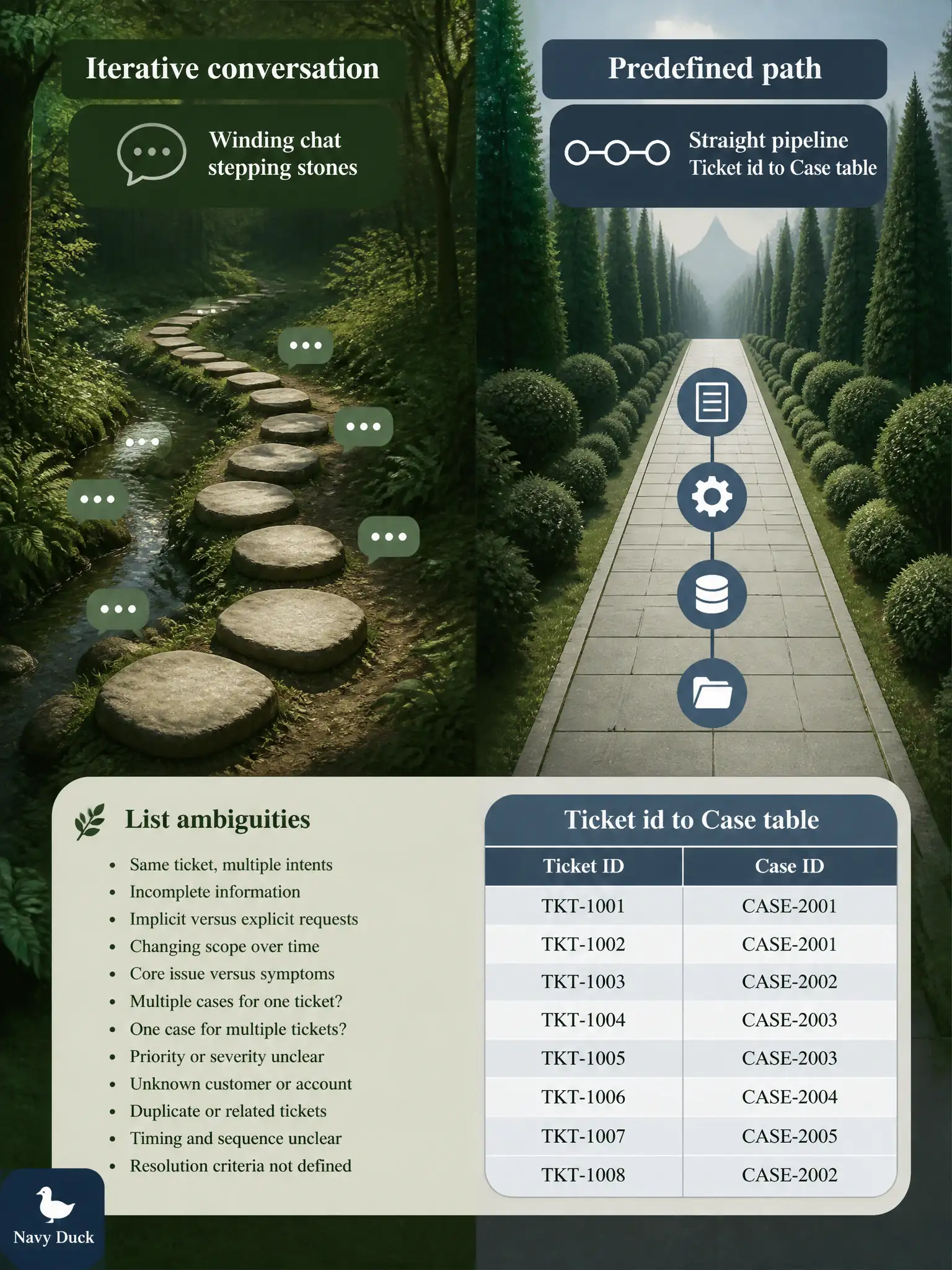
One path is a back-and-forth hike—“list gaps, then draft cases”—and the other is a fixed chute from ticket id to case table. Chatbots shine at iterative chaining; integrated tools shine at a predefined path. Same destination, different steering style.
Full Explanation
The contrast is iterative conversational refinement—including chaining steps such as “list ambiguities, then draft cases” in one chat sitting—versus a predefined automated tool path that always emits a case table from a ticket id. Tree-trimming civic testers use chat when goals unfold; they use integrated tools when the job is fixed. Both can be valuable; they are not the same interaction pattern.
Requiring both approaches to apply metamorphic testing of the LLM as the product under test misreads aid use as model-as-SUT evaluation. Claiming only the ticket-id tool can ever list ambiguities before cases is false—chatbots commonly chain analysis then design. Claiming chatbots cannot chain follow-up testing goals within a session denies a core chatbot strength shown in the stem.
Exam caveat: chatbot sessions support iterative refinement and chaining; applications follow predefined automated paths. Do not force CT-AI evaluation frames onto this contrast.
Operational check: for ambiguity-then-cases exploration, use moderated chat with a human check between steps; for ticket-id → case table, keep the automated tool; document both patterns in the municipal tree-trimming GenAI playbook.