
A food-truck permit team must choose between nightly batch case refresh and ad-hoc “explain this requirement” help. How do the two GenAI interaction models compare for those needs?
Select an answer to reveal the explanation.
Short Explanation
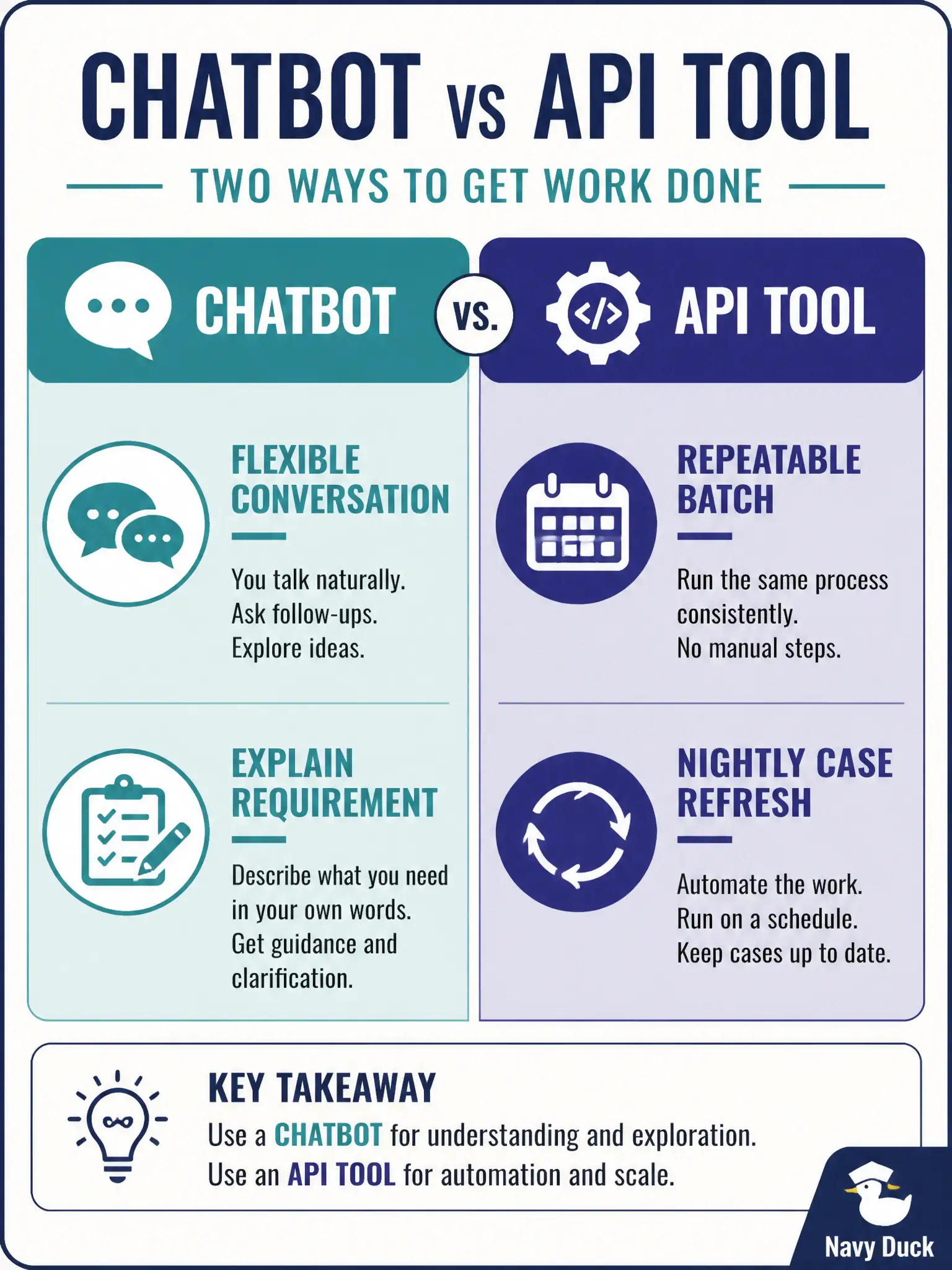
Nightly case refresh loves a boring, repeatable API job; “explain this requirement” loves a flexible chat. Match chatbot flexibility to ad-hoc help and integrated tools to automated refresh. Swap them and you fight the grain.
Full Explanation
Use a chatbot for flexible conversational explanation of requirements and an API-integrated LLM-powered testing tool for repeatable automated nightly case refresh. Food-truck permit teams commonly need both interaction models for different work shapes inside one civic program. Matching chatbot flexibility to ad-hoc “explain this requirement” help and integrated tools to batch refresh follows the syllabus contrast cleanly and avoids tool fights.
Requiring both needs to treat the LLM as the SUT and score jailbreak resistance first misreads CT-GenAI aid selection as CT-AI red-team evaluation. Using only a chatbot for nightly batch jobs fights scale—chat panes are poor unattended batch runners. Using only an API tool for ad-hoc stakeholder questions fights conversation—APIs are less exploratory for hallway clarification.
Exam caveat: choose interaction model by work shape—conversation versus automated defined task—not by forcing one channel for every GenAI testing need in the permit office.
Operational check: route “explain this requirement” to a moderated chatbot; route nightly case refresh to the API-integrated tool; measure cycle time and defect escape on both paths; write the pairing into the food-truck permit team’s municipal GenAI playbook.