
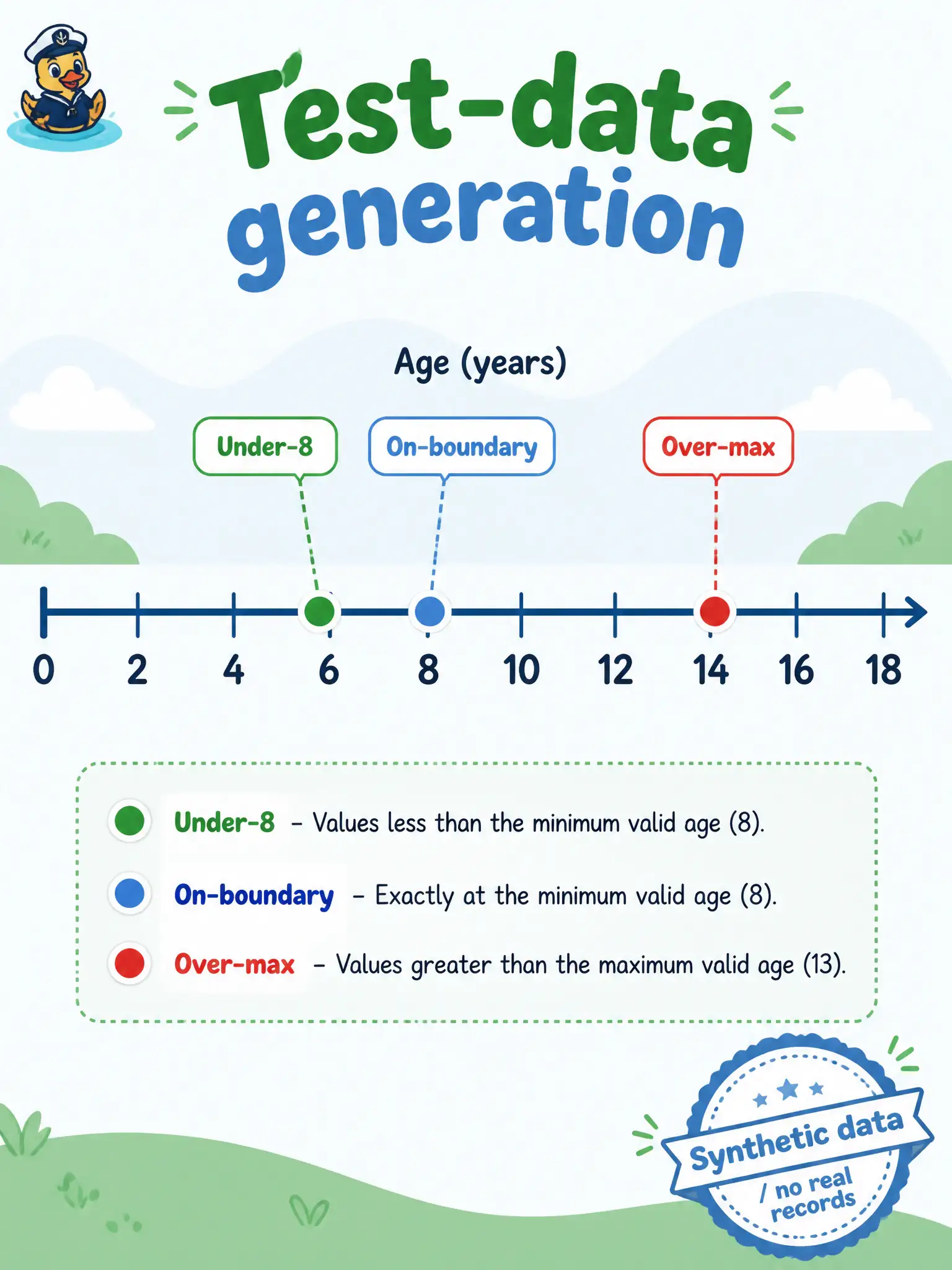
A soccer age-band registration form needs under-8, on-boundary, and over-max birthdates without using real children’s records. Which GenAI testing capability does requesting those values primarily illustrate?
Select an answer to reveal the explanation.
Short Explanation
You need birthdates that hug the age-band edges—without touching real kids’ data. That is synthetic test-data generation for boundaries and combinations. It is not script writing, log triage, or testing the model itself.
Full Explanation
Requesting under-8, on-boundary, and over-max birthdates without using real children’s records primarily illustrates test-data generation for boundaries and combinations using synthetic values. Civic youth-soccer registration must protect minors; synthetic edge values serve equivalence partitions and boundary coverage without privacy harm, parental consent issues, or policy breaches on live roster data.
Writing executable keyword scripts from an existing case list is automation support, not data generation. Summarizing overnight failure logs into severity buckets is result analysis. Measuring neuron coverage of an age-classifier model as the system under test imports CT-AI model evaluation into the wrong focus for this CT-GenAI capability item.
Exam caveat: synthetic boundary and combinatorial data is a first-class GenAI testing capability—especially where real PII or children’s data must not be used in municipal suites.
Operational check: generate synthetic birthdates for under-8, on-boundary, and over-max partitions; verify they are not real roster values; validate against registration rules; document the synthetic-data policy and retention limits in the soccer municipal test data standard.