
A municipal recycling-pickup tester pastes three weeks of route logs and the model “forgets” Monday’s missed stops. What does the context window represent?
Select an answer to reveal the explanation.
Short Explanation
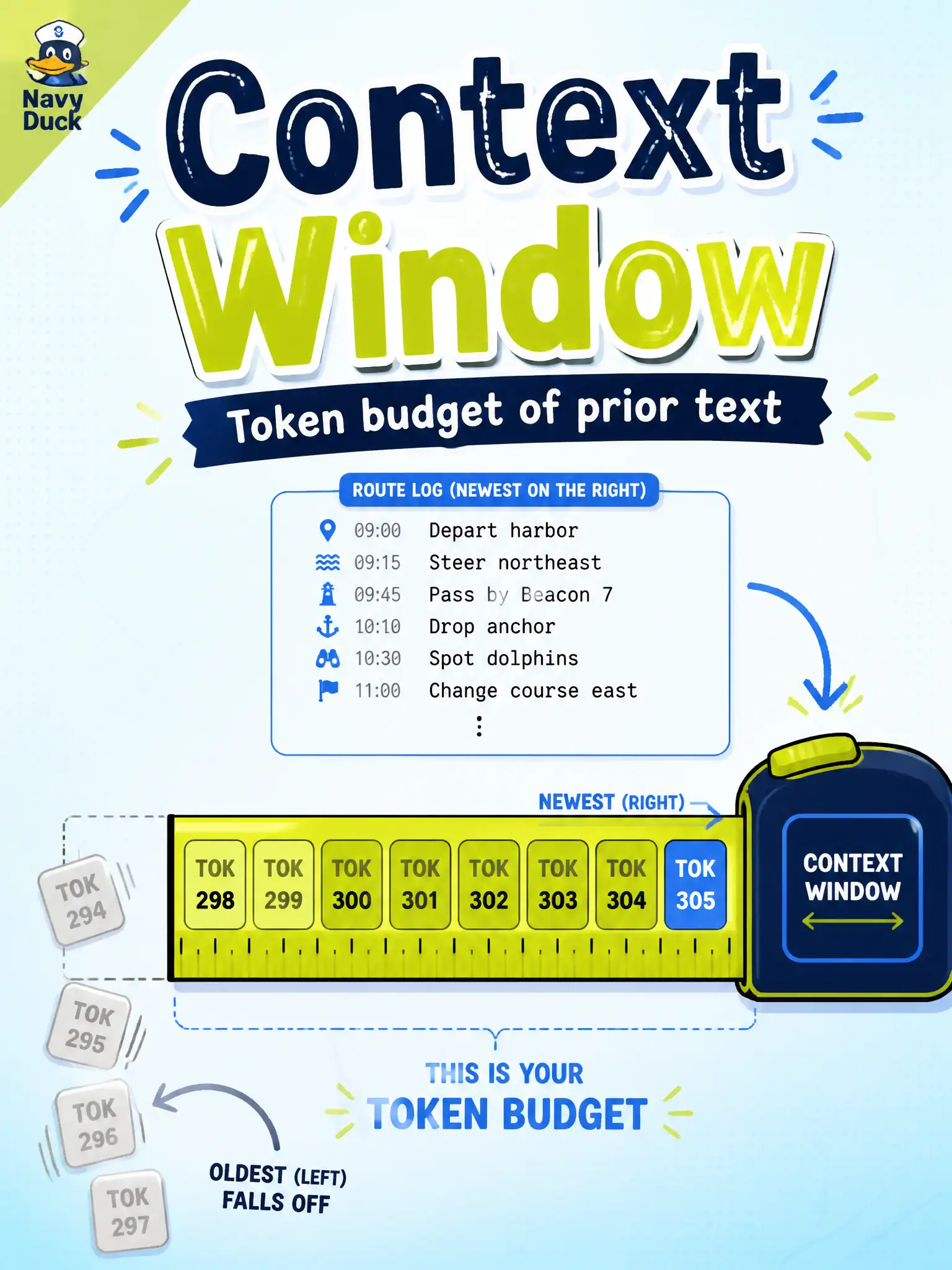
Think of a whiteboard that only holds so many sticky notes before the oldest fall off. The context window is that token budget of prior text. Overstuffed logs can leave early details outside what the model still sees.
Full Explanation
The context window represents how much preceding text, measured in tokens, the model can still consider when generating. When a municipal recycling-pickup tester pastes three weeks of route logs and the model “forgets” Monday’s missed stops, early tokens may have fallen outside that budget so the model never saw them. Civic log pastes routinely hit this limit; apparent forgetting is often capacity overflow, not proof the model “decided” Monday did not matter.
Embedding distance between defect paraphrases fails because similarity space is not the prior-text budget. Counts of symbolic if-then rules at the pickup desk fail because rule-table size is unrelated to an LLM context window. Mandatory lengths of generated test-case titles fail because output title style rules are not the definition of context capacity.
Exam caveat: context window = token budget of what still fits in view. Keep it separate from embeddings, symbolic AI rule counts, and formatting preferences for case titles.
Operational check: shorten or chunk the route-log paste; place critical Monday missed-stop details nearer the end of the prompt or summarize earlier days; confirm the model then references those stops in its reply; document window overflow as a municipal paste hazard in the recycling test guide.