
A community-college LMS tester mixes up “how the story is chopped,” “how each piece is numbered for meaning,” and “how much of the log still fits.” Which statement keeps the three LLM basics correctly separated?
Select an answer to reveal the explanation.
Short Explanation
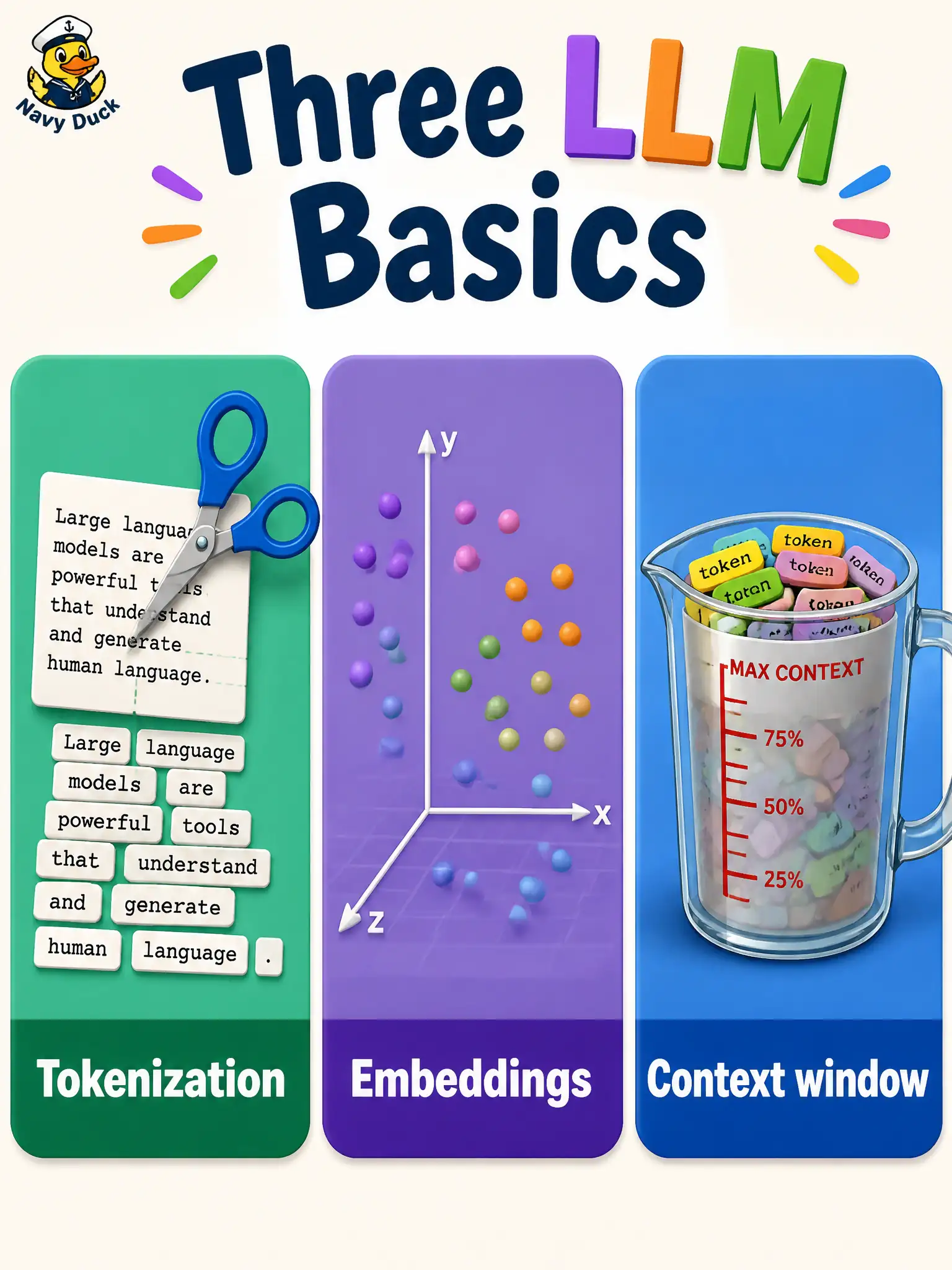
Chop the loaf, weigh each slice, then check how many slices fit in the toaster—three jobs, not one. Tokenization splits, embeddings encode meaning, and the context window caps prior text. Pasting test artefacts is easier when those three stay distinct.
Full Explanation
Testers must keep three LLM basics separate: tokenization splits text into tokens; embeddings encode meaning as vectors; the context window limits how much prior text, measured in tokens, still fits. A community-college LMS tester who confuses chopping, numbering-for-meaning, and fit-budget needs that clean separation to troubleshoot pasted stories and logs. Civic LMS work often mixes long pastes where each mechanic matters differently.
Statements that make tokenization the meaning vector, embeddings the chopper, or the context window a synonym for instruction tuning swap definitions and break diagnosis. Claiming embeddings, tokenization, and context window are three labels for next-token prediction collapses distinct preprocessing and capacity concepts into generation. Claiming the window creates embeddings, tokenization applies only to images, or embeddings set window size invents false dependencies.
Exam caveat: three mechanics, three jobs. Next-token prediction is inference behavior; it does not rename these basics.
Operational check: for a long LMS paste problem, checklist—(1) how was text tokenized, (2) are similar items embedding-near, (3) did early tokens fall outside the window—and record which check failed for the municipal incident.