
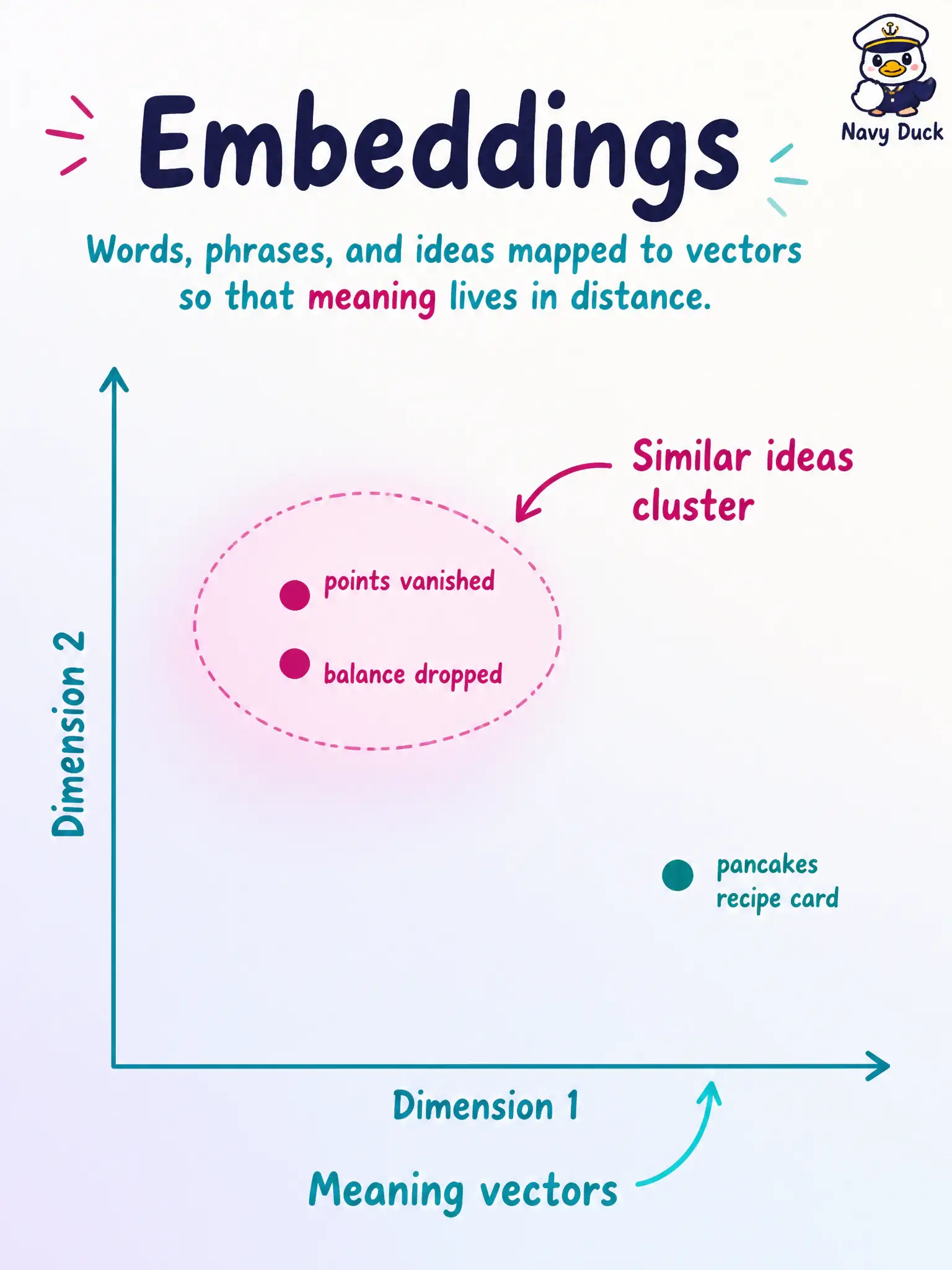
Two co-op grocery loyalty defect notes—“points vanished” and “balance dropped”—land near each other in a numeric space so the model treats them as related. Which LLM basic does this describe?
Select an answer to reveal the explanation.
Short Explanation
Neighbors on a map share a neighborhood even if their street names differ. Embeddings turn tokens into numeric vectors so similar meanings cluster. That is not the chopping step and not the size of the prompt window.
Full Explanation
Embeddings encode tokens as vectors that capture semantic meaning and context so similar ideas sit near each other in numeric space. When co-op grocery loyalty defect notes such as “points vanished” and “balance dropped” land close together, the model is using embeddings—not merely counting tokens or filling a window. Civic defect triage and retrieval-augmented helpers benefit when paraphrases cluster even if street-level wording differs across clerk entries.
Tokenization fails because it only splits notes into characters, sub-words, or punctuation; splitting alone does not place meanings near each other. The context window fails because it budgets how many prior tokens still fit; it is not a similarity space. Non-determinism fails as a definition here: varied generation outputs from probabilistic sampling are not what “similar notes sit near each other” describes, and embeddings are not defined as forcing opposite meanings on reruns.
Exam caveat: paraphrase proximity is an embeddings story. Do not credit tokenization, window size, or non-determinism for semantic clustering of civic defect paraphrases.
Operational check: take two paraphrased loyalty defect notes; confirm the tooling’s similarity or retrieval view groups them; if they do not cluster, investigate embedding or retrieval configuration rather than blaming only token chopping or window length; record the finding in the co-op test notes.