
A farmers-market stall-booking team can only host a compact on-laptop model for drafting reminder texts. How should they describe a small language model (SLM) compared with a general LLM?
Select an answer to reveal the explanation.
Short Explanation
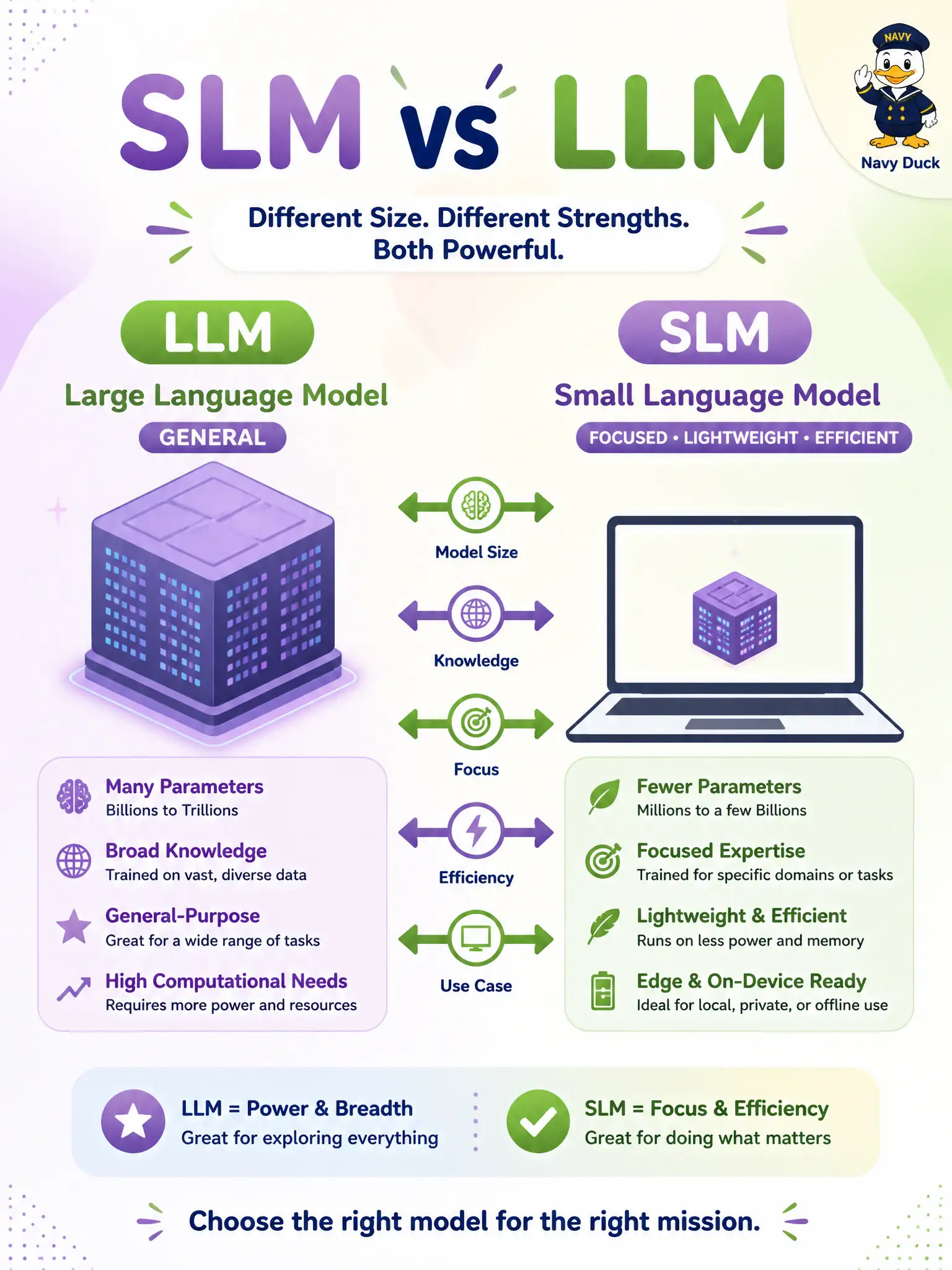
Think compact toolkit versus full workshop: fewer tools, easier to carry, aimed at a narrower job. An SLM is a smaller, lighter, focused GenAI option next to a general LLM. Size and focus are the tester-awareness points—not a guarantee of higher accuracy everywhere.
Full Explanation
A small language model (SLM) is a fewer-parameter, lightweight, often more focused GenAI option compared with a general LLM. A farmers-market stall-booking team that can only host an on-laptop drafting helper is describing that size-and-focus trade: less capacity to carry, aimed at narrower jobs such as reminder texts. Civic constrained hosts—laptops at the stall desk, limited GPU, offline-friendly drafts—are a practical reason CT-GenAI expects awareness of SLMs alongside larger cloud LLMs. The model remains generative; it is simply smaller and often more narrowly aimed.
Calling an SLM a classical ML ticket classifier that never generates text fails because SLMs remain generative language models used with prompts. Claiming an SLM is always more accurate than any LLM on every testing prompt invents a universal accuracy guarantee the syllabus does not make—size and focus are not automatic superiority. Calling an SLM another name for context-window size confuses model parameter scale with the token budget of prior text the model can still consider.
Exam caveat: SLM awareness is about parameters, footprint, and focus—not guaranteed superiority on all civic prompts and not a synonym for context window or classical classification.
Operational check: measure whether the on-laptop host can run the candidate SLM within memory limits; pilot reminder-text drafts against the stall-booking stories; compare quality and latency to a cloud LLM on the same prompts; document the civic trade-off as deployability versus breadth, with human review still required before texts go to vendors.