
A youth-soccer registration tester hears “we bought generative AI” and assumes any image-painting model can review user stories. What correctly describes an LLM in this setting?
Select an answer to reveal the explanation.
Short Explanation
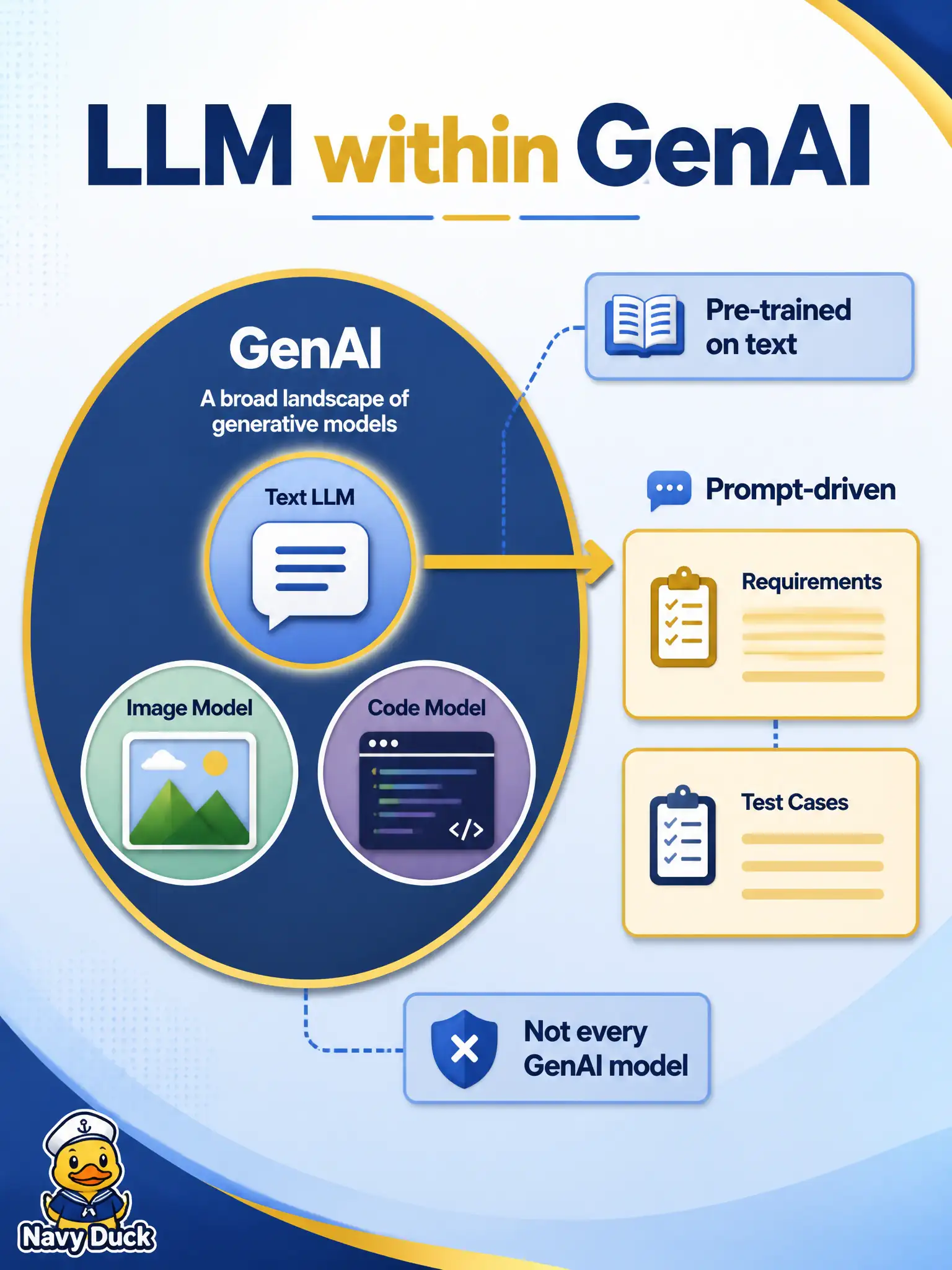
Buying “generative AI” is like buying “vehicles”—you still need the right kind for the road. An LLM is a text-pretrained GenAI model guided by prompts on language artefacts. Image-only painters are generative too, but they are not the LLM testers use on stories and cases.
Full Explanation
An LLM is a generative AI model pre-trained on large text corpora so it can follow prompts about requirements, cases, and other language artefacts. A youth-soccer registration tester who hears “we bought generative AI” must still select a text-capable LLM for story review; the purchase label alone does not make every GenAI product suitable. Civic teams need that precision when vendors bundle image painters with language tools under one GenAI contract.
Treating an LLM as any generative model, including image-only painters, whenever the vendor says GenAI fails the text-pretraining and prompting definition. Treating an LLM as a classical ML classifier that must be trained on labeled soccer tickets each sprint confuses prompting a pre-trained language model with classical training. Treating an LLM as a symbolic rule engine that stores if-then lines without prompts erases both neural language modeling and the prompt interface.
Exam caveat: GenAI is the family; LLM is the language-model member testers use on textual testware. Image generators can be GenAI without being LLMs.
Operational check: confirm the selected product accepts text prompts on requirements/cases; reject an image-only painter for story review; note in the registration test plan that LLM = text-pretrained GenAI for language work.