
A community clay-pit booking shop must handle a photo of the pit board plus a long safety note, and legal has already ruled out one license type. How should those model differences inform selection?
Select an answer to reveal the explanation.
Short Explanation
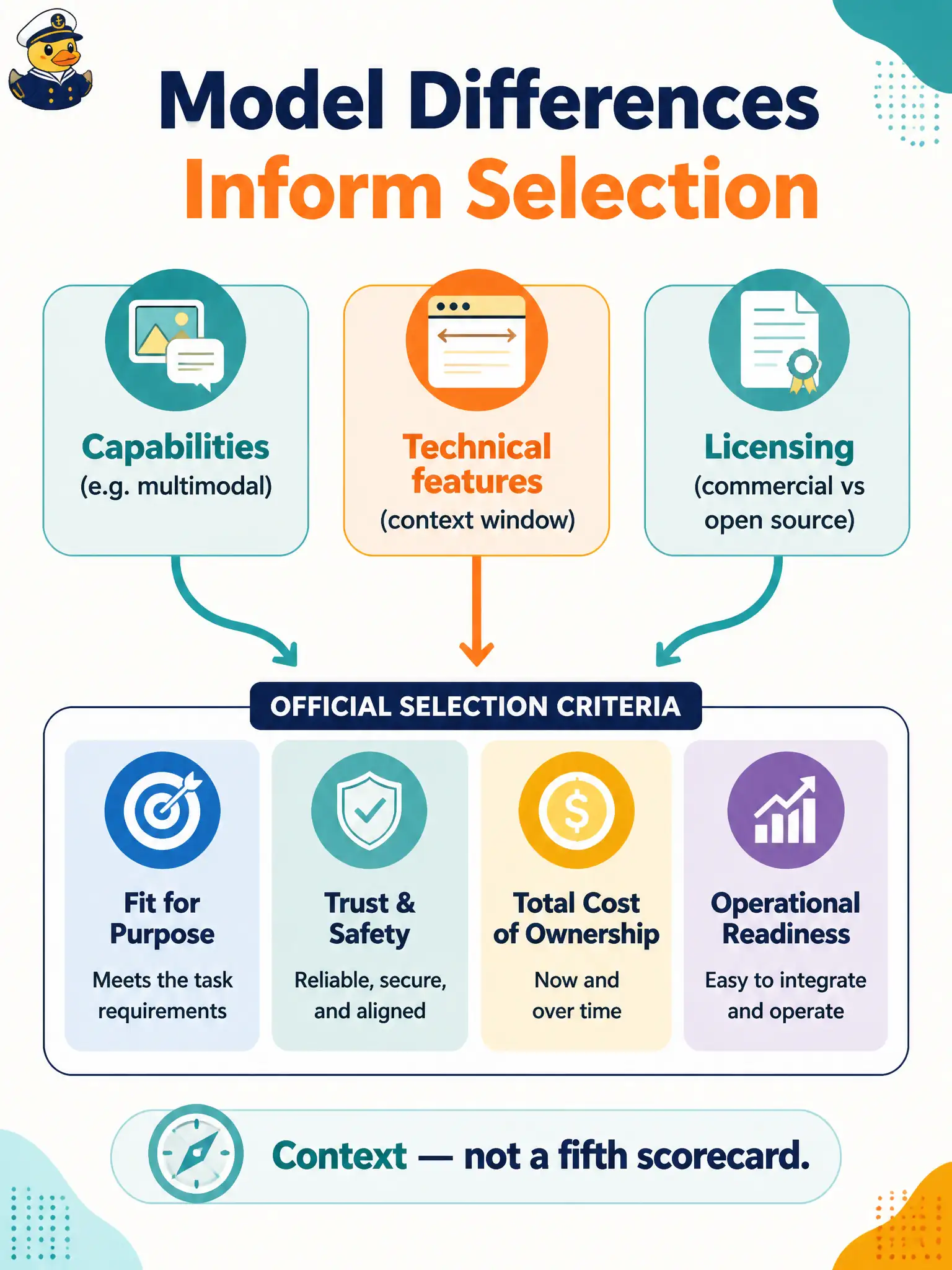
Capabilities, window size, and license type are the ingredients list — they inform the meal, they are not a fifth mystery recipe. Multimodal needs, long context, and allowed license types feed the official selection criteria. They do not replace those criteria.
Full Explanation
Models differ in functional capabilities (for example multimodal or reasoning), technical features (for example context-window size), and licensing (commercial versus open source). Those differences inform shortlisting against the official criteria such as performance, fine-tuning potential, recurring cost, and community/support. A community clay-pit booking shop that must handle a photo of the pit board plus a long safety note, with legal ruling out one license type, should treat those facts as context for selection—not as a replacement scorecard. Inventing a fifth official scorecard that replaces performance, fine-tuning, cost, and support misstates how differences feed the named criteria. Proving that only image models may ever be used for software testing overgeneralizes from one multimodal need. Requiring the shop to adopt shadow AI until legal reverses its ruling turns a licensing constraint into unapproved use. Exam caveat: capability, feature, and license differences inform official criteria; they are not a mandate for shadow AI. Operational check: map photo-plus-long-note needs and legal license limits onto candidates, then score with the official criteria before shortlisting.