
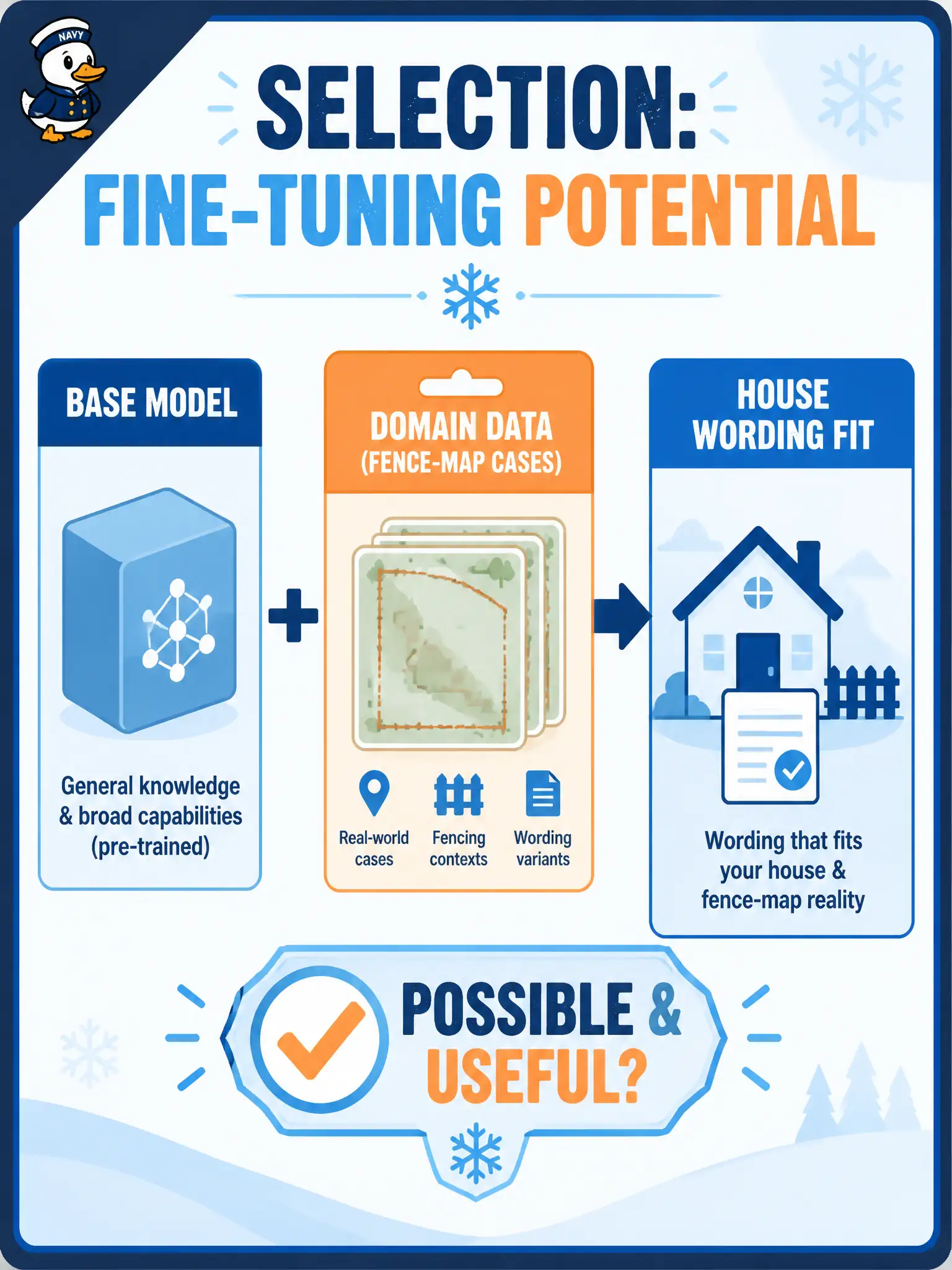
A municipal snow-fence request shop may later train a model on last year’s fence-map cases so wording matches house sheets. Which selection criterion does that future option represent?
Select an answer to reveal the explanation.
Short Explanation
Sometimes the house dialect matters more than the stock voice. Fine-tuning potential asks whether the team can usefully adapt the model with domain-specific data such as last year’s fence-map cases. That is a selection criterion, not a full training-job how-to.
Full Explanation
Fine-tuning potential—whether it is possible and useful to fine-tune with domain-specific data—is an official LLM selection criterion. A municipal snow-fence request shop that may later train a model on last year’s fence-map cases so wording matches house sheets is weighing that future option during selection. Discovery-phase sandbox access for first experiments only is an adoption-phase concern, not the fine-tuning-potential criterion. Transparency stamps on every generated defect title are a strategy transparency practice, not a model-selection criterion about tunability. Compliance risk from Chapter 3 named AI instruments confuses regulatory framing with whether fine-tuning is feasible and useful. Exam caveat: selection asks whether fine-tuning can help later; it does not require running the training job on the exam. Operational check: when shortlisting for snow-fence work, note which candidates allow useful fine-tuning on house fence-map cases and whether that path fits civic constraints. Keep civic testware subject to the same review discipline you would apply to human-authored packs. On the written exam, prefer syllabus terminology over vendor marketing language or lab choreography.