
A municipal pier-fishing license team plans to feed whatever inbox mail arrives into their LLM-powered testing helper. Why does the GenAI testing strategy call out input-data practices?
Select an answer to reveal the explanation.
Short Explanation
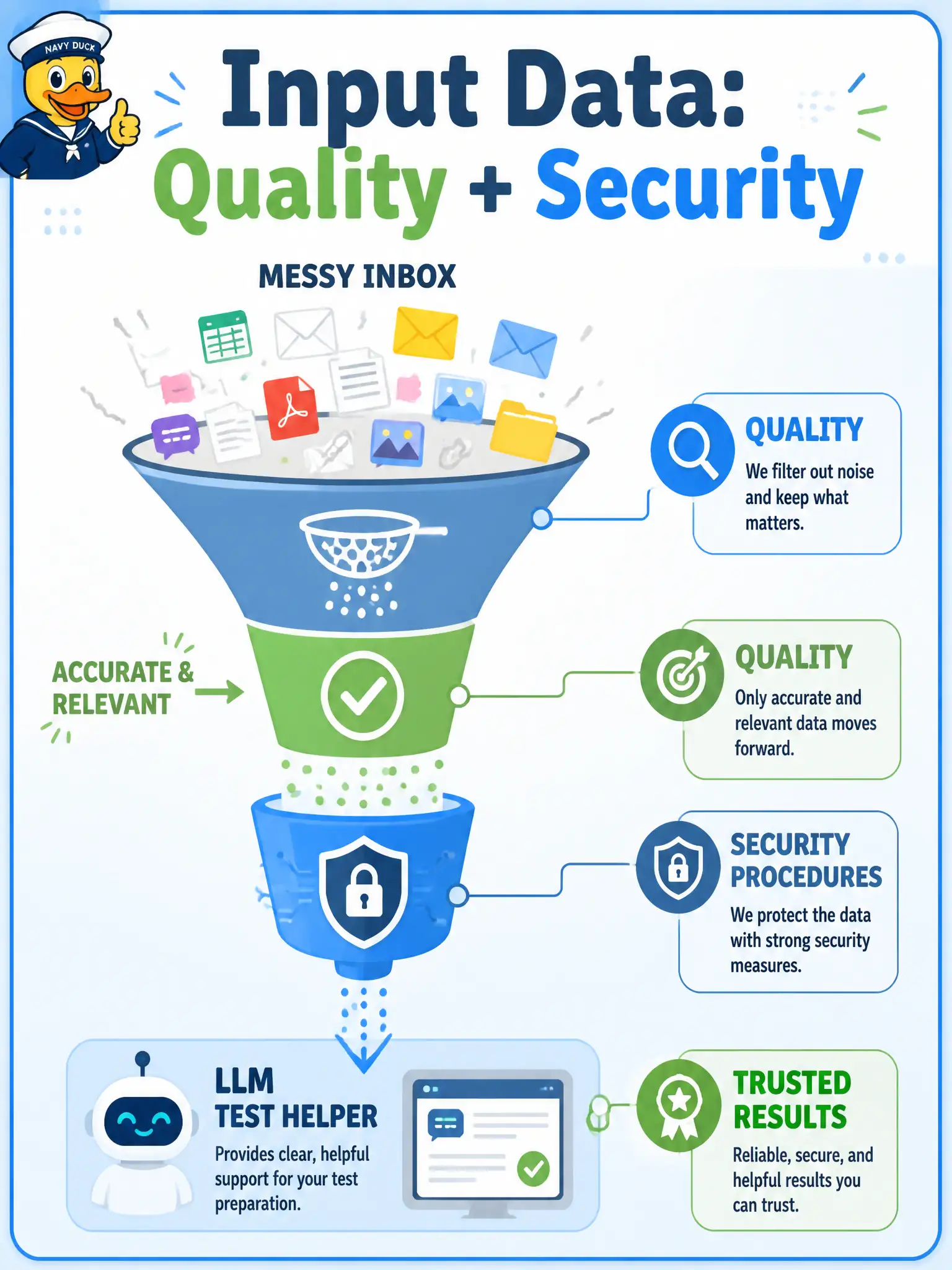
Garbage in still means garbage out — even with a fancy helper. Trusted LLM-powered testing needs accurate, relevant inputs wrapped in solid security procedures. Dumping raw inbox mail without those controls is a strategy gap.
Full Explanation
A GenAI testing strategy includes ensuring accurate and relevant input data and protecting that data with robust security procedures so results can be trusted. A municipal pier-fishing license team planning to feed whatever inbox mail arrives into their LLM-powered testing helper without those practices risks noisy, sensitive, or irrelevant prompts and weak trust in outputs. Inbox mail volume is not the only official §2.3.1 effectiveness metric and does not replace data quality and security. Personal shadow-AI tools do not automatically sanitize every inbound message and are not a strategy control. Discovery-phase experiments do not forbid any use of real requirements text; they are an adoption phase, not a ban on requirements. Exam caveat: named privacy attack vectors belong elsewhere; this item is about the strategy pillar of data quality and security. Operational check: define which pier-license inputs are allowed, how they are sanitized, and which security procedures protect them before the helper ingests mailbox content. Keep civic testware subject to the same review discipline you would apply to human-authored packs. On the written exam, prefer syllabus terminology over vendor marketing language or lab choreography.