
A municipal street-fair stall desk sees testers “just using whatever GenAI works” and wants to stop that pattern. According to the syllabus, what helps a test organization avoid shadow AI?
Select an answer to reveal the explanation.
Short Explanation
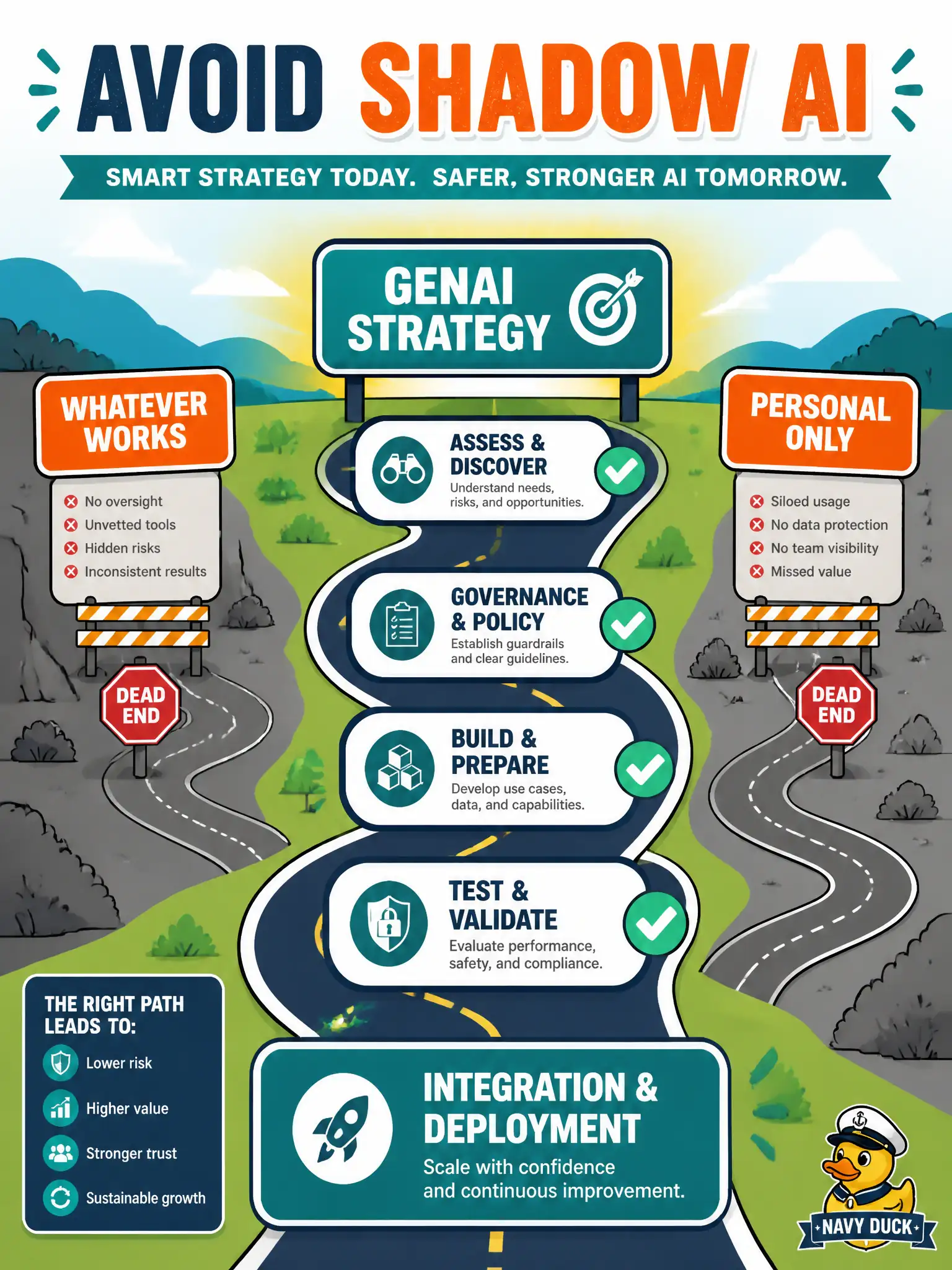
Shadow AI shrinks when the shop posts a map and a marked trail, not when everyone blazes their own path. A GenAI strategy with clear integration and deployment steps is the official avoidance path. Leaderboards and private workflows alone do not fix missing approval.
Full Explanation
Organizations reduce shadow AI by establishing a GenAI strategy and following defined integration and deployment steps so approved tools and processes are available. A municipal street-fair stall desk seeing testers “just using whatever GenAI works” needs that sanctioned path rather than more ad-hoc helpers. Relying only on public code-generation leaderboards for model choice may inform selection but does not by itself create approval, oversight, or deployment controls. Treating every personal chatbot as an approved production SUT invents authorization and confuses GenAI-for-testing with CT-AI model-as-SUT work. Skipping training so testers invent their own private workflows encourages more shadow use rather than preventing it. Exam caveat: strategy plus integration and deployment give testers a sanctioned alternative; benchmarks alone are not an avoidance path. Operational check: publish an approved GenAI testing strategy and rollout steps for street-fair work, then direct testers from personal tools to those sanctioned channels. Keep civic testware subject to the same review discipline you would apply to human-authored packs. On the written exam, prefer syllabus terminology over vendor marketing language or lab choreography.