
A community grain-mill booking tester feeds resident names from a failed reservation into an unsanctioned personal GenAI helper. Which shadow-AI risk does this primarily illustrate?
Select an answer to reveal the explanation.
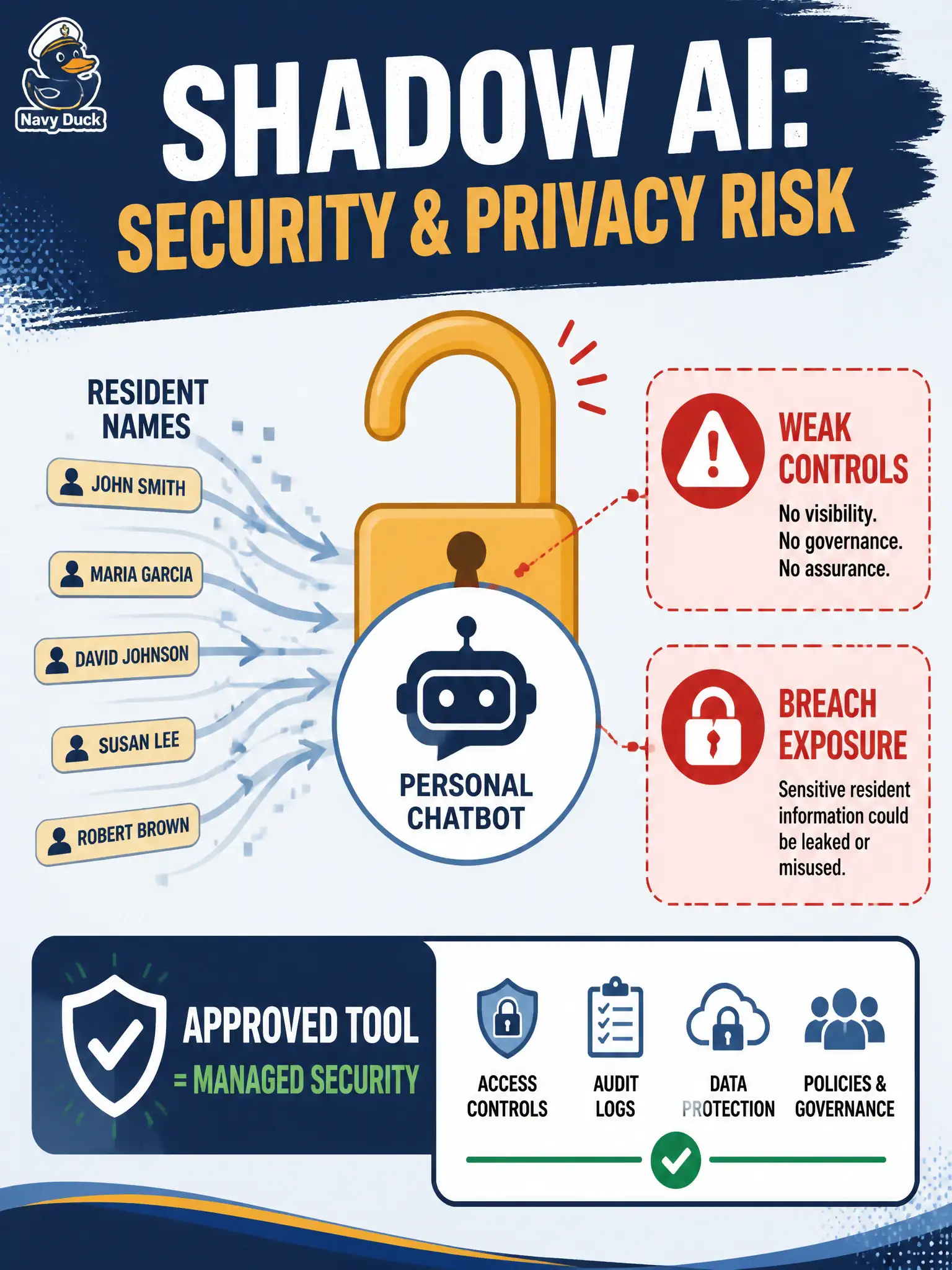
Short Explanation
Personal helpers are like unlocked filing cabinets on the sidewalk — handy, but anyone could peek. Feeding resident names into an unsanctioned tool raises breach exposure because those tools often lack shop-grade security and privacy controls. That is the information-security risk of shadow AI.
Full Explanation
One official consequence of shadow AI is information security and data privacy risk: personal or unsanctioned GenAI tools may not enforce the organization’s controls, increasing exposure of sensitive test or resident data. A community grain-mill booking tester feeding resident names from a failed reservation into an unsanctioned personal helper illustrates that privacy weakness directly. Lack of measurable test objectives such as cycle-time reduction is a strategy-goal gap, not the privacy consequence of shadow AI. Insufficient fine-tuning potential for the booking domain is a model-selection concern, not a shadow-AI risk category. Missing multimodal capability for reading mill-board photos is a functional capability gap, not the data-privacy impact of unapproved use. Exam caveat: keep personal and resident data out of unapproved helpers; strategy objectives and selection criteria are separate Chapter 5 topics. Operational check: when resident names appear in a failed civic reservation, confirm only approved instruments with adequate controls are used, and sanitize or withhold identifiers from any GenAI prompt. Keep civic testware subject to the same review discipline you would apply to human-authored packs.