
A hospital SOC analyst confirms a compromise on a clinical scheduling server, completes initial isolation, and hands off server rebuilding and firewall updates to the infrastructure and network teams through separate IT tickets. Before closing the SIEM case, what should the analyst record in the case documentation?
Select an answer to reveal the explanation.
Short Explanation
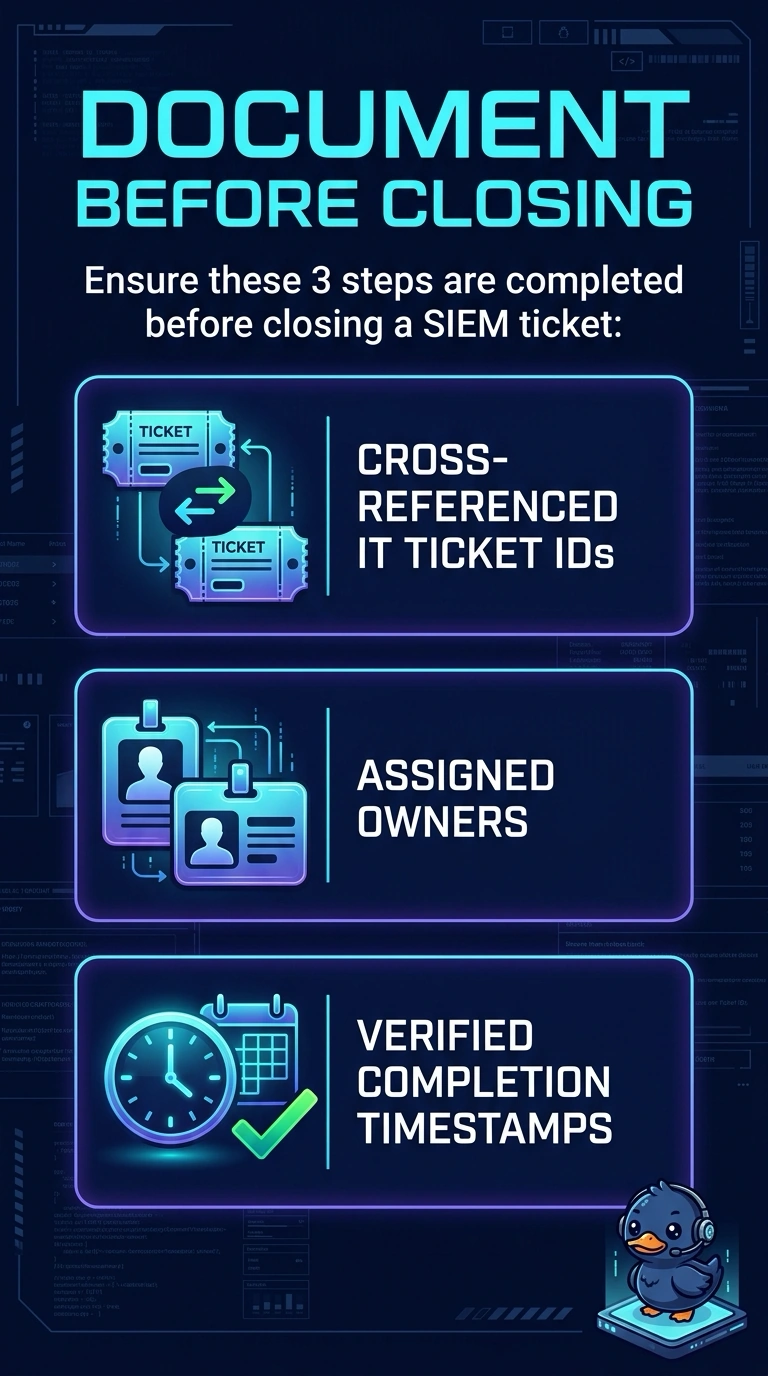
You need cross-referenced IT ticket IDs, assigned owners, and verified completion timestamps to show that the handoff was owned and completed. An email notice or raw telemetry alone cannot prove the remediation was finished.
Full Explanation
Recording cross-referenced IT ticket IDs, assigned owners, and verified completion timestamps establishes an auditable link between the SIEM case and the infrastructure and network teams’ work. When containment and remediation span departments, auditors and future responders need to identify who performed the server rebuild or firewall updates, who owned each task, and when completion was confirmed. A full export of raw endpoint and firewall events from the triage window may preserve useful evidence, but it does not establish that either requested change occurred. A note that the teams were notified by email shows only that a message was sent; it does not document ownership, execution, or confirmation. The initial detection rule title, alert identifier, and original severity rating describe how the incident began, but omit the downstream remediation needed to support closure. As a caveat, opening an external IT ticket is not proof that its work is complete, so do not treat a handoff as a finished task. Before closing the SIEM case, review the linked tickets and verify that the server rebuild and firewall updates are marked complete with confirmed timestamps.
Prefer to study offline? Printable PDF study book + test engine ($7.50, unofficial). These questions stay free here.