
A financial firm analyst runs a CQL groupBy query on the normalized username field across firewall and proxy logs to find the top active accounts. The query explicitly fills absent usernames with an empty string before groupBy. The top result shows a blank label accounting for 60 percent of all events. What is the most likely explanation?
Select an answer to reveal the explanation.
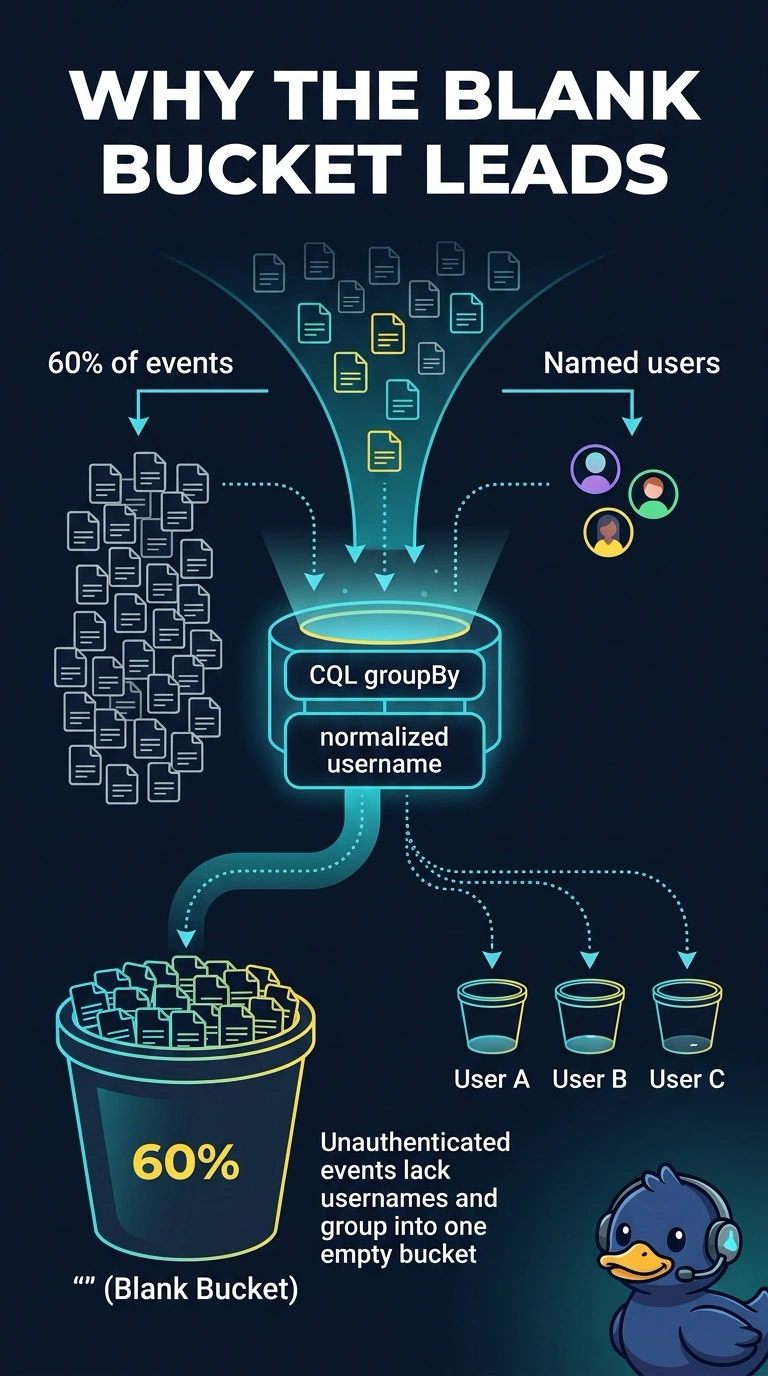
Short Explanation
You can see why that blank bar dominates when you notice your query filled in the gaps first! The explicit defaulting step makes missing-identity events share the blank bucket; inspect raw identity coverage before treating it as a named user.
Full Explanation
Unauthenticated events lack usernames and group into one empty bucket explains the blank-dominated result because firewall flows and unauthenticated proxy requests often carry no user identity. The explicit defaulting step makes missing-identity events share the blank bucket; inspect raw identity coverage before treating it as a named user. Because the query fills absent values with empty string before aggregation, all events without identity collapse into the same label, which can easily reach 60 percent in mixed network telemetry. Filtering for non-empty usernames or separating authenticated traffic restores a true top-accounts ranking. The idea of automatic deletion of usernames from high-volume records is incorrect because normalization preserves available fields and does not strip values based on event volume. The claim that groupBy always hides the most active user is false because groupBy surfaces actual field values from matched events without masking identities. The case-sensitivity merging claim is backwards because case sensitivity would split variants into separate groups, not merge distinct names into blank.
Prefer to study offline? Printable PDF study book + test engine ($7.50, unofficial). These questions stay free here.