
A media company SOC analyst runs a CQL groupBy query on full proxy request URLs containing unique session tokens to spot the most targeted web endpoints, but nearly every row in the output shows a count of one. How should the analyst adjust the query to reveal meaningful trends?
Select an answer to reveal the explanation.
Short Explanation
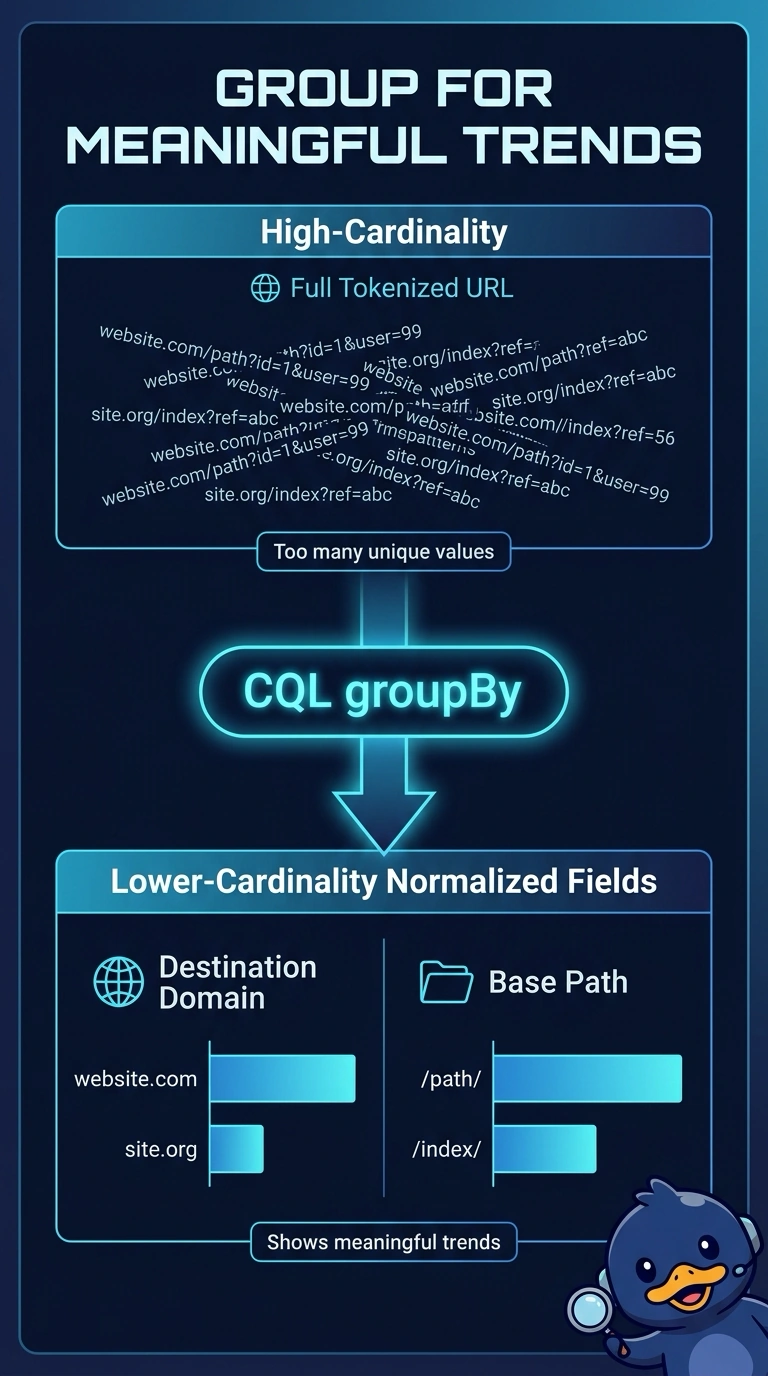
When you group on a unique session token, each request lands in its own bucket, so the count stays at one. Group by a shared, normalized field such as destination domain or base path to see repeated targets. A raw event list, a longer time window, or removing parsed fields won’t solve the high-cardinality problem.
Full Explanation
High-cardinality values such as per-request session tokens prevent events from collapsing into shared buckets, so group by a lower-cardinality normalized field such as destination domain or base path instead of the full tokenized URL. Grouping on a shared host or normalized URL path lets groupBy combine repeated requests to the same endpoint and reveal top targets. Switching to an unaggregated raw event list because groupBy cannot summarize proxy URLs abandons aggregation and leaves you reviewing individual log lines rather than trends. Expanding the time window from one day to ninety days does not make unique session tokens repeat; they remain distinct and the larger scan may add cost without improving the grouping. Removing CrowdStrike Parsing Standard fields and searching only unparsed raw logs discards structured fields that support clean grouping. Caveat: stripping query parameters can hide malicious payload strings, so pivot back to full URLs when investigating a suspect endpoint. Practical check: inspect a sample of the underlying raw URLs for the top grouped paths to confirm that they represent the same endpoint.
Prefer to study offline? Printable PDF study book + test engine ($7.50, unofficial). These questions stay free here.