
A school district SOC analyst writes a CQL query to correlate DHCP lease records with endpoint telemetry by hostname, but the query misses matches because DHCP logs record short hostnames while endpoint logs record fully qualified domain names. How should the analyst resolve this in CQL?
Select an answer to reveal the explanation.
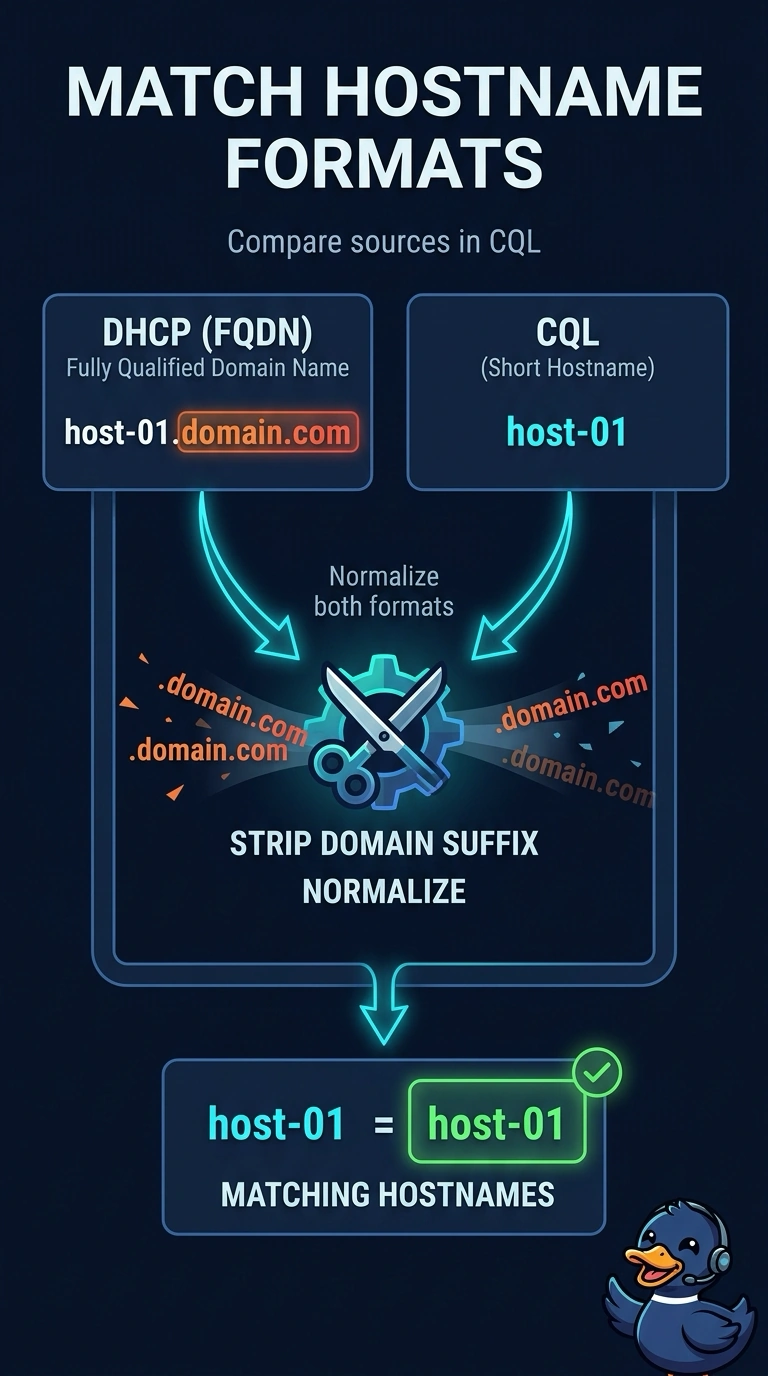
Short Explanation
You’ll get reliable matches by normalizing both hostname fields to the same format, such as removing the domain suffix. Widening the time window won’t fix a string-format mismatch, so you can focus on making the join keys comparable.
Full Explanation
Cross-source correlation succeeds only when join keys use compatible formats, so normalize the hostname fields or strip the domain suffix before matching DHCP and endpoint records. Disabling endpoint hostname logging to make both sources record only IP addresses removes useful host attribution and does not solve the problem of DHCP leases expiring and IP addresses being reassigned. Increasing the CQL query time range to ninety days may add latency and irrelevant historical noise, but it cannot make a short hostname equal a fully qualified domain name. Converting the CQL query into a third-party passthrough alert also does not fix the mismatch: passthrough alerts originate in external tools and do not change CQL join logic. Exam caveat: if multiple subdomains contain devices with identical short hostnames, stripping the suffix can create false matches; include another distinguishing field, such as subnet or IP, where appropriate. Practical check: test the transformation on a small sample of DHCP and endpoint events in CQL, confirming that both sources produce the same lowercase short hostname before running the full correlation.
Prefer to study offline? Printable PDF study book + test engine ($7.50, unofficial). These questions stay free here.