
A media company SOC analyst needs to search 90 days of proxy URLs in CQL using a complex regular expression to hunt for a newly reported phishing pattern. What is the most efficient way to validate the regex before running the full 90-day search?
Select an answer to reveal the explanation.
Short Explanation
Launching an untested regex across 90 days of proxy logs is like casting a giant fishing net before checking for holes—you waste time and still miss the catch. Test on a small slice first so your full query runs fast and clean.
Full Explanation
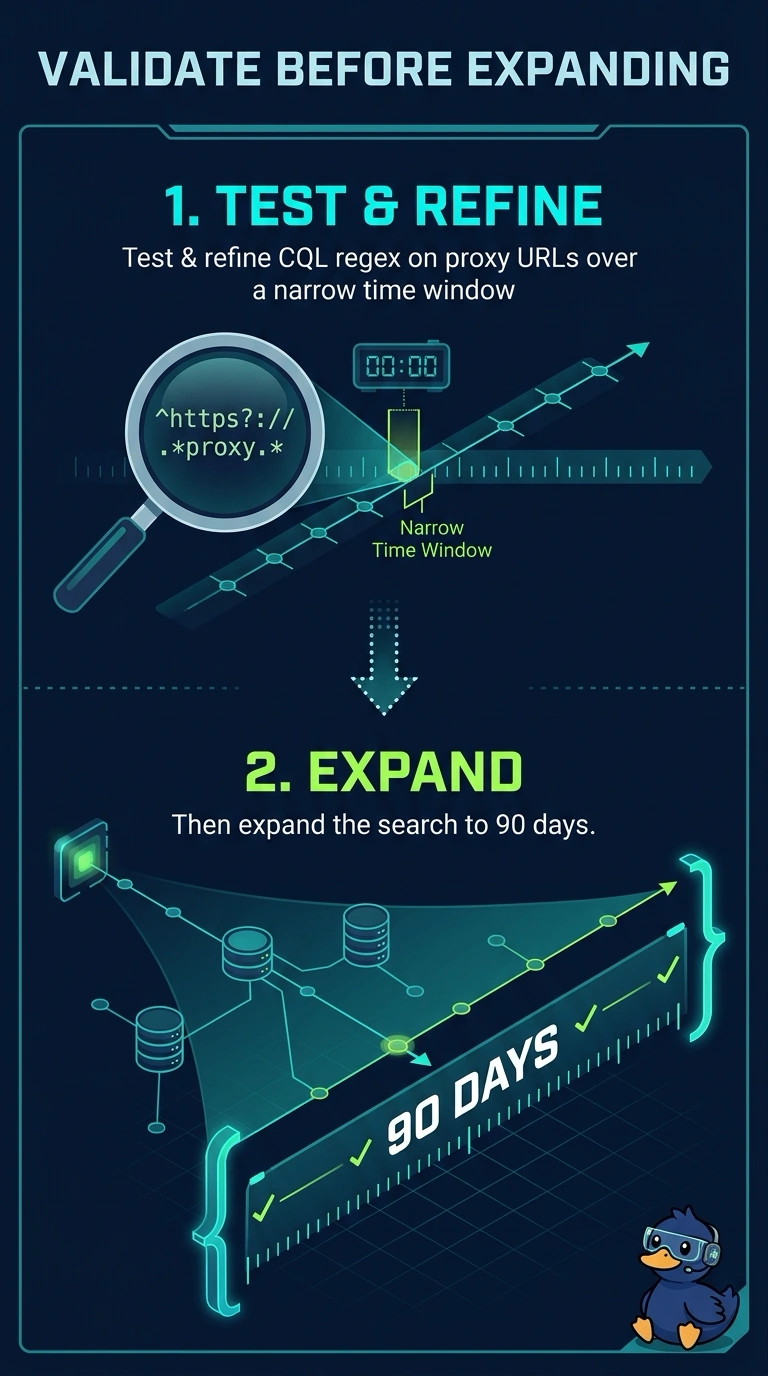
Complex regular expressions evaluated over months of high-volume proxy telemetry consume significant compute and often return noisy false matches if a quantifier or escape character is slightly off. Choosing to Test and refine the regex over a narrow time window before expanding to 90 days lets you verify syntax accuracy and inspect sample matches in seconds before committing to a full historical scan. Selecting Run the unverified regex across all 90 days and all log sources simultaneously maximizes query latency and risks hitting resource limits on unrelated datasets. Opting to Replace the regex with a broad leading wildcard across every parsed schema field degrades search performance even further and floods results with irrelevant URLs and text fields. Choosing to Create a live correlation rule first and wait 90 days to see if it triggers cannot resolve a retrospective threat-hunting question about past activity. As a caveat, ensure your short test window includes representative proxy URL traffic—or a known sample string—so you confirm the pattern actually matches. For an operational check, run the refined query on a one-hour or one-day slice, verify the matched URLs, and only then expand the time selector to 90 days.
Prefer to study offline? Printable PDF study book + test engine ($7.50, unofficial). These questions stay free here.