
A retail SOC analyst runs a CQL query over the past 24 hours and sees 18,000 failed authentication events, which is ten times the daily average. Before escalating a broad credential-stuffing attack, what should the analyst check in the query results?
Select an answer to reveal the explanation.
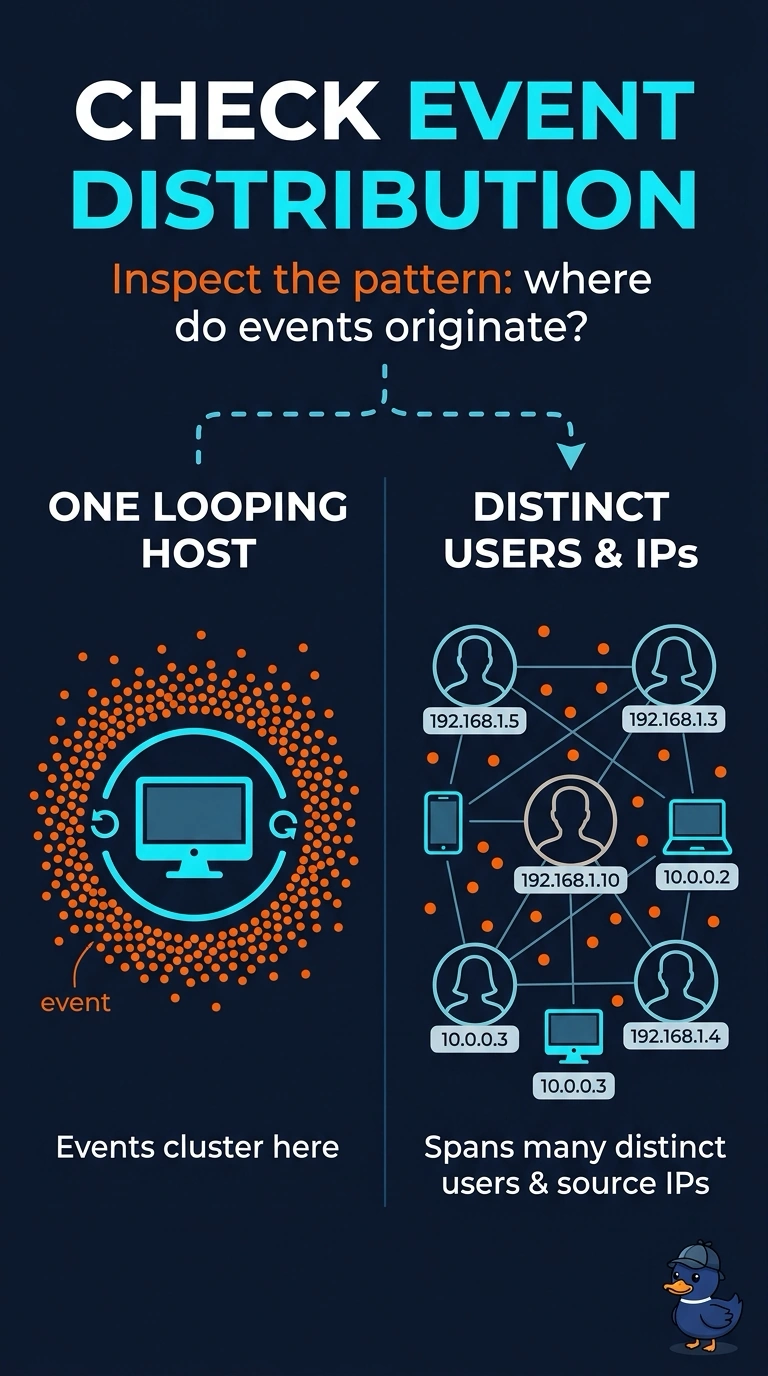
Short Explanation
A sudden spike in failed logins feels like an all-hands emergency, so you might want to sound the alarm right away. Here is the trap: one misconfigured service retrying every second can generate thousands of failures on its own. Always check whether the activity is spread across many accounts and sources before you escalate.
Full Explanation
Raw event volume alone cannot distinguish a broad attack from a localized retry loop, which is why checking whether the events come from one looping host or span many distinct users and source IPs is the right next step. By pairing total counts with distinct entity aggregations in CQL, an analyst can see immediately whether a single broken service account is responsible or if external attackers are targeting many identities across the environment. Checking whether a Falcon Fusion SOAR workflow automatically resolved similar authentication alerts last week does not explain the current 24-hour spike or measure its scope. Inspecting whether the CPS parser mapped the destination port field as a string instead of an integer is irrelevant because authentication event counts do not depend on port data types. Reviewing whether the browser timezone setting shifted the dashboard chart labels by several hours might move when a spike appears on a chart, but it cannot turn a normal day into an eighteen-thousand-event surge over a full 24-hour window. As an operational caveat, even a single-host loop can mask genuine probing happening at the same time, so filter out the noisy host after confirming it. As an operational check, run a CQL groupBy across source IP and username fields to verify entity cardinality before escalating.
Prefer to study offline? Printable PDF study book + test engine ($7.50, unofficial). These questions stay free here.