
A SaaS company SOC analyst uses CQL groupBy on destination domains sorted by highest connection count to spot anomalous outbound traffic, but misses a beaconing host making only a few connections per hour. Why did this approach miss the activity?
Select an answer to reveal the explanation.
Short Explanation
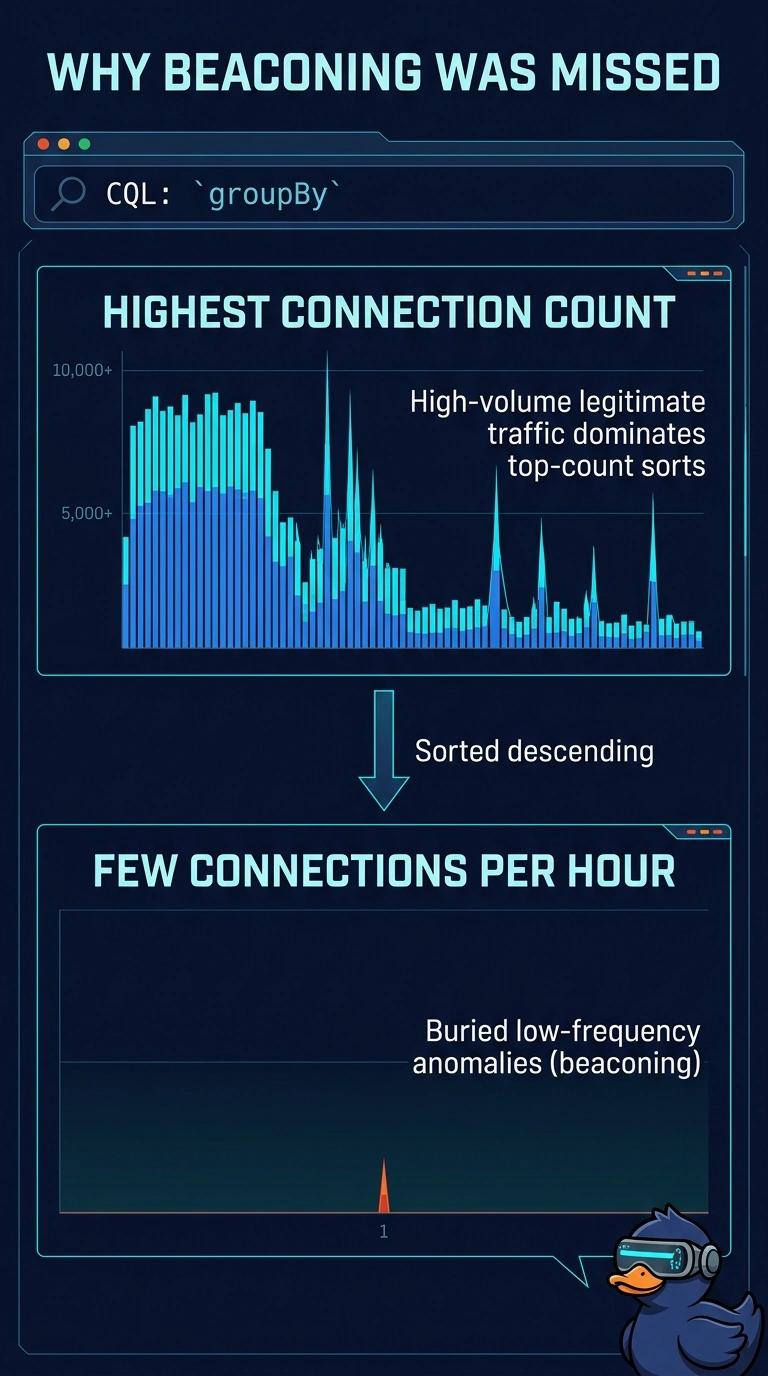
Sorting by highest count is a classic way to start hunting, and you can easily fall in love with those top-ten tables. Here is the trap: slow-and-low beaconing hides at the bottom of the list while noisy CDNs and SaaS traffic hog the spotlight. Flip your view or filter out known-good destinations to surface rare outliers.
Full Explanation
Aggregating by total volume naturally surfaces the loudest legitimate services first, which explains why high-volume legitimate traffic dominates top-count sorts and buries low-frequency anomalies. A stealthy beacon sending a handful of requests per hour cannot compete with thousands of routine updates and API calls at the top of a descending table. The claim that CQL groupBy automatically excludes any domain with fewer than one hundred matching events is false because aggregation summarizes all matching groups unless a filter or limit is applied. Saying that sorting by highest event count only displays third-party passthrough detections on the dashboard confuses raw event aggregation with alert-origin filtering. Asserting that CPS normalization strips low-frequency destination domains from outbound firewall telemetry is incorrect because normalization maps fields into a common schema without deleting rare values. As a caveat, reversing the sort order alone can flood results with one-off legitimate typos or transient lookups, so pair low-frequency sorting with domain age, rarity, or periodicity checks. As an operational check, exclude verified high-volume allowlisted domains in CQL or sort ascending on rare destination counts to inspect low-volume outbound connections.
Prefer to study offline? Printable PDF study book + test engine ($7.50, unofficial). These questions stay free here.