
A hospital SOC analyst sees a first-party endpoint detection for a suspicious script launch attempt on a radiology workstation. What should the analyst verify in the alert context before declaring the workstation compromised?
Select an answer to reveal the explanation.
Short Explanation
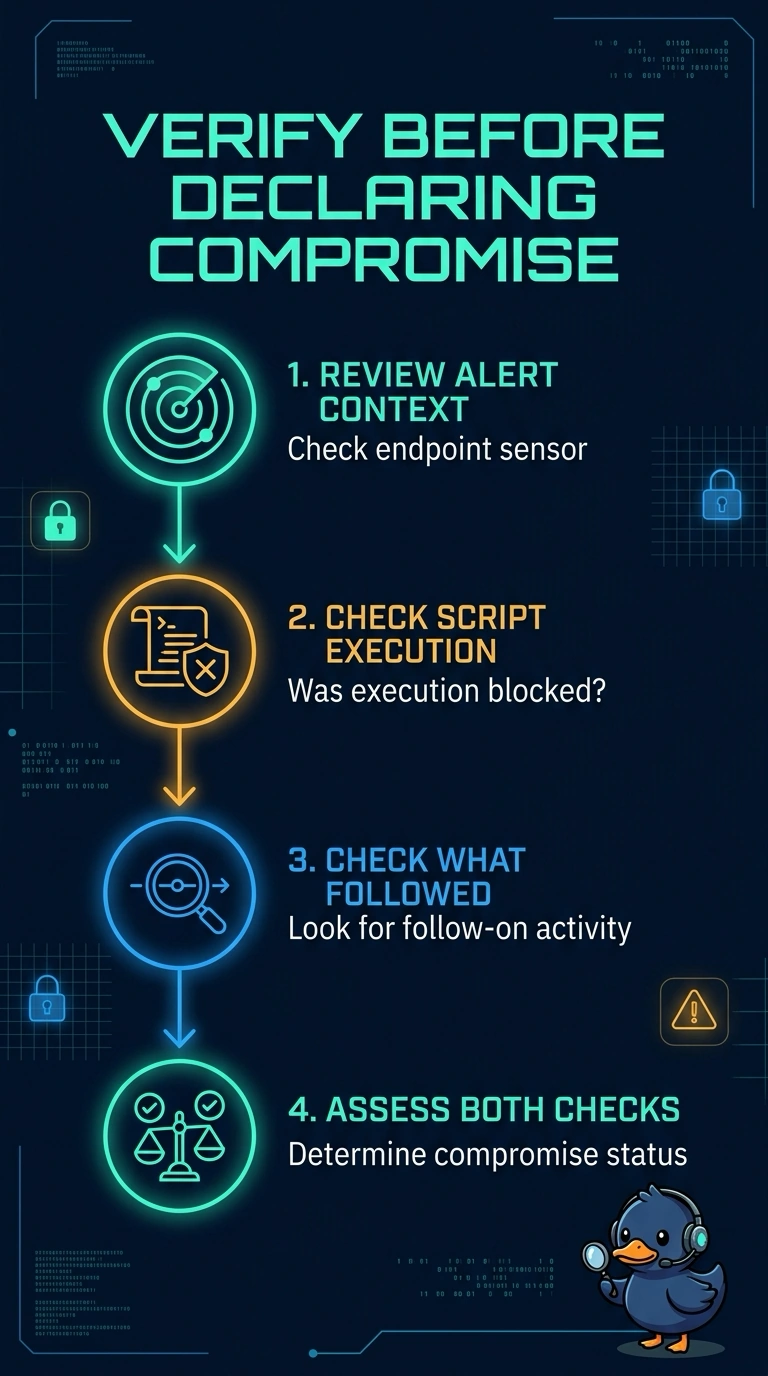
Seeing an alarm bell does not automatically mean the burglar got inside the building. Before you declare a clinical workstation compromised, check whether the sensor stopped the attempt at the door.
Full Explanation
An endpoint detection can fire on a prevented execution attempt, so the analyst must check "Whether the endpoint sensor blocked the script execution and whether any follow-on activity occurred" before escalating a full compromise. Confirming the prevention status alongside child processes, file writes, and outbound connections separates a stopped attempt from an active intrusion. Checking "Whether the radiology workstation's local Windows event logs were cleared during the previous shift" is useful if log tampering is suspected, but it does not answer whether the detected script actually ran. Verifying "Whether the script filename matches a known MITRE ATT&CK execution technique in public documentation" only describes adversary behavior categories and never proves execution succeeded. Waiting to see "Whether a third-party firewall passthrough alert also recorded the same workstation hostname" misses host-level prevention details and delays triage if no external traffic occurred. As a caveat, even a blocked script warrants checking how the file arrived on disk so the delivery vector is addressed. Operationally, review the alert's action disposition and run a brief host-scoped CQL search around the timestamp for subsequent process or network events.
Prefer to study offline? Printable PDF study book + test engine ($7.50, unofficial). These questions stay free here.