
A financial firm SOC analyst suspects an employee fell victim to an MFA fatigue attack after seeing a late-night cloud login from an unfamiliar IP address. Which investigation step best confirms this adversary behavior?
Select an answer to reveal the explanation.
Short Explanation
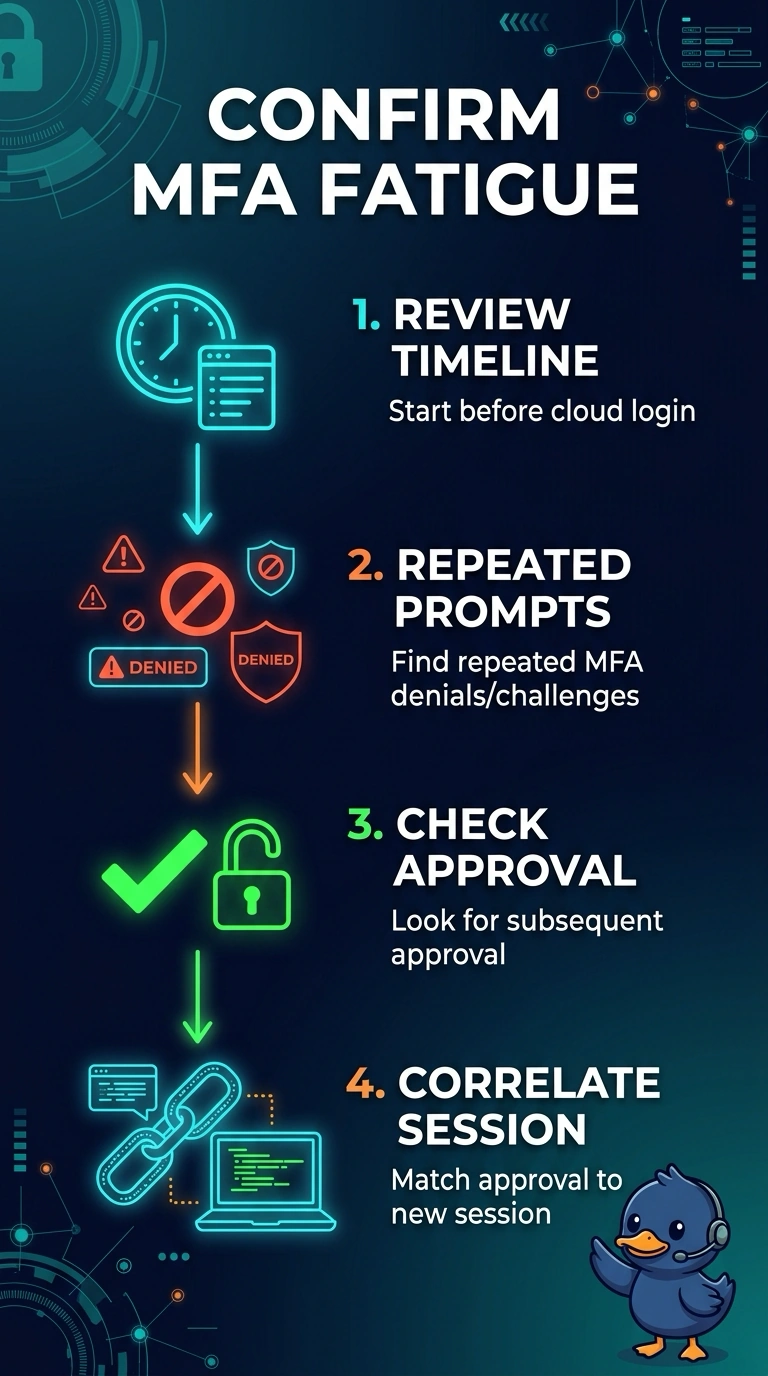
An MFA fatigue attack is like someone repeatedly ringing your doorbell until you open it just to stop the noise. To confirm it, trace the sequence of repeated MFA denials or challenges leading to approval and session creation. Looking only at the final successful login or reimaging the laptop first won’t establish that behavior.
Full Explanation
Adversaries using MFA fatigue rely on stolen credentials to generate a rapid burst of authentication prompts, hoping you approve one out of confusion or frustration. Correlating preceding repeated MFA denials or challenges with the subsequent approval and session creation establishes the behavioral sequence that distinguishes prompt bombing from a routine login. Inspecting only the final successful authentication event and its assigned severity score misses the preceding failed challenges that may reveal coercion. Triggering an immediate endpoint reimage on the employee’s corporate laptop first may destroy local context without confirming whether the cloud session was unauthorized or even involved that laptop. Searching firewall logs solely for outbound port scans originating from the branch office examines unrelated network activity instead of cloud identity telemetry. Exam caveat: a user traveling or experiencing mobile connectivity issues may also retry MFA several times, so the source IP, device posture, and user confirmation still matter. Practical check: build a chronological CQL timeline of the user’s identity events covering at least an hour before and after the suspicious approval.
Prefer to study offline? Printable PDF study book + test engine ($7.50, unofficial). These questions stay free here.