
A healthcare SOC analyst sees a high-priority alert for a physician's cloud identity login originating from an unfamiliar overseas IP address ten minutes after a badge swipe at the main hospital. What should the analyst verify next to determine whether this is a confirmed account takeover?
Select an answer to reveal the explanation.
Short Explanation
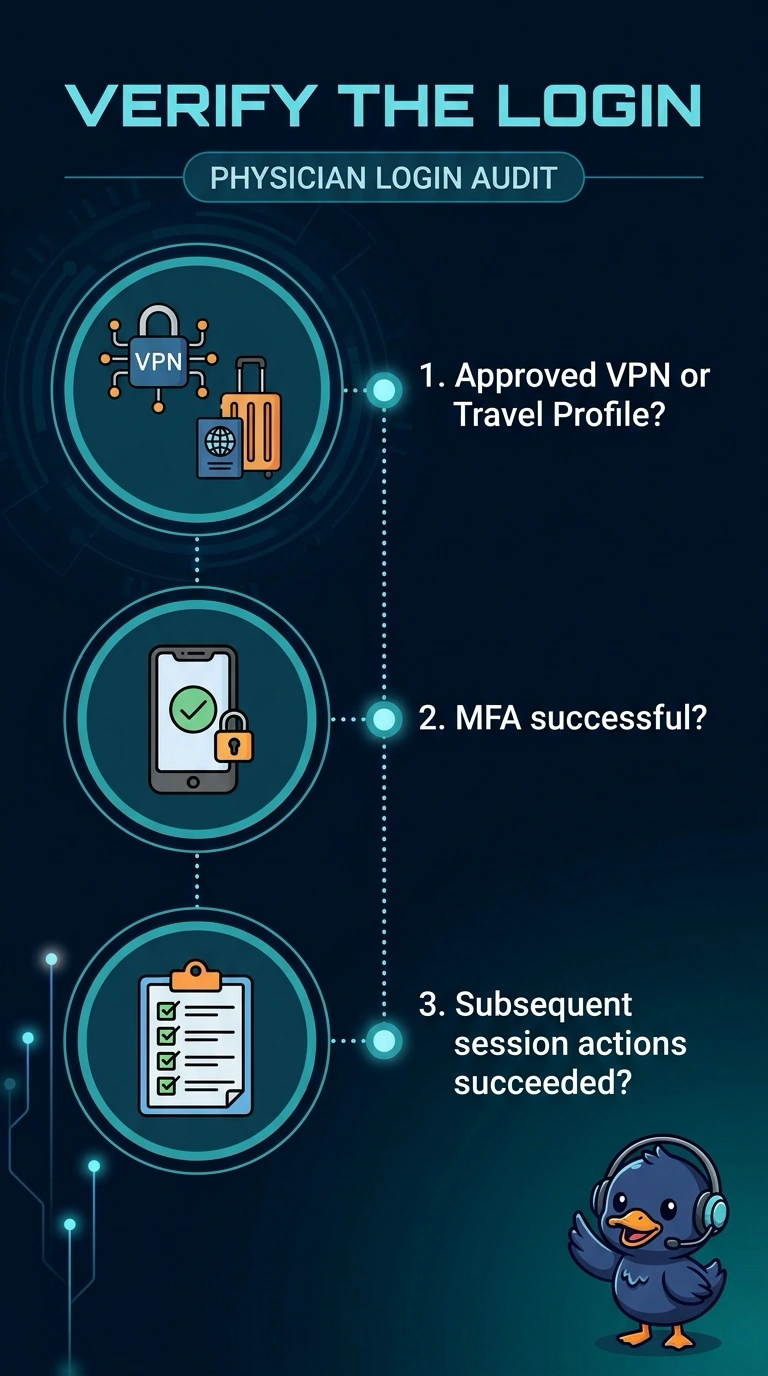
Seeing a login from overseas right after a local badge swipe feels like catching someone in two places at once, but commercial VPNs and mobile carriers can teleport your apparent IP address in seconds. Before you lock out a clinician mid-shift, check the full authentication story and what happened after the sign-in. The trap is treating an impossible-travel alert as automatic proof of compromise without checking MFA and session context.
Full Explanation
Geolocation discrepancies frequently stem from commercial VPN egress nodes, mobile roaming, or split-tunnel routing rather than stolen credentials. Checking "Whether the physician used an approved VPN or travel profile, and whether MFA and subsequent session actions succeeded" establishes whether the sign-in was authorized and whether the actor actually gained an active session to access clinical resources. Conversely, "Whether the hospital's public DNS resolver cached the overseas IP address during routine maintenance" is irrelevant because DNS caching does not alter the source IP recorded in an identity provider's authentication log. Similarly, "Whether the physician's workstation has an active Falcon Fusion SOAR workflow scheduled for patching" does not explain a cloud identity sign-in from an external IP address. Finally, "Whether the third-party passthrough alert includes a MITRE ATT&CK Initial Access tactic mapping" provides only a framework label, which never proves malicious intent on its own. As a caveat, even if MFA was prompted, an attacker using credential stuffing or MFA fatigue could still succeed if the user approved the prompt by mistake. Operational check: query cloud identity logs in CQL for the session's MFA method, device posture, and post-login actions, and confirm with the user or IT help desk if needed.
Prefer to study offline? Printable PDF study book + test engine ($7.50, unofficial). These questions stay free here.