
A university SOC analyst sees an alert for a legitimate remote-support tool launching on a finance staff workstation at 9:30 PM. What should the analyst check before escalating the activity as unauthorized remote access?
Select an answer to reveal the explanation.
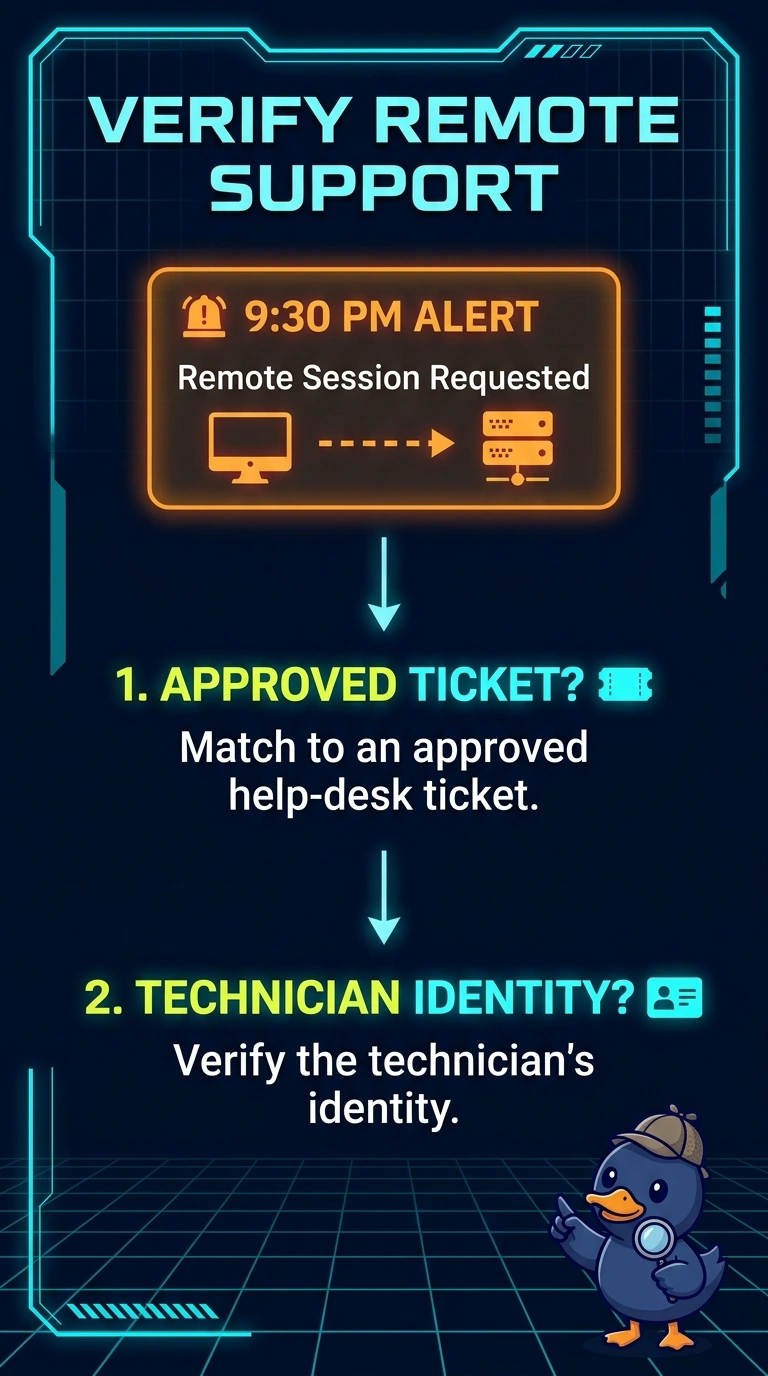
Short Explanation
Seeing a locksmith at your front door at night is alarming until you remember you called for emergency service. Always check support tickets and technician identity before treating a legitimate remote tool as an intrusion, or conversely assuming it is safe.
Full Explanation
Adversaries frequently abuse legitimate remote-monitoring tools, while IT staff also work after hours, making Verify whether the session matches an approved help-desk ticket and technician identity the essential check to separate authorized support from unauthorized access. Choosing Assume any remote-support session occurring after 5:00 PM is confirmed adversary activity ignores legitimate evening support and causes unnecessary disruption. Selecting Isolate the finance workstation immediately without checking support or authentication logs risks interrupting valid work before verifying whether an intrusion occurred. Choosing Close the alert as benign solely because the remote-support binary has a valid signature falls for living-off-the-land abuse, because attackers often use legitimately signed tools. Keep in mind that even with a ticket, the initiating account, source IP, and follow-on commands should align with the documented support request. As an operational check, corroborate the help-desk ticket timestamp and assigned technician with VPN, SSO, and endpoint process logs.
Prefer to study offline? Printable PDF study book + test engine ($7.50, unofficial). These questions stay free here.