
A manufacturing plant SOC receives a first-party Falcon endpoint detection flagging a legitimately signed system administration binary for credential-access behavior. Why should the analyst inspect the command line and parent process before closing the alert?
Select an answer to reveal the explanation.
Short Explanation
Just because a tool wears an official badge doesn't mean you can wave it past the security desk! The trap here is dismissing a behavioral alert based on a valid signature, forgetting that attackers love abusing built-in admin tools.
Full Explanation
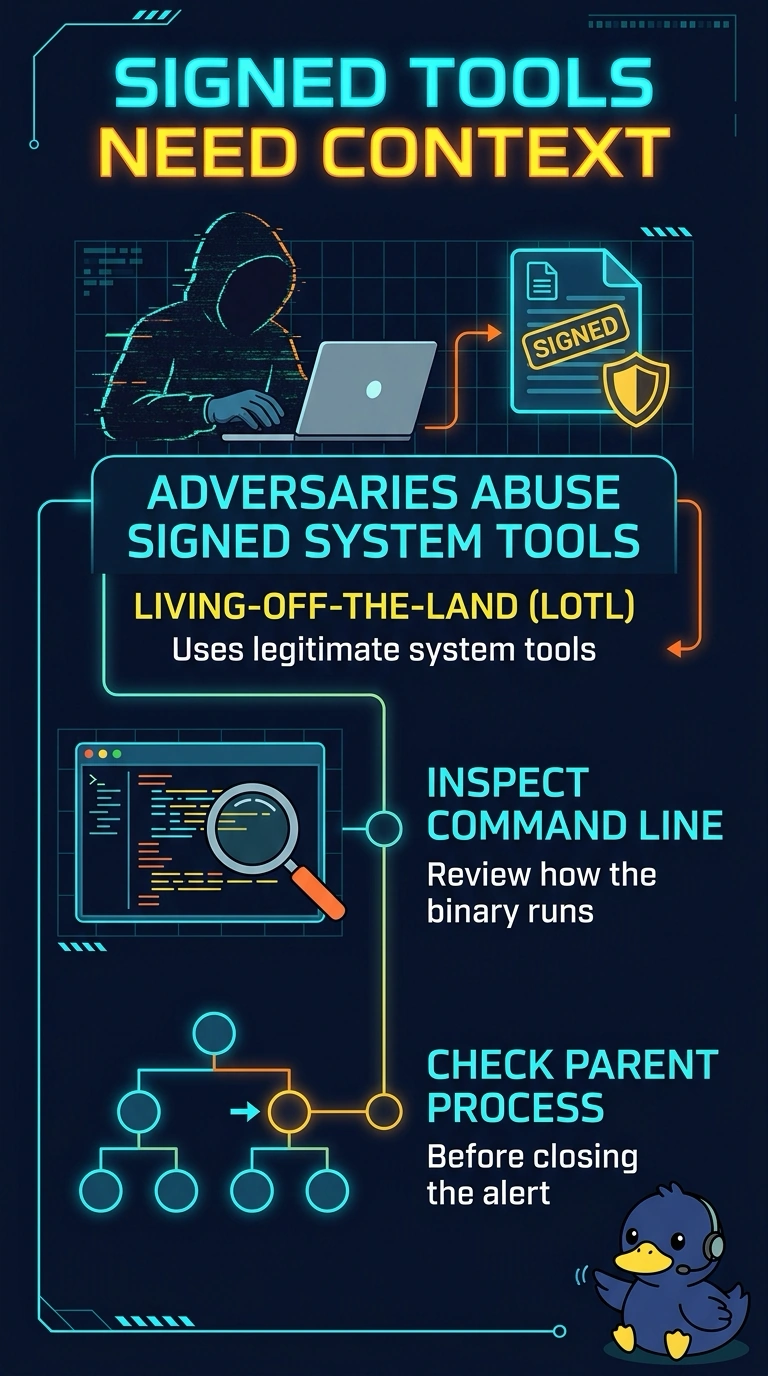
Adversaries abuse signed system tools for living-off-the-land attacks explains why behavioral detections on legitimate binaries require careful context review: attackers routinely invoke built-in utilities with suspicious arguments to harvest credentials while blending into normal administration. Inspecting the command line, user session, and parent process reveals whether the execution was authorized maintenance or malicious misuse. Signed binaries can never trigger false positives in first-party endpoint detections is false, because legitimate IT automation can still resemble suspicious behavior and trigger behavioral rules. A valid digital signature guarantees that the binary was run by an authorized admin is a dangerous misconception, as code signing verifies file integrity and publisher identity rather than who invoked the program. First-party behavioral detections only fire after an attacker disables code signing is inaccurate because behavioral engines monitor runtime actions regardless of signature status. As an exam caveat, never treat a valid publisher signature or file reputation alone as proof that an execution is benign. As an operational check, pivot to the parent process lineage and verify the initiating user's change ticket before resolving the detection.
Prefer to study offline? Printable PDF study book + test engine ($7.50, unofficial). These questions stay free here.