
A logistics SOC analyst adds several service accounts to an exclusion list in a correlation rule that detects unusual scheduled-task creation. What should the analyst verify in the SIEM before finalizing the updated rule?
Select an answer to reveal the explanation.
Short Explanation
Tuning out noisy service accounts is like adjusting a smoke detector near a kitchen—you want fewer false alarms without turning off the sensor for real fires. You must test both benign and malicious cases, and the trap is assuming an exclusion that silences noise is automatically safe.
Full Explanation
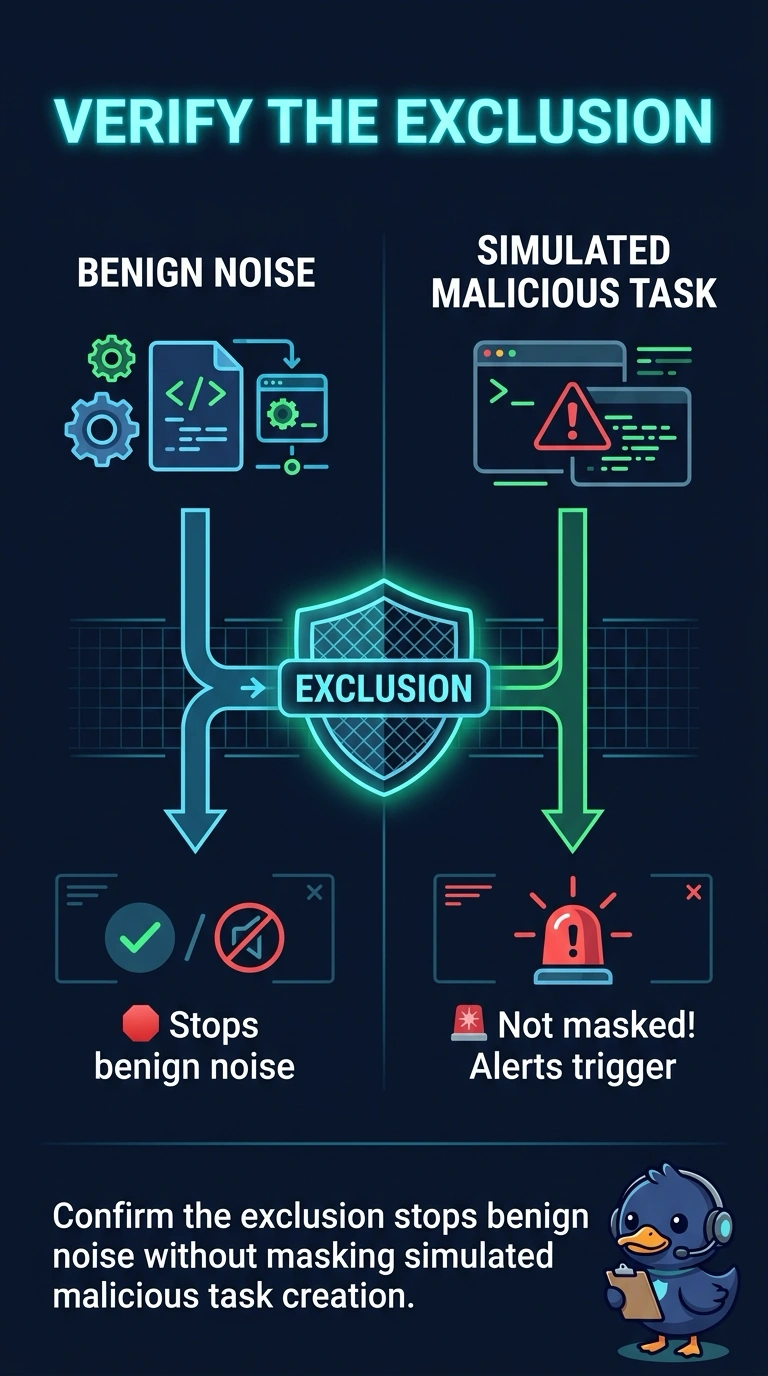
Before saving a correlation-rule exclusion, the analyst must "Confirm the exclusion stops benign noise without masking simulated malicious task creation" because overly broad account exclusions can let an attacker abuse those same service accounts undetected. Choosing to "Verify that the correlation rule now assigns a critical severity to every remaining scheduled-task alert" is unrelated to tuning accuracy and can flood analysts with inflated priorities. Trying to "Confirm that all third-party passthrough detections from the firewall are also suppressed by the rule" misunderstands detection origins, since SIEM correlation rules do not suppress upstream third-party passthrough alerts. Expecting to "Check that historical closed cases automatically reopen to reflect the updated exclusion filter" is incorrect because rule edits affect future evaluations rather than retroactively reopening closed cases. Caveat: if a service account is excluded by name alone, pair the exclusion with expected parent processes or binary paths so hijacked service-account activity still triggers an alert. Operational check: run the updated correlation query against historical data containing both routine service-account tasks and a controlled red-team task-creation event to verify expected filtering.
Prefer to study offline? Printable PDF study book + test engine ($7.50, unofficial). These questions stay free here.