
A retail SOC sees frequent false-positive alerts from a rule that fires whenever any user has five failed VPN logins in ten minutes. How can the team make this detection more accurate without missing real account takeovers?
Select an answer to reveal the explanation.
Short Explanation
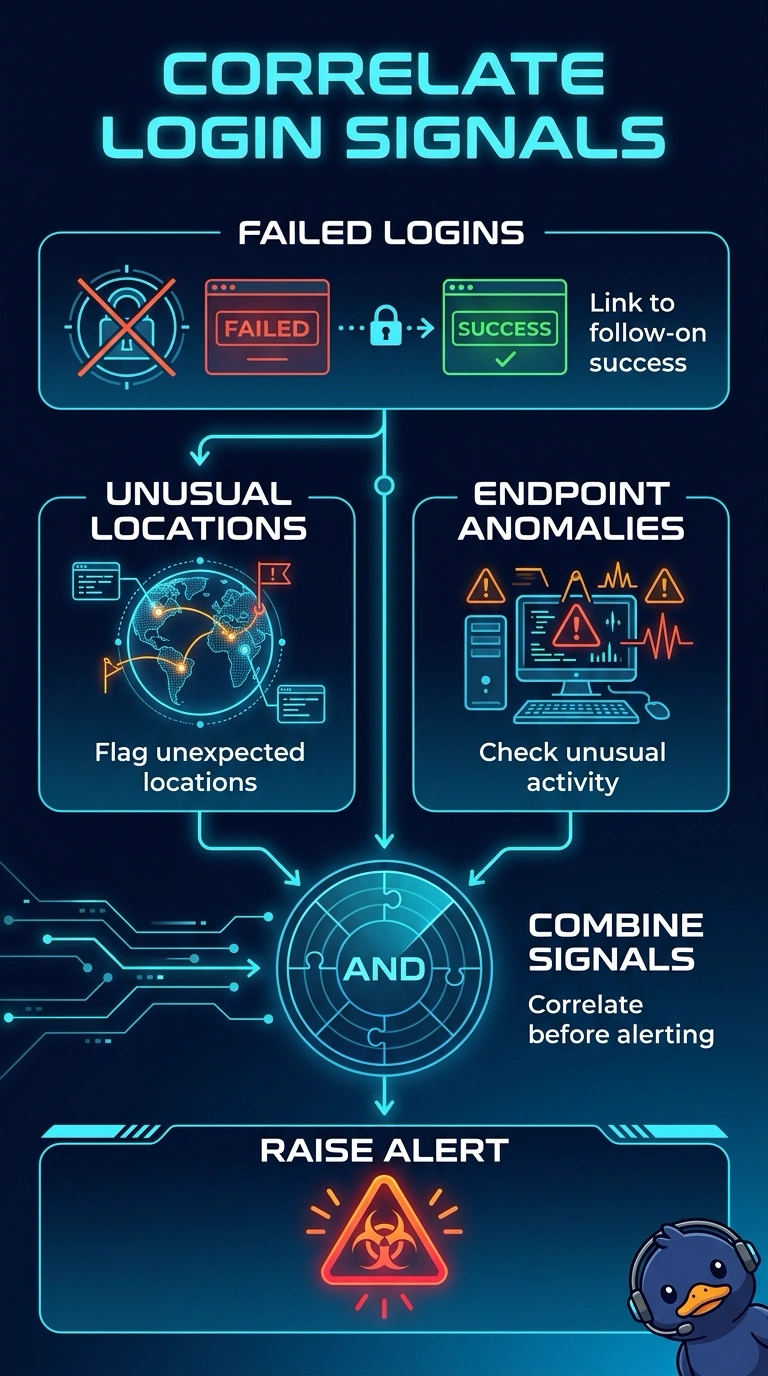
Everyone mistypes a password now and then, so a pure failed-login counter will bury your analysts in false alarms. The trap is trying to fix noisy logic by auto-closing alerts or breaking parsing. Correlate those failures with a follow-on success or risky context so real takeovers stand out cleanly.
Full Explanation
Multi-condition correlation dramatically improves signal-to-noise ratio over single-threshold rules, which is why the team should correlate failed logins with follow-on success, unusual locations, or endpoint anomalies. Mistyped passwords from a known corporate laptop rarely lead to an immediate sign-in from an unfamiliar IP or unusual post-login endpoint activity, whereas real credential attacks show those linked behaviors. Choosing to increase the Falcon Fusion SOAR timeout value so failed login alerts close automatically masks potential brute-force attempts without improving the underlying detection logic. Opting to switch all VPN logs to unparsed raw storage so CPS normalization does not count retries destroys structured querying and cross-source correlation across the SIEM. Deciding to change the rule severity from medium to critical so analysts review every retry immediately worsens alert fatigue instead of filtering out benign user mistakes. As a caveat, retain separate visibility for sustained high-volume password spraying that never succeeds, because failed attempts across many accounts still indicate active targeting. As an operational check, validate the updated correlation rule against historical incident and benign login datasets in CQL before enabling it in production.
Prefer to study offline? Printable PDF study book + test engine ($7.50, unofficial). These questions stay free here.