
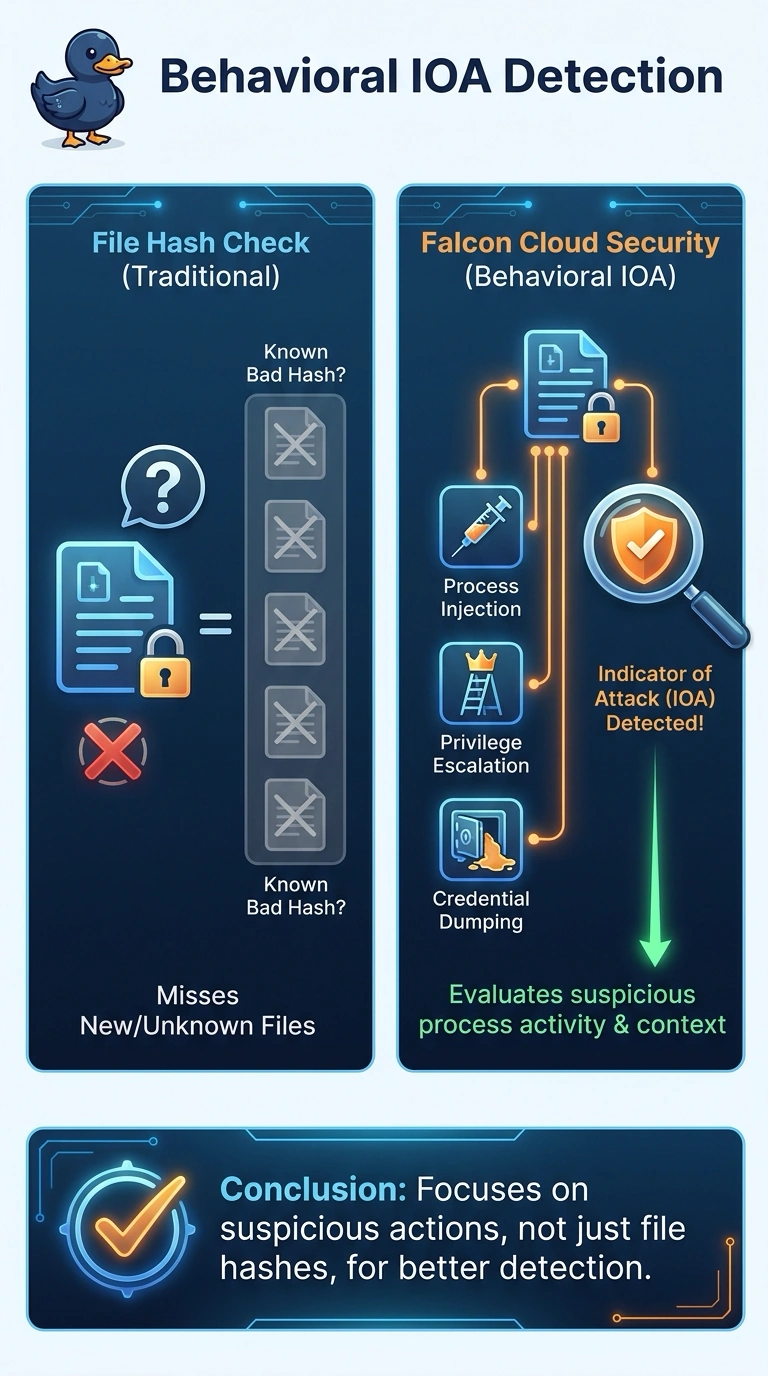
During a manufacturing SOC investigation, Falcon Cloud Security raises a runtime Indicator of Attack (IOA) alert when a database container process spawns an unexpected network listener using a built-in operating system utility. Why is behavioral IOA detection effective in this scenario even though no custom malware binary was introduced?
Select an answer to reveal the explanation.
Short Explanation
A chef's knife is a normal kitchen tool until someone carries it into a bank vault. In the same way, you rely on behavioral Indicators of Attack to catch legitimate system utilities behaving suspiciously inside a running container. The trap is thinking attackers always drop custom malware files that signature or hash checks can match.
Full Explanation
Behavioral IOAs evaluate suspicious process activity and execution context rather than relying solely on known malware file hashes. When a database container process unexpectedly launches a shell or network listener, the parent-child relationship and runtime actions signal potential abuse even if the binary itself is a standard operating system tool. Behavioral IOAs only trigger when a container downloads a previously cataloged malicious binary that matches an external threat-intelligence file hash. fails because hash-based matching misses living-off-the-land techniques that reuse built-in utilities. Behavioral IOAs require an in-container sidecar proxy to inspect every packet payload before flagging unusual process activity. fails because the node-level Falcon sensor observes container process and network behavior directly without requiring per-pod sidecar proxies. Behavioral IOAs only evaluate static container image layers during registry ingestion and cannot observe active runtime processes. fails because static image scanning happens pre-runtime, whereas IOAs monitor live execution. As a caveat, legitimate administrative or diagnostic scripts can occasionally resemble suspicious behavior if poorly scoped. For an operational check, inspect the detection's process tree, command-line arguments, and container metadata to confirm whether the activity is unauthorized.
Prefer to study offline? Printable PDF study book + test engine ($7.50, unofficial). These questions stay free here.