
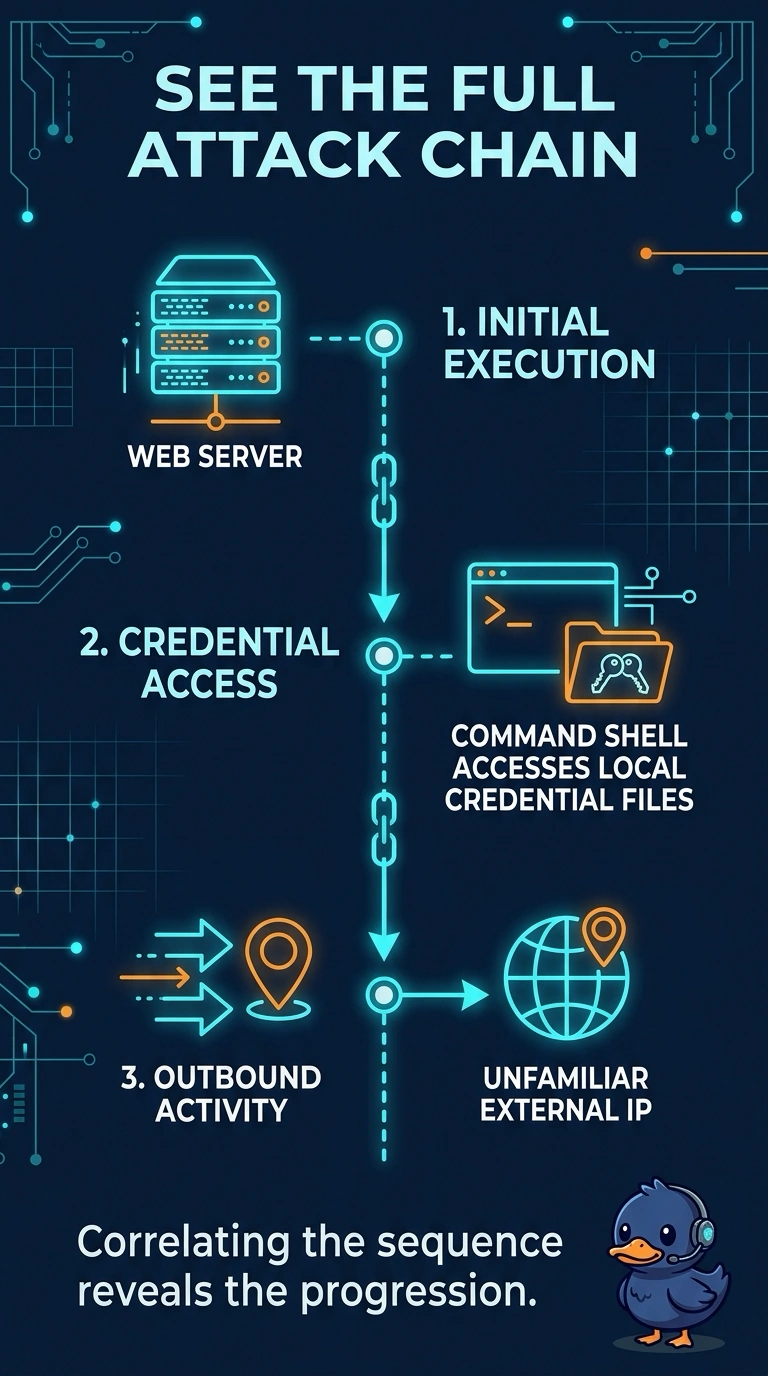
During a hospital SOC investigation, an analyst sees three runtime Indicators of Attack (IOAs) fire within minutes on a cloud virtual machine: a web server spawning a command shell, an attempt to read local credential files, and an outbound connection to an unfamiliar external IP. Why should the analyst correlate these events as a sequence rather than triaging each alert separately?
Select an answer to reveal the explanation.
Short Explanation
A single footprint near a window might be nothing, but footprints leading to an open safe and out the back door tell a clear story. When you correlate sequential runtime alerts, you see how an attacker moved from initial execution toward data theft. The trap is handling each alert in a silo and missing the bigger picture.
Full Explanation
Correlating the sequence reveals the progression from initial execution to credential access and outbound activity, clarifying the full attack chain. Linking the web-server child shell to subsequent credential discovery and external network traffic confirms active post-exploitation rather than an isolated anomaly, helping responders prioritize containment. Treating each runtime event as an unrelated static misconfiguration allows the SOC to close the alerts automatically after the next scheduled posture scan. fails because runtime IOAs represent active behavioral threats that posture configuration scans do not resolve. Waiting for a weekly scheduled compliance report to summarize all three events ensures no action is taken until the next audit cycle. fails because active intrusions require immediate triage rather than periodic compliance reporting. Disabling the earlier execution IOA rule reduces alert volume so only the final outbound network event appears in the SOC queue. fails because suppressing early-stage execution signals removes critical root-cause context needed to stop the intrusion. As a caveat, rapid automated administrative scripts can occasionally mimic multi-step sequences if unverified. For a concrete operational check, inspect the shared parent process lineage, host timeline, and destination IP reputation in Falcon Cloud Security to confirm the full scope of compromise.
Prefer to study offline? Printable PDF study book + test engine ($7.50, unofficial). These questions stay free here.