
A retail cloud security team repeatedly finds that newly created S3 buckets violate the company's required customer-managed SSE-KMS default by falling back to SSE-S3 and wants Falcon Cloud Security to automatically apply the required encryption setting as soon as the misconfiguration is detected. Which capability should the team configure?
Select an answer to reveal the explanation.
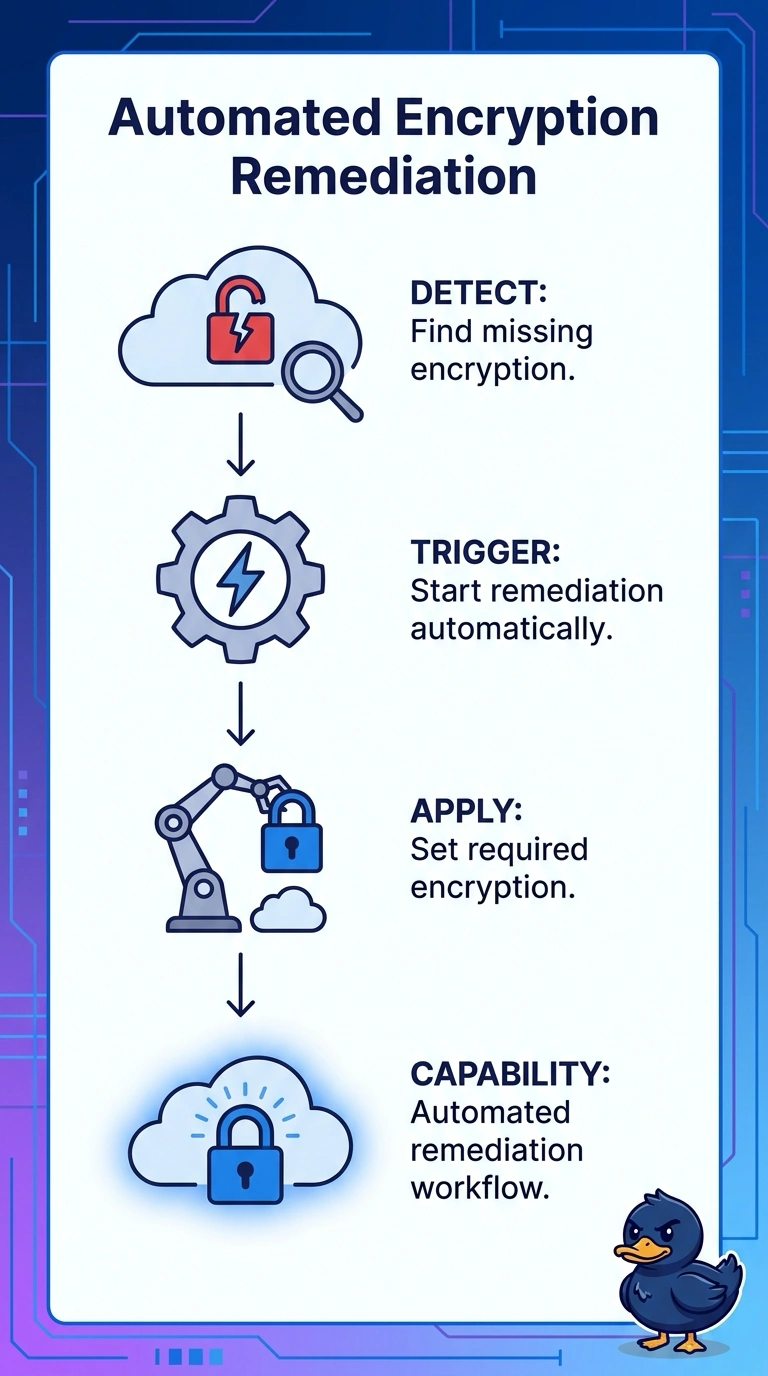
Short Explanation
You catch S3 buckets slipping to SSE-S3 and you want them corrected back to your required customer-managed SSE-KMS default without manual tickets. Don't pick a reporting or container-governance tool that can't change storage settings. Use an automated remediation workflow so you fix recurring drift automatically, knowing repair is asynchronous and can't guarantee repair before the first write.
Full Explanation
An automated remediation workflow resolves recurring cloud configuration drift by pairing continuous posture detection with an automated action playbook that invokes cloud provider APIs to correct S3 buckets that violate the company's required customer-managed SSE-KMS default by falling back to SSE-S3. Automate an approved idempotent KMS-default correction using the workflow's action identity and tested key access. Detection/execution is asynchronous and does not guarantee repair before the first write; provider guardrails are needed for preventive enforcement. Defaults do not retroactively re-encrypt old objects. A scheduled compliance summary report only packages posture status into periodic deliverables for stakeholders and cannot modify live storage resources. A pre-runtime registry scan exclusion rule suppresses vulnerability or secret checks on selected container images before deployment, which has no effect on cloud object storage configuration. A Kubernetes admission control block rule evaluates pod specifications and image compliance before scheduling workloads inside a cluster, so it cannot remediate standalone storage buckets created outside Kubernetes. As a scope caveat, automated remediation requires appropriate write permissions and should be scoped carefully. As an operational check, test the workflow against a non-production bucket using SSE-S3, confirm the finding triggers the playbook, and verify the KMS default is applied.
Prefer to study offline? Printable PDF study book + test engine ($7.50, unofficial). These questions stay free here.