
A manufacturing DevSecOps team runs Falcon Cloud Security pre-runtime image assessment during an intermediate CI/CD build step, yet production pods later show unexpected vulnerable libraries that were absent from the CI scan report. What is the most likely cause?
Select an answer to reveal the explanation.
Short Explanation
Inspecting a cake before you add the frosting misses whatever goes on top afterward. The trap is assuming an intermediate pipeline scan covers the final production image when later build steps still modify the artifact.
Full Explanation
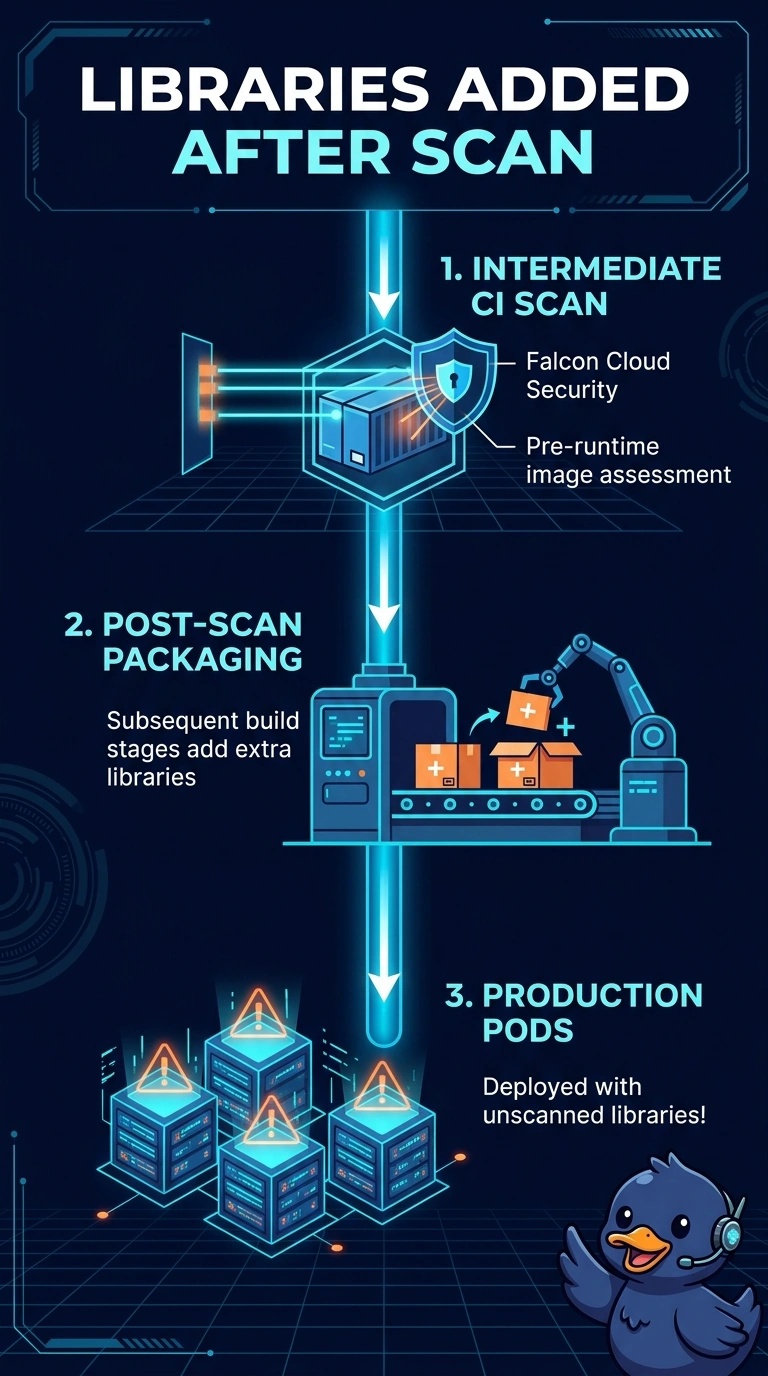
Pre-runtime image assessment evaluates only the exact image layers present at the moment the scan executes, so the discrepancy occurs when Subsequent build stages or post-scan packaging steps added extra libraries after the intermediate CI scan ran. If a pipeline scans an intermediate image and then runs another build step or pushes a different final digest, the production image contains unassessed packages. By contrast, Pre-runtime image assessment ignores all third-party libraries unless a runtime sensor is attached is false because static image assessment inspects both OS packages and application dependencies without a running sensor. Similarly, The Kubernetes scheduler injects application dependencies into container images after registry pull is wrong because Kubernetes pulls and runs the packaged image rather than installing application libraries. Finally, CI/CD image scans only evaluate cloud IAM roles rather than packages inside container layers confuses image assessment with cloud posture auditing. As a caveat, pairing final-stage CI scans with continuous registry assessment ensures the exact pushed digest is evaluated. For an operational check, compare the image digest scanned in CI against the digest actually deployed in the production pod specification.
Prefer to study offline? Printable PDF study book + test engine ($7.50, unofficial). These questions stay free here.