
A distributed enterprise software team patches a critical OS library in its shared internal base container image, and Falcon Cloud Security pre-runtime assessment confirms the base image is now clean. However, existing downstream microservice images stored in the private registry still show the same critical package finding. Why do those downstream images still report the vulnerability?
Select an answer to reveal the explanation.
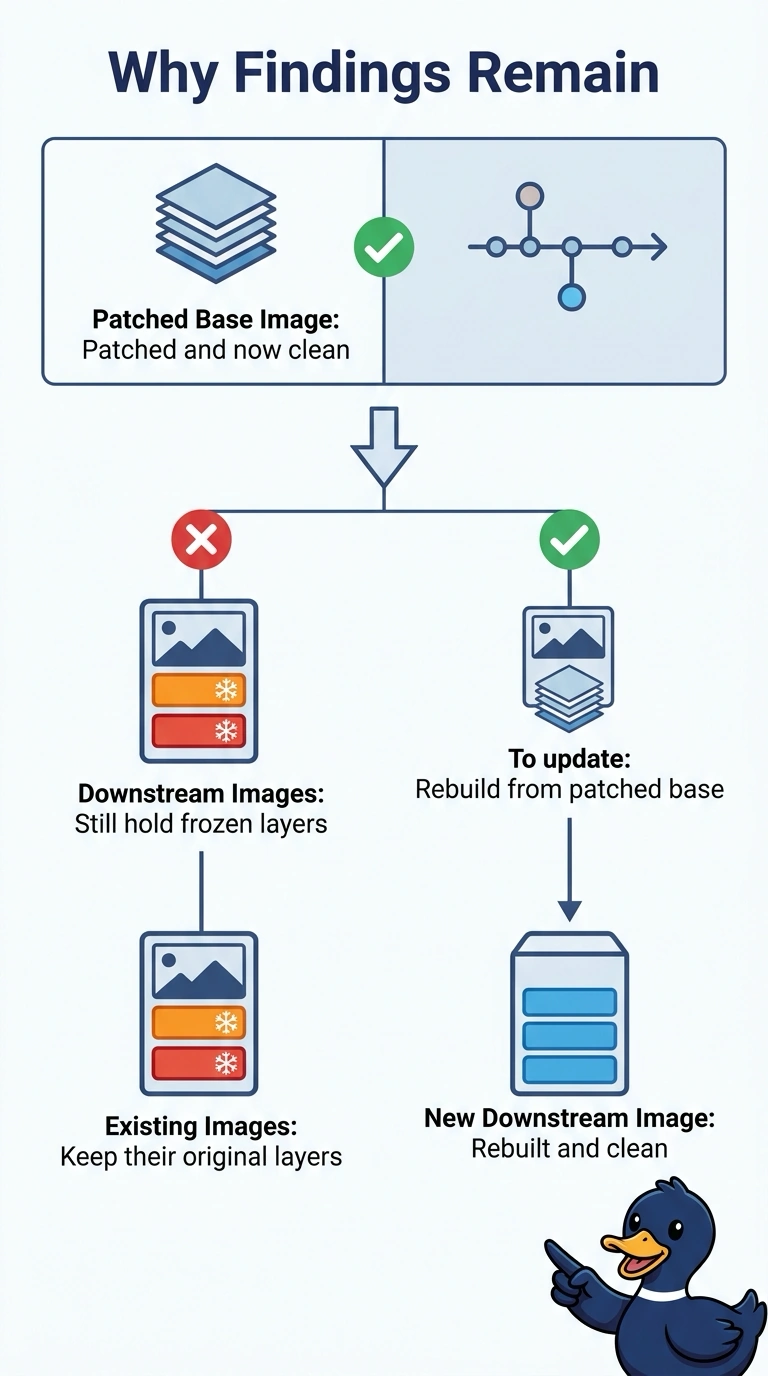
Short Explanation
Think of a container image like a baked cake—changing the recipe card later does not alter the cakes already sitting on the shelf. Because each downstream image freezes its base layers at build time, you must rebuild those microservice images from the patched base image to clear their findings. The common trap is assuming a registry automatically propagates base-image updates into derived images.
Full Explanation
Each downstream image retains its original frozen layers until it is rebuilt from the patched base image because container builds snapshot the filesystem layers of the parent image at build time. Patching and pushing a new base image updates only that base image in the registry, leaving previously built application images with the older vulnerable library inside their own stored layers. The belief that Container registries only refresh package vulnerability findings for downstream images after a running pod pulls them is wrong because registry-based pre-runtime assessment evaluates stored images independently of cluster pulls. Similarly, assuming Pre-runtime image assessment caches old scan results permanently and never re-evaluates images stored in a registry misses that Falcon Cloud Security continuously re-evaluates stored images as new vulnerability intelligence arrives, but re-evaluation accurately still sees the unpatched package in unchanged layers. The idea that Derived microservice images inherit base-image patches automatically only when they share the exact same mutable tag is also false because tags are just pointers and cannot rewrite another image's immutable layers. Caveat: even after rebuilding and pushing the downstream images, running containers will remain vulnerable until updated deployments replace them. Operational check: trigger a CI/CD rebuild of the downstream microservice images against the patched base image digest, push them, and verify in Falcon Cloud Security that the critical package finding clears.
Prefer to study offline? Printable PDF study book + test engine ($7.50, unofficial). These questions stay free here.