
A software DevSecOps team runs pre-runtime image assessment on a microservice container image that receives database credentials at startup from a Kubernetes Secret rather than storing them in the Dockerfile. Why does the image scan report zero embedded secrets?
Select an answer to reveal the explanation.
Short Explanation
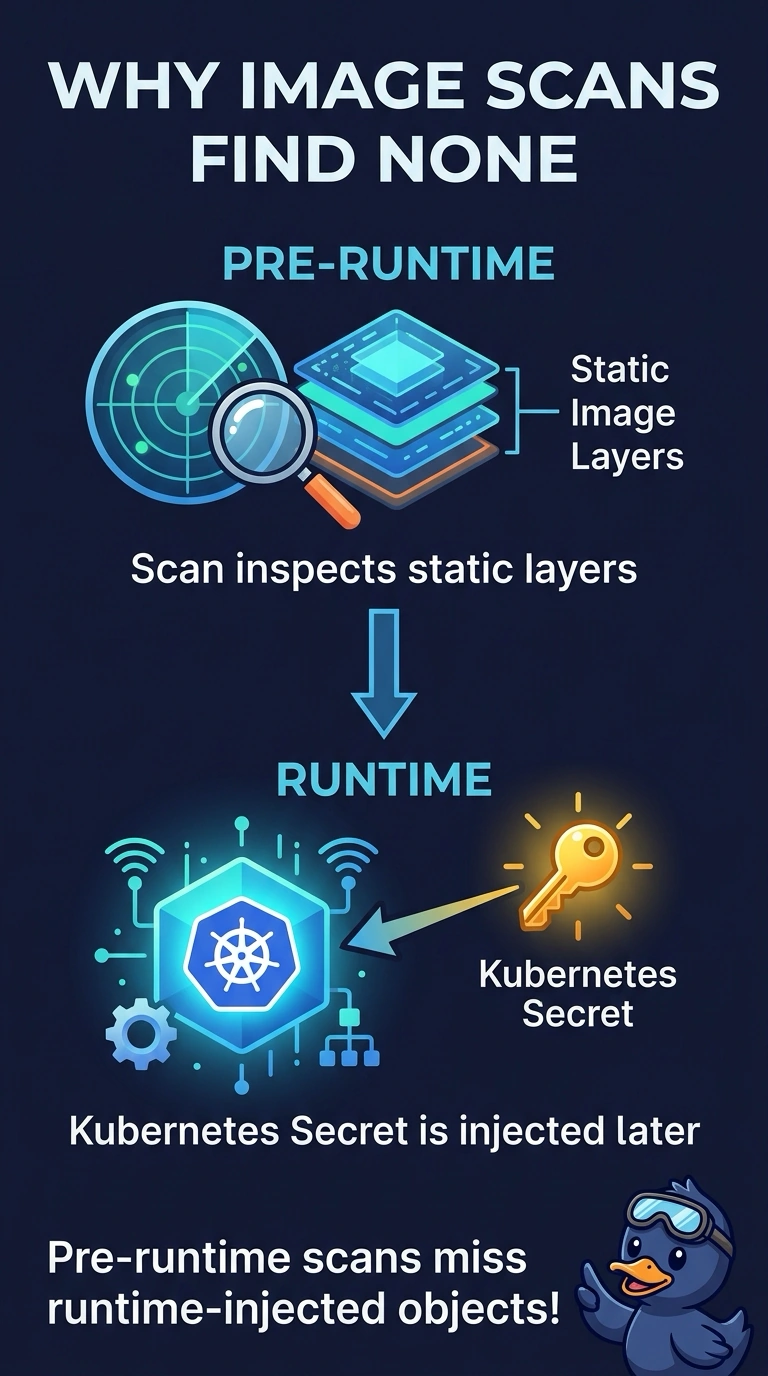
An image scanner can only read what was packed into the suitcase before the trip, not what gets handed to you at the gate! The trap is thinking zero secret findings means credentials are absent everywhere, when they are simply injected later by Kubernetes at startup. Pre-runtime scans check the static image layers alone.
Full Explanation
The reason Pre-runtime image assessment inspects static image layers rather than runtime-injected objects is that CI/CD and registry scans analyze the immutable filesystem layers, packages, and files committed into the image artifact before a pod is scheduled. Claiming that Pre-runtime image assessment only inspects operating system packages and skips credential files is incorrect because image assessment evaluates OS packages, application dependencies, and embedded secrets stored inside image layers. Claiming that Pre-runtime image assessment automatically bypasses secret checks when images use minimal base layers is wrong because base image size does not disable secret detection across application layers. Claiming that Container registries strip all runtime environment variables before Falcon Cloud Security scans is also wrong because Kubernetes Secrets are cluster objects mounted or injected by the kubelet at pod startup, not stored in the registry image. As a caveat, keeping secrets out of image layers is best practice, but runtime access to mounted Kubernetes Secrets still requires least-privilege RBAC and runtime monitoring. For an operational check, review the pod deployment manifest to confirm credentials come from external Secret references rather than hardcoded image files.
Prefer to study offline? Printable PDF study book + test engine ($7.50, unofficial). These questions stay free here.