
A hospital software team builds several clinical microservice images from a single internal base image. During pre-runtime image assessment, a critical OS library vulnerability appears across all of those microservice images even though none of their application manifests reference that library. What explains this pattern?
Select an answer to reveal the explanation.
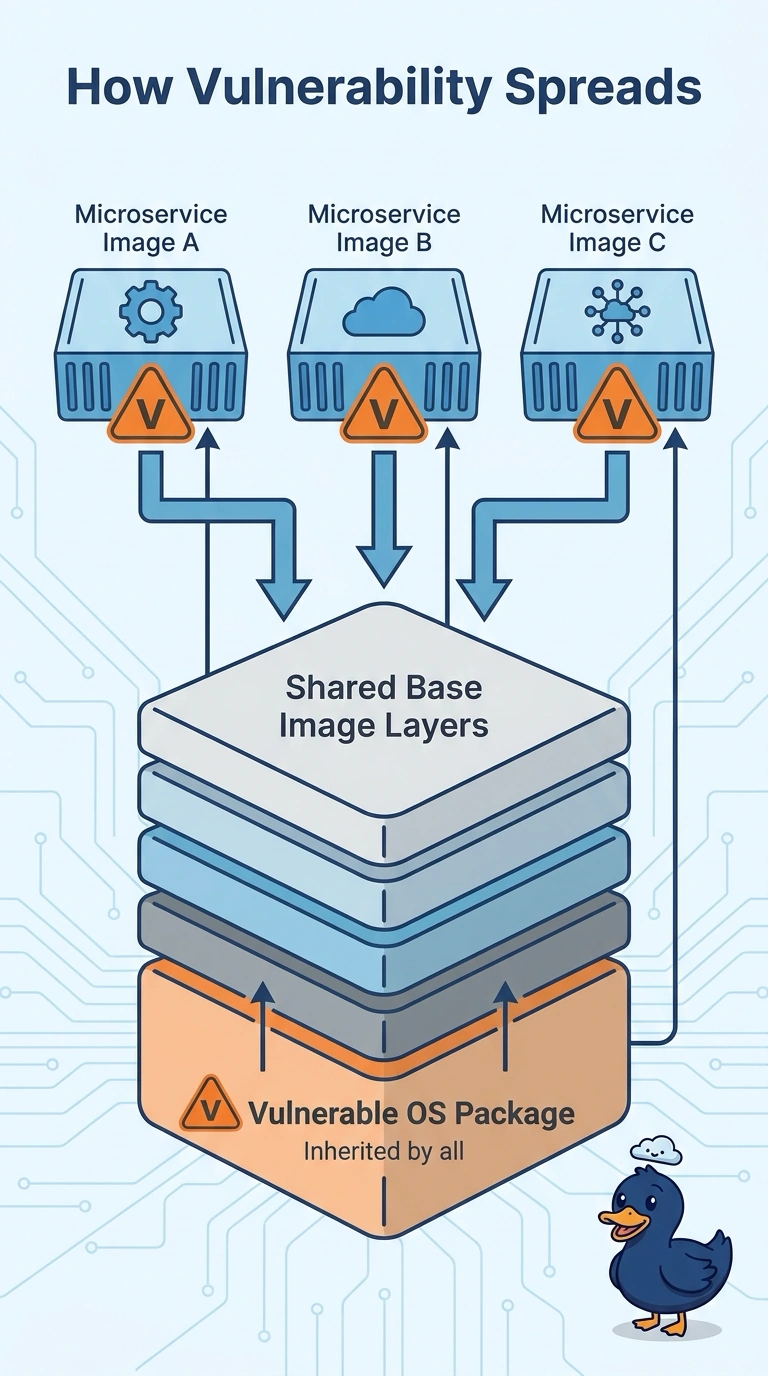
Short Explanation
Shared base images act like a blueprint foundation: any crack in the foundation shows up in every house built on top of it. When you see the same OS library flaw across multiple services, look down at the shared base layers rather than assuming the scanner ran live code.
Full Explanation
Container images are assembled in layers, so The microservice images inherit the vulnerable OS package from the shared base image layers whenever they build on top of that common foundation. Pre-runtime image assessment inspects the static filesystem layers and package databases inside each image, which is why an OS-level library shows up even when application manifests never list it directly. By contrast, The pre-runtime scanner automatically executes each container to probe active network listeners and shared libraries is incorrect because pre-runtime assessment is static analysis and does not run container workloads. Likewise, The container registry duplicates application dependency manifests across every repository in the same project is false because registries store pushed image layers and manifests per repository without copying dependency files across services. Finally, The posture assessment service flags every microservice in a cloud account when one workload runs an outdated kernel confuses cloud control-plane posture checks with container image layer inspection. Caveat: patching only one downstream application image leaves sibling services exposed until the shared base image is updated and all dependent images are rebuilt. Operational check: inspect the finding's layer and package details to confirm the vulnerable OS package originates in the base image, then rebuild the base image and downstream microservices.
Prefer to study offline? Printable PDF study book + test engine ($7.50, unofficial). These questions stay free here.