
A software security engineer needs to tighten vulnerability thresholds on an existing Falcon Cloud Security image assessment policy that already covers production repositories. Instead of leaving the old policy active and adding a second overlapping policy, what is the cleaner approach?
Select an answer to reveal the explanation.
Short Explanation
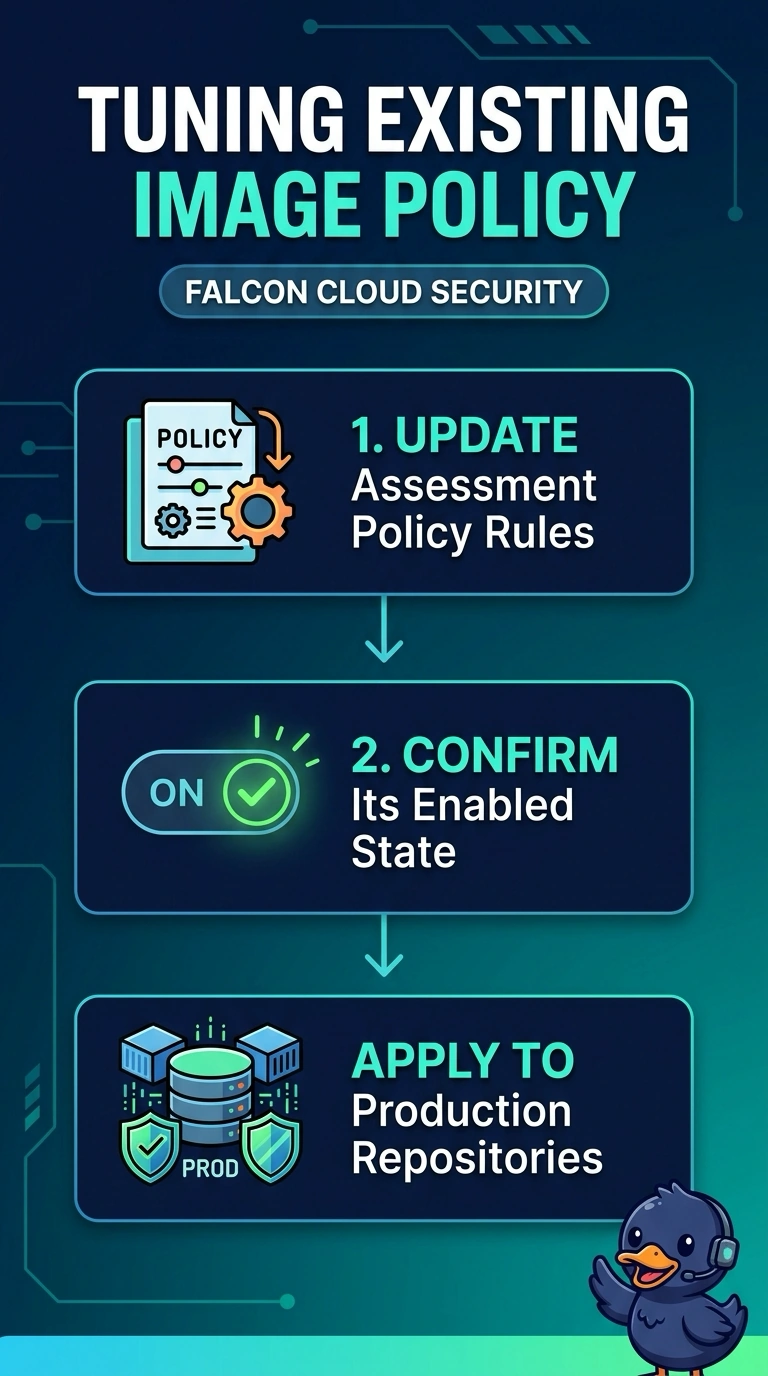
You can keep things tidy by adjusting the policy you already have, like changing the thermostat instead of adding another one. Updating its rules and confirming it is enabled gives you consistent evaluation without overlapping policies or unrelated runtime rules.
Full Explanation
Updating the existing image assessment policy rules and confirming its enabled state keeps vulnerability thresholds unified without creating overlapping rule sets. Falcon Cloud Security lets you update image assessment policy details and toggle the enabled state directly, supporting consistent enforcement for the repositories already covered. A separate runtime protection policy in the cluster fails to address this need because runtime policies monitor active workload behavior, not pre-runtime image packages. Deleting all cloud groups from the account registration is also ineffective: cloud groups organize cloud accounts for posture scoping and do not adjust image assessment thresholds. Adding a global scan exclusion for the production registry would have the opposite effect, blinding pre-runtime scanning across production images rather than tightening vulnerability checks. Exam caveat: review policy precedence and assigned policy groups whenever multiple image policies exist, so their rules do not conflict. Practical check: read back the updated image assessment policy configuration, confirm it is enabled, and trigger a test image evaluation to verify that the stricter threshold applies.
Prefer to study offline? Printable PDF study book + test engine ($7.50, unofficial). These questions stay free here.