
A school district DevSecOps team already enforces a strict image assessment policy on its container registry and asks whether it can retire its runtime protection policy for the same Kubernetes cluster. Why should both policies remain active?
Select an answer to reveal the explanation.
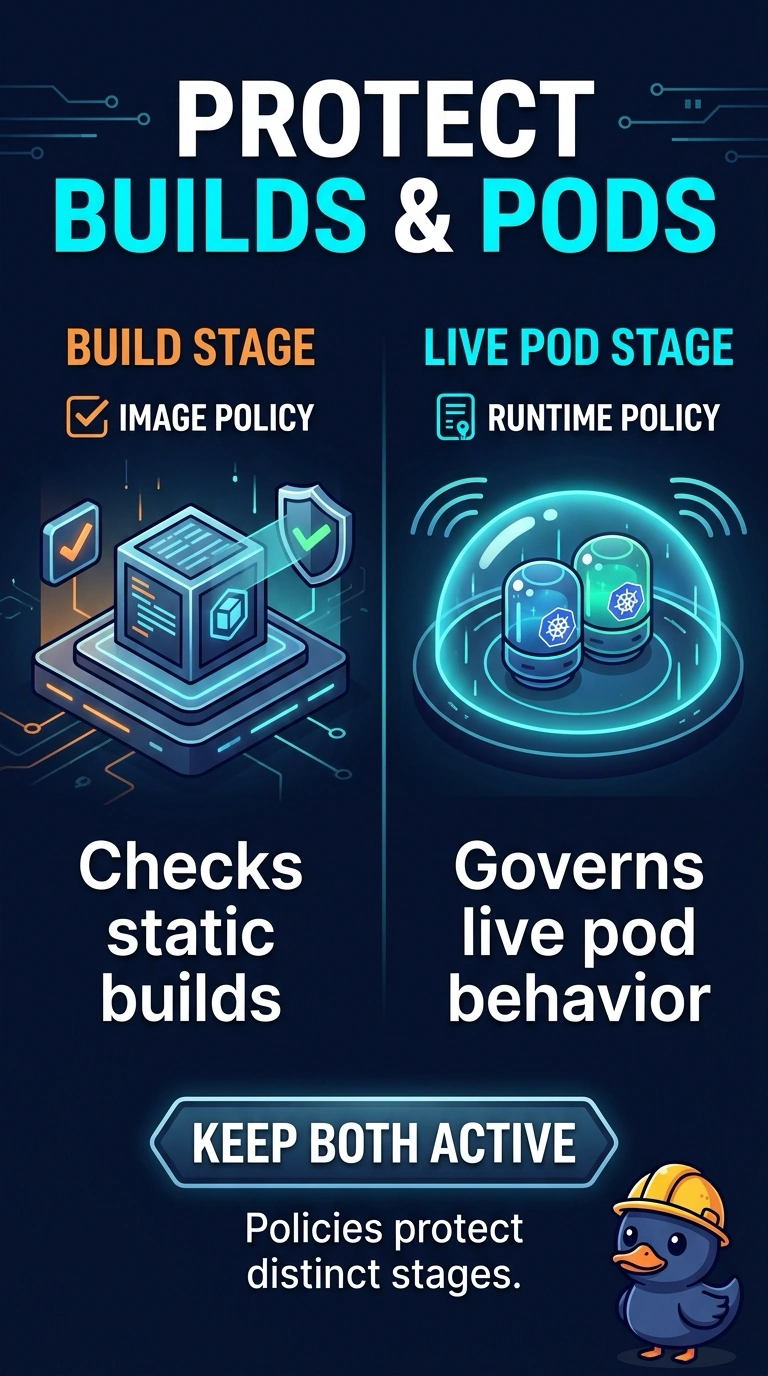
Short Explanation
Checking a container's luggage at the airport gate does not tell you what happens once the plane is in the air. Keep both policies active because pre-runtime scans only inspect static images, whereas your runtime policy watches live process behavior.
Full Explanation
Falcon Cloud Security separates policy types by lifecycle stage because pre-deployment checks and live workload defense inspect completely different signals. "Because image policies check static builds while runtime policies govern live pod behavior" explains why both are necessary: image assessment policies flag vulnerable packages and embedded secrets before launch, while runtime protection policies detect and block unauthorized shells, drift, and privilege escalation after containers start. "Because image assessment policies only evaluate cloud storage buckets and IAM user accounts" confuses image policies with Cloud Security Posture Management policies. "Because runtime protection policies automatically patch vulnerable OS packages in registries" is incorrect because runtime sensors monitor and block live execution rather than rebuilding stored images. "Because disabling runtime policies also disables all scheduled compliance benchmark exports" is false because scheduled posture reports operate independently of workload runtime rules. Caveat: even an image that passes strict pre-runtime checks can be exploited through zero-day flaws or application logic bugs at runtime. Operational check: confirm that both image assessment policies and runtime protection policies remain enabled and scoped to production clusters.
Prefer to study offline? Printable PDF study book + test engine ($7.50, unofficial). These questions stay free here.