
A hospital platform team wants to enforce two controls on its managed Kubernetes environment: ensuring cluster control-plane audit logging is enabled at the cloud provider level, and rejecting any new pod manifest that requests host-network access. Which policy combination enforces both controls?
Select an answer to reveal the explanation.
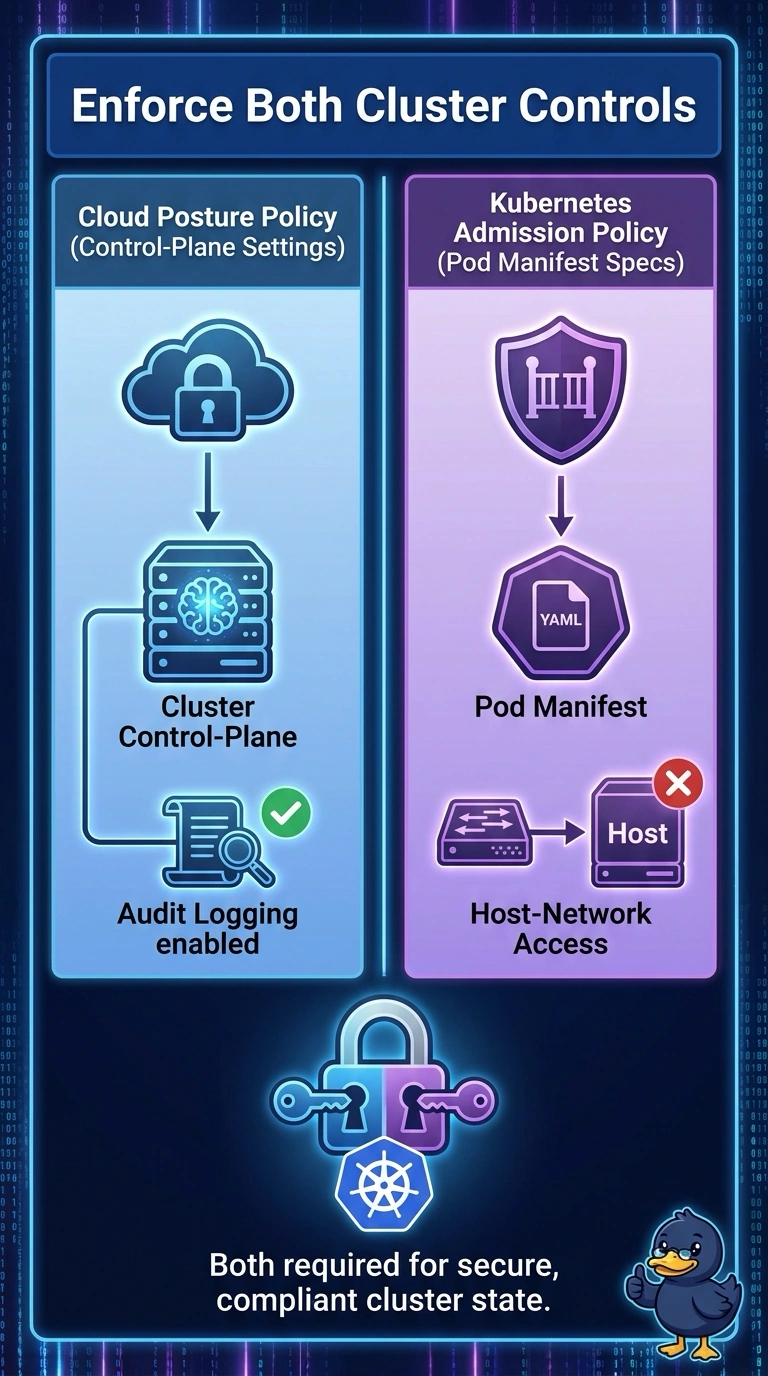
Short Explanation
Checking the building's electrical panel is a different job from checking badges at the front door. You need two distinct policy layers here, and the trap is expecting one Kubernetes rule to govern cloud-provider settings.
Full Explanation
Managed Kubernetes security spans both the cloud provider control plane and the cluster's internal workload scheduling path. Combining a cloud posture policy for cluster control-plane settings and a Kubernetes admission policy for pod manifest specifications ensures CSPM audits provider-level cluster logging while the admission controller blocks risky pod configurations before scheduling. Posture detection alone does not enable the provider logging setting. An image assessment policy for cluster control-plane settings and a runtime policy for pod manifests is incorrect because image assessment inspects container packages and layers, and runtime policies monitor live execution rather than blocking pre-launch pod specs. A single Kubernetes admission policy covering both cloud provider settings and container vulnerabilities is incorrect because admission controllers evaluate Kubernetes API requests and cannot audit cloud-provider control-plane configurations. A runtime protection policy for cluster audit logging and a scheduled report for pod specifications is incorrect because runtime policies inspect host and container behavior while scheduled reports summarize findings rather than blocking deployments. Caveat: admission policies only evaluate new deployment requests and will not retroactively terminate pods already running with host-network access. Operational check: verify provider-level logging checks evaluate the intended account and the effective KAC rule is Prevent on the target workload scope and test the admission policy with a dry-run pod manifest.
Prefer to study offline? Printable PDF study book + test engine ($7.50, unofficial). These questions stay free here.