
A retail DevSecOps team wants to prevent developers from deploying Kubernetes pods that mount the host's root filesystem, even when the underlying container image has zero package vulnerabilities. Why will updating only the image assessment policy fail to enforce this requirement?
Select an answer to reveal the explanation.
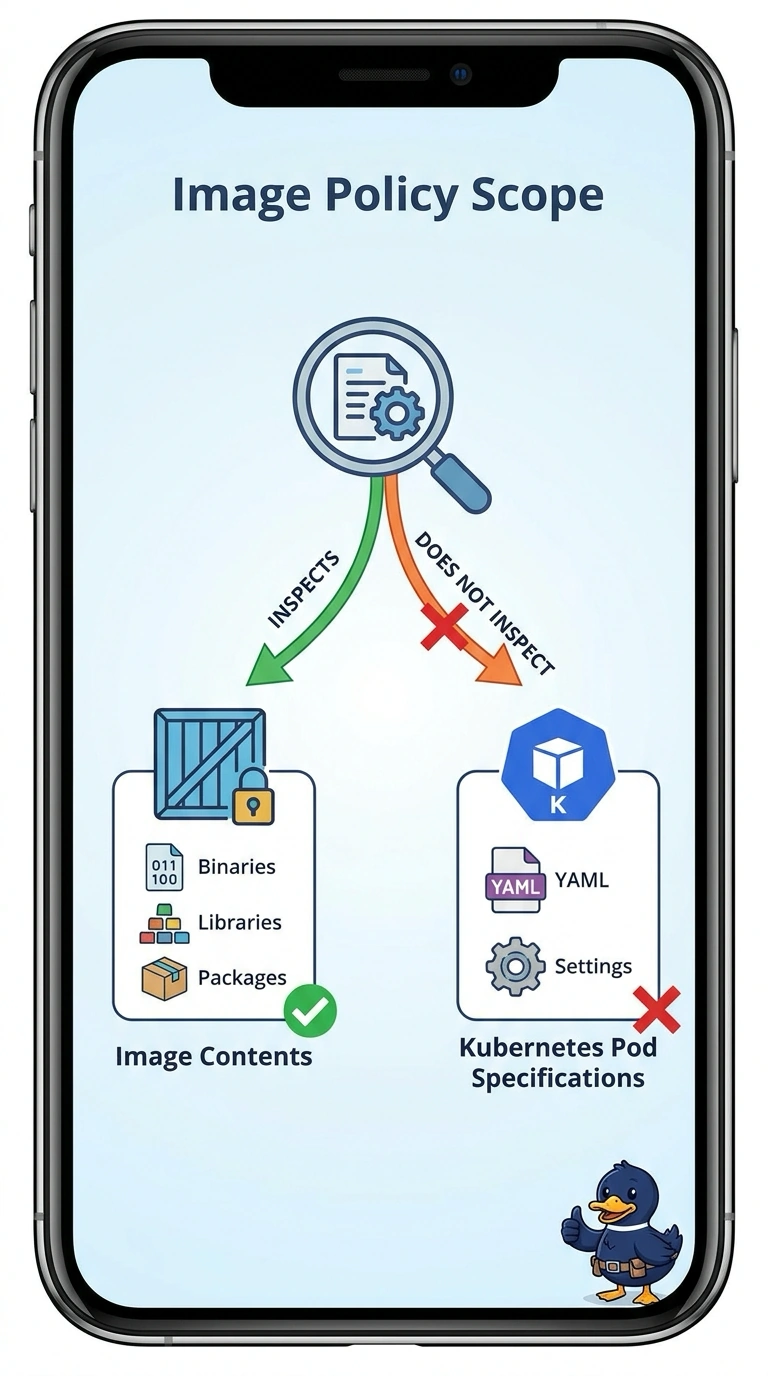
Short Explanation
Inspecting the ingredients inside a sealed box won't tell you how someone plans to wire that box into your building. You need an admission policy to check Kubernetes pod specifications, because the trap is expecting image assessment to police deployment settings.
Full Explanation
Choosing Image assessment policies inspect image contents rather than Kubernetes pod specifications explains why host-path mounts cannot be blocked by image rules alone. Image assessment evaluates packages, libraries, and embedded secrets inside container image layers before deployment, whereas host filesystem mounts are defined in the Kubernetes pod manifest at deployment time and require an admission policy. Claiming Image assessment policies only inspect cloud IAM roles and cannot evaluate container storage is false because cloud IAM roles are evaluated by posture and entitlement capabilities, not image assessment. Stating Image assessment policies automatically terminate running Kubernetes pods after deployment is incorrect because image assessment operates pre-runtime and does not terminate live pods. Saying Image assessment policies only apply to virtual machines running outside Kubernetes clusters is also wrong because image assessment specifically targets container images. As a caveat, enforce both image assessment and admission policies together so clean images cannot be launched with unsafe pod privileges. Operationally, configure an admission policy rule blocking host-path mounts and test deploying a non-compliant manifest.
Prefer to study offline? Printable PDF study book + test engine ($7.50, unofficial). These questions stay free here.