
A hospital platform team enforces a Kubernetes admission policy that blocks pods running as root, but one vetted legacy clinical utility requires temporary root privileges during a scheduled migration. How should the team accommodate this workload safely?
Select an answer to reveal the explanation.
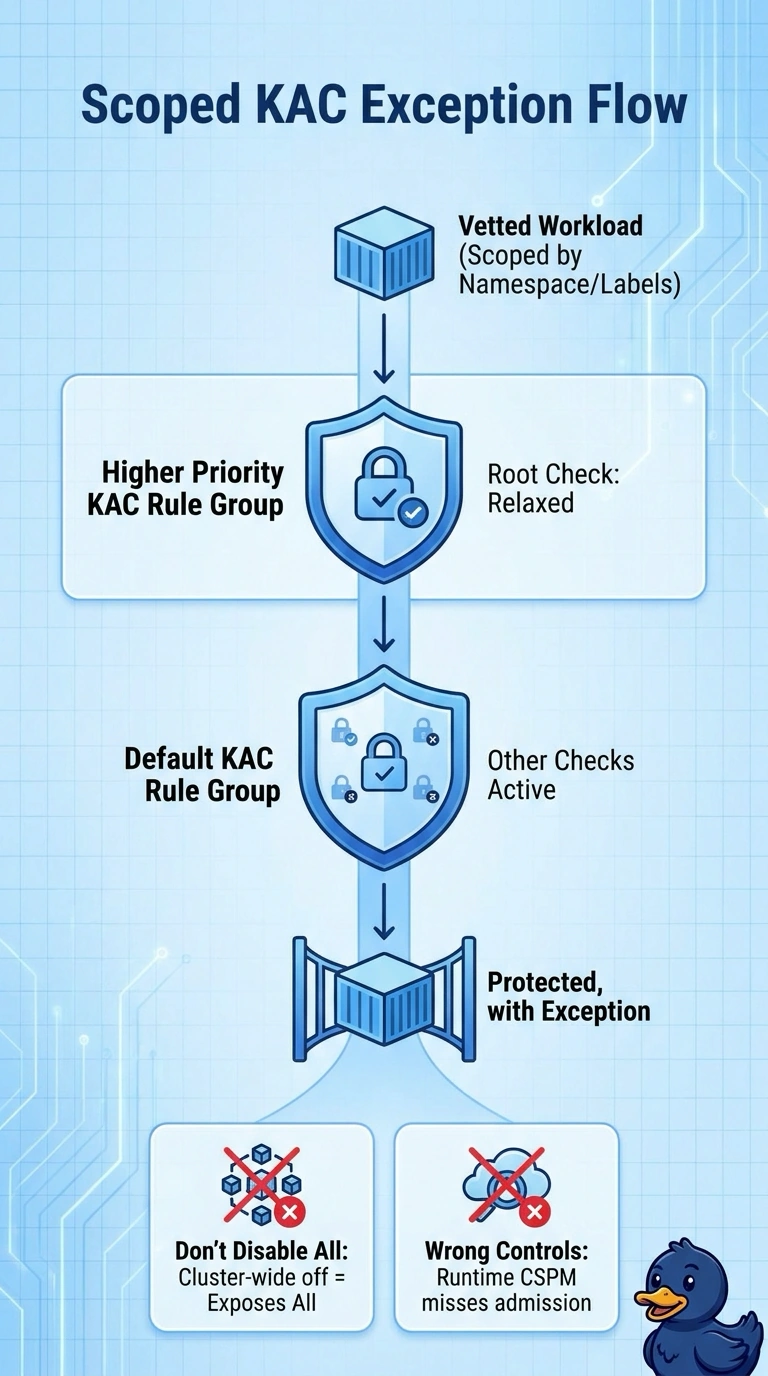
Short Explanation
When one vetted workload needs a temporary exception, you should never drop your guard for the entire cluster. You can use a higher-priority KAC rule group scoped to that workload so only the root check is relaxed while you keep protection everywhere else. The trap is disabling the whole policy or confusing admission rules with cloud posture scan exclusions.
Full Explanation
The safest approach is to Create a higher-priority KAC rule group for the vetted workload scoped by governed namespace/labels, because setting only the root check to Alert/Disabled for that scope lets the approved clinical utility run during migration while retaining other protections for every other pod in the cluster. Choosing to Disable the admission policy across the entire cluster until the migration finishes leaves every other namespace exposed to unapproved root containers during that window. Selecting to Switch the cluster's runtime protection policy to alert-only mode for all workloads targets post-launch behavioral monitoring rather than the deployment-time admission check, and it unnecessarily weakens runtime enforcement cluster-wide. Likewise, choosing to Add a cloud account scan exclusion to omit the Kubernetes cluster from posture checks affects CSPM control-plane posture scanning rather than Kubernetes admission control. Use the documented selectors, rule actions and precedence; review/remove this temporary exception after migration. For an operational check, test deploying both the excluded workload and an unapproved root pod to confirm only the vetted workload is admitted.
Prefer to study offline? Printable PDF study book + test engine ($7.50, unofficial). These questions stay free here.