
A hospital platform team is enabling a blocking Kubernetes admission policy to reject non-compliant application pods, but wants to avoid accidentally disrupting core cluster control-plane components during rollouts. Which policy configuration best achieves this goal?
Select an answer to reveal the explanation.
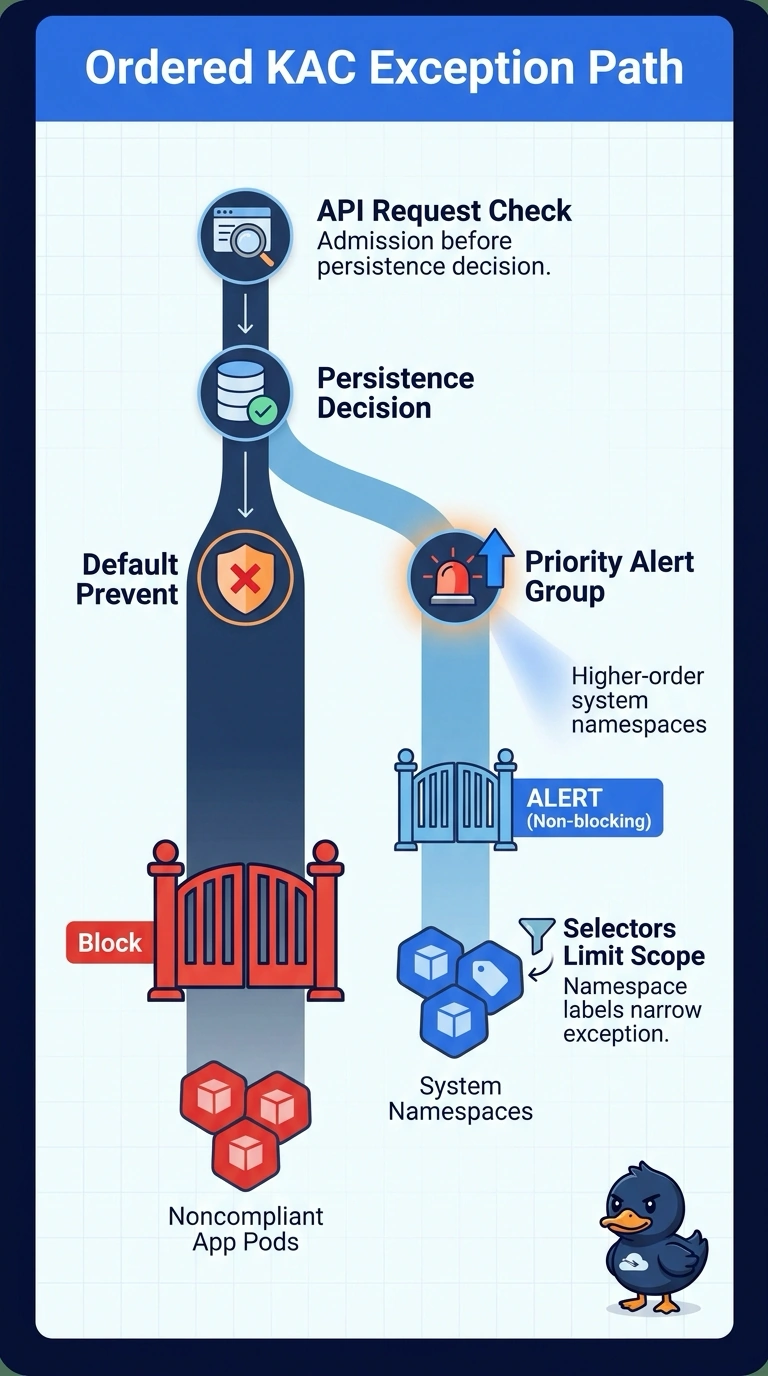
Short Explanation
You can keep strong blocking protection on while giving control-plane pods breathing room. Use a narrowly scoped, higher-priority non-blocking rule group for the required system namespaces, remembering admission is in the API request path, so test your exception.
Full Explanation
Choosing to Use a narrowly scoped, higher-priority non-blocking rule group for the required system namespaces keeps blocking guardrails active for application workloads while protecting essential infrastructure. Falcon KAC documents namespace/label selectors and Alert/Disabled/Prevent actions, ordered rule groups and a lowest-priority default; configure and test the necessary system exception rather than assume a universal namespace-exclusion field. Admission is in the API request path, not the scheduler. That Alert exception lets control-plane restarts proceed without weakening security elsewhere. Choosing to Disable all admission policy rules whenever cluster components are being upgraded creates dangerous enforcement gaps where unapproved application pods can deploy during the window. Choosing to Replace the blocking admission policy with a scheduled cloud posture benchmark check removes pre-deployment gating because benchmarks audit cloud configuration on a schedule rather than blocking Kubernetes pod specs. Choosing to Move all control-plane pods into a separate cloud account without runtime sensors is operationally impractical for a single cluster and sacrifices runtime visibility. Keep the exception tight and audit events to confirm only expected system pods use it.
Prefer to study offline? Printable PDF study book + test engine ($7.50, unofficial). These questions stay free here.